Stork that ate babies, rather than delivering them
News in pictures
News in pictures
On Facebook
From the blogs

Disclosure: We’d never even been to a club when we made our first single

For most of us, reaching eighteen years of age opens up a new world for exploration, spontaneity and...

Sepp Blatter: Penalty shoot-outs must remain, they’re football’s great leveller

As England supporters, we should scorn at any such deciding factor within football. On so many occas...

Why do some men consider the street as a female meat market?

Pronouncements on sexual inequality in the UK are normally met with an eye roll by my generation. As...

Political corruption reflects the widening chasm between the political class and the electorate

The corruption and hypocrisy which has come to characterise politics and politicians, and in particu...

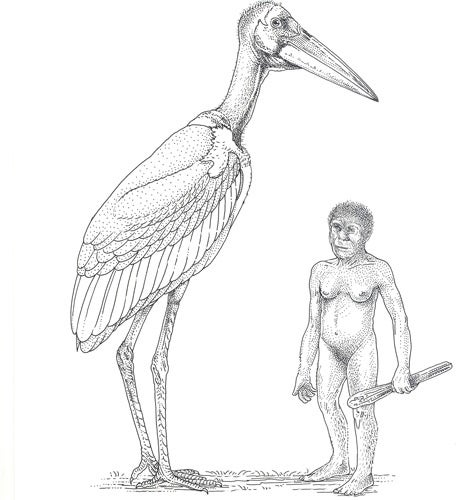
The fossilised bones of a giant stork big enough to devour human babies has been found on the Indonesian island of Flores, home of the miniature "hobbit" people who lived there more than 18,000 years ago.

The giant marabou stork grew up to 6ft tall, weighed 35lbs and would have towered over the adult hobbits, who were just 3ft tall. Although there was no evidence that it preyed on the tiny humans, scientists believe that it may well have dined on juvenile hobbits.

Bones of the stork, called Leptoptilos robustus, were unearthed from the floor of the Liang Bua cave, the same site where the bones of the hobbit, Homo floresiensis, were uncovered. Scientists believe that the stork may have lost its ability to fly, judging by the size and weight of its bones.

Hanneke Meijer, an expert in extinct bird species, made the discovery on a trip to Jakarta where the bones from the Ling Bua cave are kept in the national museum. "These big bones immediately stood out from the rest because of their large size," Dr Meijer said. "They clearly belonged to some big bird. I thought they must have belonged to a big raptor, such as a really big eagle, but to my surprise, when I was able to study them in more detail, I realised they were from a marabou stork. The leg bones are so thick, it must have spent much of its time on the ground."

Other than the human hobbits, who probably arrived on the island on boats, there were no large mammalian predators such as wolves or big cats on Flores at the time. This allowed many species to grow bigger, such as the stork and the giant rats that lived at the same time as the hobbits. "We think the stork moved into the position of being a top predator," Dr Meijer added. "It would have probably fed on the giant rats and even juvenile hobbits, which were the same size as the rats."

The giant stork most probably evolved from smaller storks that had flown to the island and, over time, lost the ability to fly away. The geographic isolation of Flores allowed the evolution of bizarre species, such as dwarf elephants, giant komodo dragons and miniature humans. Tests on the sediment around the bones suggest that the stork lived between 20,000 and 50,000 years ago. The hobbits were believed to have lived in isolation on the island for tens of thousand of years then vanished after a giant volcanic eruption about 17,000 years ago.

Despite its large size, the Flores stork was not the biggest to have existed; an even bigger flying stork once lived in what is now India.

Independent Comment
blog comments powered by Disqus
Career Services

Day In a Page

Is Ridley Scott the most macho man in movies?

Ridley Scott: The most macho man in movies?

His cinematic CV is unparalleled. Yet the Alien director is still obsessed with beating his rivals.
Being Gary Lineker: The clean-cut anchorman is this summer's Mr Sport

Being Gary Lineker

The clean-cut anchorman is this summer's Mr Sport...
Gallic gourmets are putting French cuisine back on the culinary map

Gallic gourmets put France back on culinary map

Overdone, out of touch and old-fashioned: French cuisine has never been at a lower ebb...
So Moorish: Mark Hix offers his own take on classic Moroccan dishes

So Moorish: Mark Hix's Moroccan dishes

Why not create a north African-inspired feast to share with your friends?
Sin and the single mother: The history of lone parenthood

Sin and the single mother

Maureen Paton explores the history of lone parenthood.
The outsider: Margaret Howell is British fashion's queen of minimalism

The outsider: Margaret Howell

The designer tells Susannah Frankel why she has never felt part of the fashion industry.
The 50 Best luggage

The 50 Best luggage

From chic cases to compact baggage, pack it all in this summer
For men only: A pilgrimage to Mount Athos in Greece

For men only: A pilgrimage to Mount Athos

On a secluded peninsula in north-east Greece lies an enclave that's way off the tourist map, especially for women...
48 Hours In: Faro

48 Hours In: Faro

More than just the gateway to the Algarve, this city has much to tempt you off the beach.
Here, the coast is always clear: Celebrating sixty years of Pembrokeshire's National Park

60 years of Pembrokeshire's National Park

Mick Webb reveals a land of puffins, tanks and Hollywood blockbusters.
Free Range: Meet the designers of tomorrow

Free Range

Meet the artists of the future
Feeding a hungry world – or meddling with laws of nature?

Feeding a hungry world – or meddling with laws of nature?

As scientists at Rothamsted's GM trials plead with activists not to sabotage their work, Michael McCarthy visits the battle field
Monkey meat that could be behind the next HIV

Monkey meat that could be behind the next HIV

Deep in Cameroon's rainforests, poachers are killing primates for food. Evan Williams reports from Yokadouma on a practice that could create a pandemic
Catcalls, whistles, groping: just another day for a young woman

Catcalls, whistles, groping: just another day for a young woman

Government urged to take abuse more seriously as London study shows 41 per cent are harassed
Jailing of Maori separatists stirs colonial-era resentment

Jailing of Maori separatists stirs colonial-era resentment

Militant Tuhoe tribe members defiant amid claims race relations had been set back 100 years