Sun snapped in stereo for first all-round view
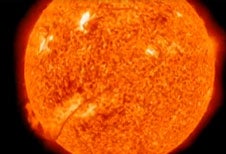
The sun in all its illuminating glory has for the first time been photographed on all sides at once in an historic image that could help to revolutionise our understanding of the immense magnetic forces at the burning heart of our own star.
A full 360-degree portrait of the Sun was released yesterday by Nasa, the US space agency, after two identical spacecraft were aligned in their solar orbits precisely opposite one another on each side of the star.
Scientists said that seeing both of the Sun's hemispheres at the same time marked a turning point in humankind's relationship with the ultimate provider of all life on the Earth – an image akin to the "earthrise" picture taken by the Apollo 8 astronauts in 1968. They believe that viewing the Sun in stereoscopic vision might enable them to predict dangerous magnetic storms on Earth caused by the immense solar flares that fling out billions of tonnes of matter through the solar system.
The 3-D images were captured by ultraviolet-sensitive cameras on board the Solar Terrestrial Relations Observatory (Stereo), a pair of spacecraft launched in October 2006 on the same orbital path around the Sun as the Earth, but with one moving progressively ahead of the Earth and the other trailing regressively behind. Yesterday marked the point when both spacecraft – known as Stereo Behind (B) and Stereo Ahead (A) – were exactly opposite one another on each side of the Sun, with the Earth positioned precisely midway between both space observatories.
Scientists believe that being able to see both sides of the Sun simultaneously in 3-D will allow them to study and better understand how the vast coils of magnetic energy swirling around the solar surface interact with one another over vast distances – sometimes spanning two hemispheres. "For the first time we can actually take images of the entire solar disc. From this moment on we'll be able to see everything going on around the Sun," said Chris Davis, the British project scientist on the imaging equipment of Stereo.
The solar surface is writhing with magnetic forces which twist and contort themselves into huge knots of energy that explode regularly, rather like a rubber band that has been wound up tightly before being suddenly released, Dr Davis said.
"One of the things that Stereo is trying to predict is when these knots are going to fling things into space. We are moving towards an era when you can understand the processes you need to know about in order to make a solar weather forecast."
Britain's Rutherford Appleton Laboratory (RAL), funded by the Science and Technology Facilities Council and the UK Space Agency, has played a critical role in the Nasa-led project. All of the cameras on board the mission were designed and built in Britain.
Professor Richard Harrison, a solar scientist at the RAL, said that the data gathered from the two orbiting spacecraft – along with information collected by ground stations based on Earth – would give unprecedented insight into the mysterious forces that lead to sunspots, solar flares and the massive explosions of the solar atmosphere, called coronal mass ejections.
"It's not a novelty. There are some real reasons why we want to observe the Sun in its entirely. You can't look at one little bit of the Sun and hope to understand it," Professor Harrison said.
"If you want to understand the Sun you've got to look at the big picture.
"The Sun is a truly complex object which influences many aspects of our lives. In the same way that you would not expect to understand the workings of the brain by studying just a small part of it, global investigation into the nature of our star as a complete object is essential to understanding how it works," he said.
Mapping a mighty wind
The Earth is constantly bathed in a low density "wind" of electrically charged matter that streams out from the Sun. The magnetic forces of our planet shield us by funnelling these charged particles to the polar regions, where they generate the aurora borealis and aurora australis – the northern and southern lights.
Occasionally, this solar wind is strengthened by enormous plumes of matter from the Sun's atmosphere, ejected in explosions on its surface. These coronal mass ejections cause billions of tonnes of matter to be thrown out at speeds greater than 1 million mph and are estimated to hold the energy equivalent of the world's combined nuclear arsenals multiplied by 100.
The solar storms can penetrate the Earth's magnetosphere to generate dangerous electric currents and disturbances to power grids, pipelines, railway signalling systems and magnetic surveys used in oil and gas exploration. Being able to predict a coronal mass ejection and to watch it develop might enable scientists accurately to forecast "space weather" and alert us to the potential risk of a major magnetic storm on Earth.
Steve Connor
Join our commenting forum
Join thought-provoking conversations, follow other Independent readers and see their replies
Comments
Bookmark popover
Removed from bookmarks