That's reassuring: Nasa chief Charles Bolden's advice on asteroid heading for Earth: just pray
Head of Nasa made statement at hearing held to establish what was being done and how much money is needed to better protect the planet for asteroids and meteors
Last year, in an effort to tackle the myths surrounding the belief that the world would end on December 21st, Nasa set up a website to debunk theories about 'Mayan Prophecies', and even released a video explaining why Armageddon was not imminent.
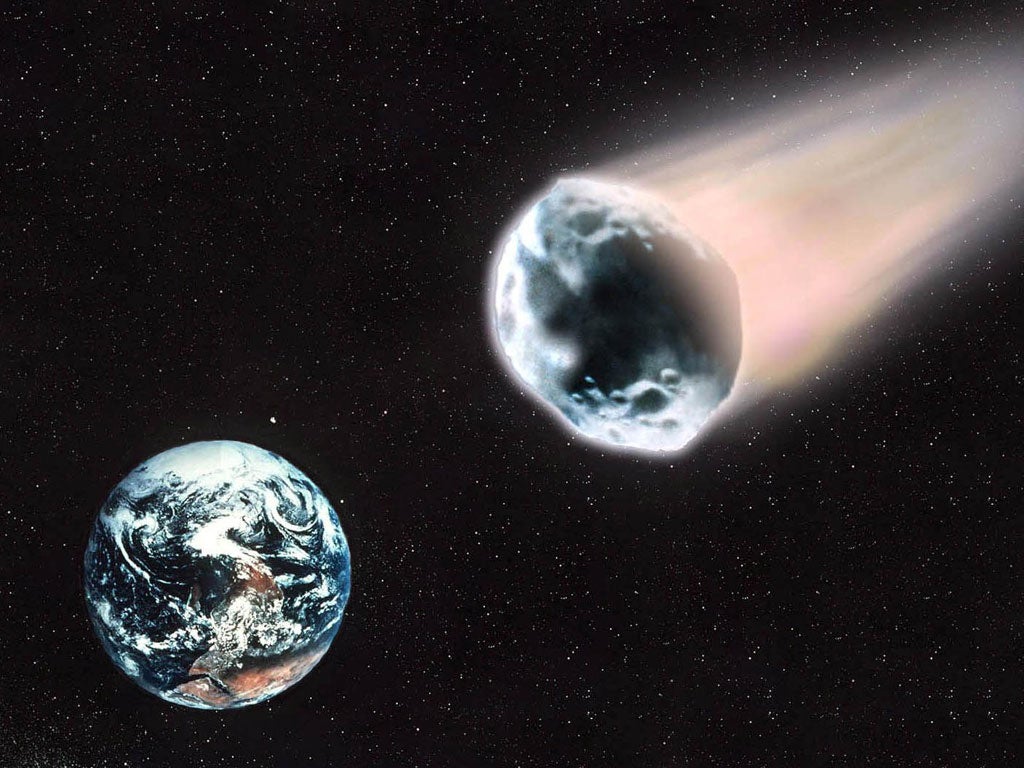
Nasa chief Charles Bolden was somewhat less reassuring, however, when asked this week for advice on how to handle a large asteroid headed toward New York City.
His suggestion: Pray.
Mr Bolden gave his stark advice to lawmakers at a US House of Representatives Science Committee hearing on Tuesday, telling them that all that anyone in the US, or indeed anywhere, could do about unknown asteroids or meteors on a collision course with earth is offer up a prayer.
Last month an asteroid, estimated to be have been about 55 feet (17 meters) in diameter exploded over Chelyabinsk, Russia, generating shock waves that shattered windows and damaged buildings.
More than 1,500 people were injured.
On the same day an asteroid, which was discovered by scientists last year, passed about 17,200 miles (27,681 km) from Earth, closer than the network of television and weather satellites that ring the planet.
US House of Representatives Science Committee chairman Lamar Smith, a Texas Republican, called the hearing held on Tuesday in response to the events of last month.
The hearing was held to establish what was being done and how much money is needed to better protect the planet.
"We were fortunate that the events of last month were simply an interesting coincidence rather than a catastrophe," he told the committee.
Representative Eddie Bernice Johnson, a Texas Democrat, told the hearing that the events: "serve as evidence that we live in an active solar system with potentially hazardous objects passing through our neighborhood with surprising frequency."
Nasa has found and is tracking about 95 percent of the largest objects flying near Earth, those that are .62 miles (1 km) or larger in diameter.
"An asteroid of that size, a kilometer or bigger, could plausibly end civilization," White House science advisor John Holdren told legislators at the same hearing.
But only about 10 percent of an estimated 10,000 potential "city-killer" asteroids, those with a diameter of about 165 feet (50 meters) have been found, Holdren added.
On average, objects of that size are estimated to hit Earth about once every 1,000 years.
Although it may seem like the stuff of science-fiction disaster movies, experts are seriously considering how to deflect or destroy meteorites or asteroids set on a collision course with our planet.
The ideas range from the outlandish to barely plausible, but no single idea - as Russia discovered to its cost last month, appears to provide all the answers.
Sun-powered space lasers, gravity tractor beams, or a nuclear device have all been suggested by people attempting to solve the problem of how to stop asteroids and meteors from hitting the earth.
In addition to stepping up its monitoring efforts and building international partnerships, Nasa is reported to be also looking at developing technologies to divert an object that may be on a collision course with Earth.
However most monitoring systems are considered to be inadequate.
Bolden told the committee: "From the information we have, we don't know of an asteroid that will threaten the population of the United States but if it's coming in three weeks, pray."
White House science advisor John Holdren told the committee: "The odds of a near-Earth object strike causing massive casualties and destruction of infrastructure are very small, but the potential consequences of such an event are so large it makes sense to takes the risk seriously."
The asteroid that exploded over Russia last month was the largest object to hit Earth's atmosphere since the 1908 Tunguska event when an asteroid or comet exploded over Siberia, leveling 80 million trees over more than 830 square miles (2,150 sq km).
Join our commenting forum
Join thought-provoking conversations, follow other Independent readers and see their replies
Comments
Bookmark popover
Removed from bookmarks