The Big Question: Is time travel possible, and is there any chance that it will ever take place?
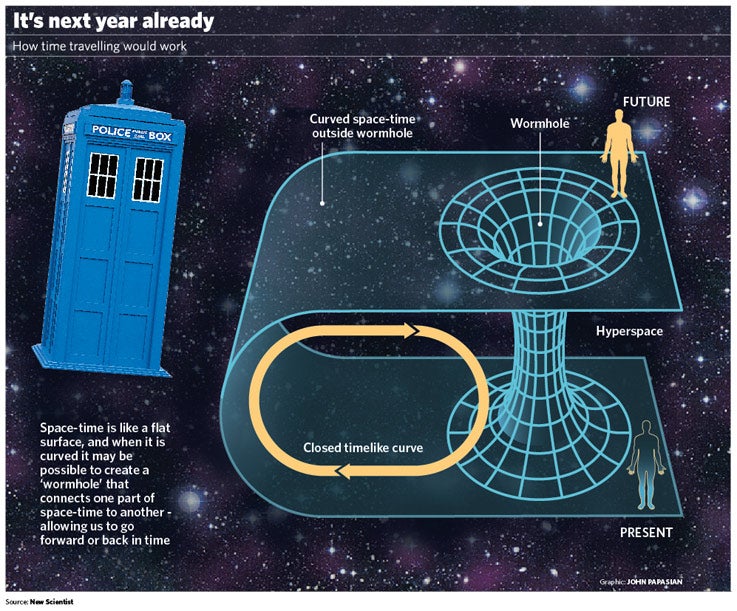
Why are we asking this now?
Two Russian mathematicians have suggested that the giant atom-smasher being built at the European centre for nuclear research, Cern, near Geneva, could create the conditions where it might be possible to travel backwards or forwards in time. In essence, Irina Aref'eva and Igor Volovich believe that the Large Hadron Collider at Cern, which is due to be switched on this year for the first time, might create tiny "wormholes" in space which could allow some form of limited time travel.
If true, this would mark the first time in human history that a time machine has been created. If travelling back in time is possible at all, it should in theory be only possible to travel back to the point when the first time machine was created and so this would mean that time travellers from the future would be able to visit us. As an article in this week's New Scientist suggests, this year – 2008 – could become "year zero" for time travel.
Is this really a serious proposition?
The New Scientist article points out that there are many practical problems and theoretical paradoxes to time travel. "Nevertheless, the slim possibility remains that we will see visitors from the future in the next year," says the magazine says, rather provocatively.
It has to be said that few scientists accept the idea that the Large Hadron Collider (LHC) will create the conditions thought to be necessary for time travel. The LHC is designed to probe the mysterious forces that exist at the level of sub-atomic particles, and as such will answer many important questions, such as the true nature of gravity. It is not designed as a time machine.
In any case, if the LHC became a time machine by accident, the device would exist only at the sub-atomic level so we are not talking about a machine like Dr Who's Tardis, which is able to carry people forwards and backwards from the future.
What do the experts say about the idea of time travel?
The theoretical possibility is widely debated, but everyone agrees that the practical problems are so immense that it is, in all likelihood, never going to happen. Brian Cox, a Cern researcher at the University of Manchester, points out that even if the laws of physics do not prohibit time travel, that doesn't mean to say it's going to happen, certainly in terms of travelling back in time.
"Saying that the laws of physics as we know them permit travel into the past is the same as saying that, to paraphrase Bertrand Russell, they permit a teapot to be in orbit around Venus," Dr Cox says. It's possible, but not likely.
"Time travel into the future is absolutely possible, in fact time passes at a different rate in orbit than it does on the ground, and this has to be taken into consideration in order for satellite navigation systems to work. But time travel into the past, although technically allowed in Einstein's theory, will in the opinion of most physicists be ruled out when, and if, we develop a better understanding of the fundamental laws of physics – and that's what the LHC is all about."
Why is the possibility of time travel even considered?
It comes down to the general theory of relativity devised by Albert Einstein in 1905. It is the best theory we have so far on the nature of space and time and it was Einstein who first formulated the mathematical equations that related both time and space in the form of an entity called "space-time". Those equations and the theory itself do not prohibit the idea of time travel, although there have been many attempts since Einstein to prove that travelling back in time is impossible.
Is there anything to support the theory?
Lots of science fiction writers have had fun with time travel, going back to H.G. Wells, whose book The Time Machine was published in 1895 – 10 years before Einstein's general theory of relativity. Interestingly, it was another attempt at science fiction that revived the modern interest in time travel.
When Carl Sagan, the American astronomer, was writing his 1986 novel Contact, he wanted a semi-plausible way of getting round the problem of not being able to travel faster than the speed of light – which would break a fundamental rule of physics. He needed his characters to travel through vast distances in space, so he asked his cosmologist friend Kip Thorne to come up with a possible way of doing it without travelling faster than light.
Thorne suggested that by manipulating black holes it might be possible to create a "wormhole" through space-time that would allow someone to travel from one part of the Universe to another in an instant. He later realised that this could also in theory be used to travel back in time. It was just a theory of course, and no one has come close to solving the practical problem of manipulating black holes and creating wormholes, but the idea seemed to be sound. It spawned a lot of subsequent interest in wormholes and time travel, hence the latest idea by the two Russian mathematicians.
Apart from the practicalities, what's to stop time travel?
The biggest theoretical problem is known as the time-travel paradox. If someone travels back in time and does something to prevent their own existence, then how can time travel be possible? The classic example is the time traveller who kills his grandfather before his own father is conceived.
Cosmologists, renowned for their imaginative ingenuity, have come up with a way round this paradox. They have suggested that there is not one universe but many – so many that every possible outcome of any event actually takes place. In this multiple universe, or "multiverse" model, a woman who goes back in time to murder her own granny can get way with it because in the universe next door the granny lives to have the daughter who becomes the murderer's mother.
Where does this leave the time machine in Geneva?
The science writer and physicist John Gribbin, who explains these things better than most, points to a saying in physics: anything that is not forbidden is compulsory. "So they expect time machines to exist. The snag is that the kind of accidental 'time tunnel' that could be produced by the LHC in Geneva would be a tiny wormhole far smaller than an atom, so nothing would be able to go through it. So there won't be any visitors from the future turning up in Geneva just yet. I'd take it all with a pinch of salt, but it certainly isn't completely crazy."
So, not completely crazy, just a bit crazy.
So will we one day be able to travel into the future?
Yes...
* There is nothing in the laws of physics to prohibit it, and events in Geneva are pointing the way and could be a first step
* In physics, so the saying goes, if nothing is prohibited, it must happen at some point
* All we need to do is to work out how to manipulate black holes and wormholes, and away we go
No...
* The practical problems with time travel are too immense to solve, and even if you could, who would want to?
* You might travel back in time and kill one of your grandparents by accident. Then where would you be?
* If time travel is possible, why are we still waiting to welcome our first visitors from the future?
View all comments that have been posted about this article.
Offensive or abusive comments will be removed and your IP logged and may be used to prevent further submission. In submitting a comment to the site, you agree to be bound by the Independent Minds Terms of Service.
- Print Article
- Email Article
-
Click here for copyright permissions
Copyright 2009 Independent News and Media Limited


Comments
However, in the physics world, things happen sequentially and there is no way you would break this law.
You cannot travel to the past, and you cannot travel to the future. You can only be here and at this very moment. Scietists should stop misleading the innercent public.
Dr Quanmin Guo
School of Physics and Astronomy
University of Birmingham
Q.Guo@bham.ac.uk
Dr. Guo, "Scientists" like yourself have claimed, space travel, heavier than air travel, underwater travel and what not impossible, they all were proven wrong and so will you.
Its just a matter of time till we have our project complete i would say in less then three years we will have conquored time travel.
Although i do agree with the comment before me the public should not be told it is possible because if the public all do belive it is real there will be countless attepts to travel through time which could create a black hole which would end physics and life as we know it.
Dr James M.V Smith
Former Gov Scientist & Tutor of University of Manchester
Englandjb@hotmail.com (Temp Email Adress)
I am from the future. I have time-travelled. It was a wonderful journey, and I am please to be here.
Forget about sequences, Dr Guo. The physical world is not one big sequence, and I am sure you will agree, mathematics and the physical world are closely related.
As for you, Dr. Smith. I have seen your future, and your project fails. I am sorry to be harsh about it.
Hint on time travel projects: to succeed, it starts and ends with the mind.
Mr. R. Fishton
If someone were to find a way to time travel they certainly wouldnt be able to come back the ultimate present. The moment you leave Point A, you ultimately become a time traveller non-stop, there is absolutely no way you could ever come back to the current time we are in now and as we know it. By definition, you would always be traveling behind it.
You might be able to return to Point A, the time you left to start your travels, but once you returned it would be in itself 'in the past' as time from the moment you left Point A did not stand still for you, it carried on. So therefore you become a prisoner to time itself.
To transport yourself back into our reality and time zone, you would need to know its exact positon right now. If you are in another time zone you would have no way of knowing that. Even if you managed to get close to it, and lets say you have a machine that gets you to a billionth-billionth of a second close, you would still be 'behind' the current time, so therefore everyone you knew wouldnt be the same. Even a billionth-billionth of a second, in terms of time travel, is eternity.
For you to arrive right in this very moment there would only ever be one possible way and that would be the ability to 'stop time' as we know it. This is impossible, because 'time' by its very nature doesnt stop.
Imagine you invent time travel, it would be like taking a single drop from a wave in the pacific ocean, off onto the beach, out into the forest, then bringing it back and placing it in the exact same wave in the exact same spot in order to return to the moment. All the while of course, the wave hasnt stopped moving, however small it has become, and so finding the exact same spot to place your little drop into, is impossible. Again, the only way you could do it would be to freeze time...freeze the wave as it was when you left, so you knew the exact moment and time to come back to.
So time travel may be 'possible' in one sense, but you or i would never know because the person who decided to take the trip would not be able to come back into the 'very moment' to tell us so. They would in effect, always be chasing our shadows.
if there were time travlers would you want to tell any one, all you would get what next weeks lotto numbers.
the big ? is could you get the fucher 100% writ untill then the pass is not what shoul be mess with, put it this way how would you know if you went back and kill hitla that would be the best thing to do, you set it up for some one who was much more of a tot git, so the thing we should be doing is to find out the fucher so we could try and avould the bad parts the a come up and not look to the pass and see what we mith beabla to fix.
I believe its possible, i mean if people would REALLY try hard enough almost anything is possible. I'll bet centerys ago people thought it was IMPOSSIBLE BEOND ALL REASON to fly. They didn't meet the wright brothers. As for cars? why bother we have horses for that! Humanity has come so far with people who believed. And i think if we tryed hard enough we CAN time travel!
*just my thoughts =)
Perhaps H.G. Wells ,Time Machine ,may end up being right on track all along.Just need to build it and make it work.Then who can be trusted to travel in it?
In my mind, there are several possibilities.
One: time being, in theory. infinite, man can likely do anything he contemplates, if he survives long enough to gain and use the knowledge he gathers. Time travel, in this scenario, is not only possible, but likely inevitable.
Two: time does not actually exist except as a relative concept in the human mind and therefore could never be manipulated physically, only through mental excursions into the ether. In fact, some ancient teachings state that NOTHING actually exists and everything we experience is of our own creation.
Three: all of time exists all at once and our limited ability to actually "see" time is like that of a tape recorder head playing only the present, able to "review" the past and "guess" the future, but in reality unable to perceive that the "time" we live in is like a book on a shelf with many other books surrounding it. I like this scenario because while it limits time to just those things that are possible, it creates a type of freedom by which anyone can choose the book they are in at any given time without totally destroying the concept of predestination as a rule.
If, for example, all of time exists all at once and every possible outcome has already been and is simply somewhere out there (whatever out there means), waiting for us to make a conscious decision and create the instant we live in simply by, say, turning right instead of left, then we have free will, but not the ability to step outside of the pattern already predetermined since the pattern itself represents all that is possible. Another way of looking at it? What if, simply by imagining I COULD be or do something, I already had somewhere, sometime in say, another alternate time stream?
What if, when the universe was first formed, instead of being limited to the time stream we live in, the universe (or multi-verse, if you prefer) was actually comprised of all the things that were possible or could ever BE possible?
Time, then, would be shaped like a huge sphere, comprised of many almost infinite possibilities. In fact, time would actually BE infinite until it reached an event or series of events that were simply not possible.
At the beginning of the sphere a single event, say the big bang, would created a time stream, but as events became more and more influenced by each other, time would break out and branch into all sorts of variant patterns, stretching as far as the possibility of events could occur, only ending where events simply were not possible, ever branching out until they reached a point of absolute saturation, a center or "equator" of the time sphere, where the absolute number of events that could occur, had, indeed, occurred. Then, because the absolute number of possibilities was reached, less and less things would become possible. Time would begin to fold back in on itself. Time streams would become fewer and fewer, eventually culminating in a sort of reverse big bang where time would then collapse upon itself.
Now, IF this scenario is reality, we have just encompassed two very opposite ideas, without contradiction in either of them. One, all time is predetermined and predestined and two, despite this, we all have free will to do anything we wish, but won't because some things, whether we wish them or not, are simply not possible for whatever reason.
I don't know if time travel is possible, but if it is, it certainly exists. That we don't know of it is not even a case for it not existing. Too many variables and too many possibilities are at play here. Until we can understand the workings of our own minds and thoughts, we may never understand the complexities of time. Until we can step outside of the human experience and capture a true perspective of the universe, unemcumbered by our own humanity, or at the very least, our own real estate, we may never understand much of anything in its entirety.
And also they could be making changes in the past to help them in the future as they make the changes in the past we dont even know they were made because we dont realize the change do to being in the present from where they made the change.
So do you see how important it is to have Time Travel being controlled by our leadership National Security, Defense Deptartment? And not just some billionaires who had a scientest create a time machine just for them to use forprofit.
Who knows, may be there is an ulterior reason why so much money is being spent on the CERN project........hold on......i.m getting a message from the future......."no, its just one massive waste of money and it wont work"
Time travel in theory
Some theories, most notably special and general relativity, suggest that suitable geometries of spacetime, or specific types of motion in space, might allow time travel into the past and future if these geometries or motions are possible.[9] In technical papers physicists generally avoid the commonplace language of "moving" or "traveling" through time ('movement' normally refers only to a change in spatial position as the time coordinate is varied), and instead discuss the possibility of closed timelike curves, which are worldlines that form closed loops in spacetime, allowing objects to return to their own past. There are known to be solutions to the equations of general relativity that describe spacetimes which contain closed timelike curves[citation needed], but the physical plausibility of these solutions is uncertain.
Physicists take for granted that if one were to move away from the Earth at relativistic velocities and return, more time would have passed on Earth than for the traveler, so in this sense it is accepted that relativity allows "travel into the future" (although according to relativity there is no single objective answer to how much time has 'really' passed between the departure and the return). On the other hand, many in the scientific community believe that backwards time travel is highly unlikely. Any theory which would allow time travel would require that issues of causality be resolved. The classic example of a problem involving causality is the "grandfather paradox": what if one were to go back in time and kill one's own grandfather before one's father was conceived? But some scientists believe that paradoxes can be avoided, either by appealing to the Novikov self-consistency principle or to the notion of branching parallel universes
Time travel is the concept of moving between different moments in time in a manner analogous to moving between different points in space, either sending objects (or in some cases just information) backwards in time to a moment before the present, or sending objects forward from the present to the future without the need to experience the intervening period (at least not at the normal rate). Some interpretations of time travel also suggest that an attempt to travel backwards in time might take one to a parallel universe whose history would begin to diverge from the traveler's original history after the moment the traveler arrived in the past.[1] Although time travel has been a common plot device in fiction since the 19th century, and one-way travel into the future is arguably possible given the phenomenon of time dilation based on velocity in the theory of special relativity (exemplified by the twin paradox) as well as gravitational time dilation in the theory of general relativity, it is currently unknown whether the laws of physics would allow backwards time travel. Time travel has not been proven to be impossible nor possible. Any technological device, whether fictional or hypothetical, that is used to achieve time travel is known as a time machine.
"TIME SLIP"
time slip (also called a timeslip) is an alleged paranormal phenomenon in which a person, or group of people, travel through time through supernatural (rather than technological) means. As with all paranormal phenomena, the objective reality of such experiences is disputed.
First of all, who says time is something that you "can travel" anyways? Time is simply change; nothing more and nothing less. You can't travel change can you? Makes no sense.
In this sense you can have more change (like time "speeds" up), less change (like time "slows" down), or no change (like time stays "still"), but you can't have negative change. I hope that clears things up. Also, even if the "alternate universe" theory is correct (which I HIGHLY doubt) you would still NOT be traveling to the past through time; instead, you would be traveling to alternate universes. Also, c is the universal speed limit...it is the speed of time! Once you reach c you will have used up all of the available time in the universe!
Wormholes are a hypothetical warped spacetime which are also permitted by the Einstein field equations of general relativity,[18] although it would be impossible to travel through a wormhole unless it was what is known as a traversable wormhole.
A proposed time-travel machine using a traversable wormhole would (hypothetically) work in the following way: One end of the wormhole is accelerated to some significant fraction of the speed of light, perhaps with some advanced propulsion system, and then brought back to the point of origin. Alternatively, another way is to take one entrance of the wormhole and move it to within the gravitational field of an object that has higher gravity than the other entrance, and then return it to a position near the other entrance. For both of these methods, time dilation causes the end of the wormhole that has been moved to have aged less than the stationary end, as seen by an external observer; however, time connects differently through the wormhole than outside it, so that synchronized clocks at either end of the wormhole will always remain synchronized as seen by an observer passing through the wormhole, no matter how the two ends move around.[19] This means that an observer entering the accelerated end would exit the stationary end when the stationary end was the same age that the accelerated end had been at the moment before entry; for example, if prior to entering the wormhole the observer noted that a clock at the accelerated end read a date of 2007 while a clock at the stationary end read 2012, then the observer would exit the stationary end when its clock also read 2007, a trip backwards in time as seen by other observers outside. One significant limitation of such a time machine is that it is only possible to go as far back in time as the initial creation of the machine;[20] in essence, it is more of a path through time than it is a device that itself moves through time, and it would not allow the technology itself to be moved backwards in time. This could provide an alternative explanation for Hawking's observation: a time machine will be built someday, but has not yet been built, so the tourists from the future cannot reach this far back in time.
According to current theories on the nature of wormholes, construction of a traversable wormhole would require the existence of a substance with negative energy (often referred to as "exotic matter") . More technically, the wormhole spacetime requires a distribution of energy that violates various energy conditions, such as the null energy condition along with the weak, strong, and dominant energy conditions.[21] However, it is known that quantum effects can lead to small measurable violations of the null energy condition,[21] and many physicists believe that the required negative energy may actually be possible due to the Casimir effect in quantum physics.[22] Although early calculations suggested a very large amount of negative energy would be required, later calculations showed that the amount of negative energy can be made arbitrarily small.[23]
In 1993, Matt Visser argued that the two mouths of a wormhole with such an induced clock difference could not be brought together without inducing quantum field and gravitational effects that would either make the wormhole collapse or the two mouths repel each other.[24] Because of this, the two mouths could not be brought close enough for causality violation to take place. However, in a 1997 paper, Visser hypothesized that a complex "Roman ring" (named after Tom Roman) configuration of an N number of wormholes arranged in a symmetric polygon could still act as a time machine, although he concludes that this is more likely a flaw in classical quantum gravity theory rather than proof that causality violation is possible.[25]
if their is any time machine would like to be the first one to travel time.....
i believe anything could be done and that most things we are not supposed to do ie time travel we are not responsible enough some things are better left alone and not explored.
Date Winning Number Draw
4/24/2009 9, 20, 21, 48, 49 Mega Ball = 7
4/21/2009 5, 24, 37, 47, 52 Mega Ball = 6
4/17/2009 5, 13, 26, 35, 45 Mega Ball = 32
4/14/2009 4, 11, 22, 48, 50 Mega Ball = 42
4/10/2009 18, 25, 36, 42, 51 Mega Ball = 22
4/7/2009 2, 4, 13, 17, 36 Mega Ball = 15
Time is viewed incorrectly.
Time is a consequence of objects in motion, not objects moving through time.
What happens in movies for example the X-Men movie, "when time is stopped", NO, time did not stop, the motion of everyone has stopped and "frozen" at the same speed as everyone else who has been frozen and as a consequence it looks as if time has stopped for these people from the point of view of the few X-Men for whom time had not stopped, but they are not "frozen in time" as the saying goes for they were never in time, but they were in motion and that motion stopped with relation to those who didn't stop, it's all relative you see.
Perhaps a clearer understanding of relativity is needed.
Imagine I am god and I want to create a universe in the shape of a clock with a face and the three hands that may denote the speed at which I want time to run and that can only move in one direction, clockwise to be precise. My universe (clock) has no time until I make the decision to move the second hand one tick to the right, then my universe is only one second old, then time is frozen again until I decide to move it again one tick to the right, now it is two seconds old. The fundamental point is that the time in my universe is as a consequence of the change in motion of the hands, but sometimes the hands can be quicker than the eye, and therefore time can seem to flow continuously.
Is all that I have said a correct assertion or am I looking at time incorrectly? Any comments would be great fully received, I like thought provoking people. Ask me about my theories on time's relation to matter, consciousness' relation to matter and therefore time's relation to consciousness if you like.
Ever felt time has seemed to zip by when having fun or dragged on when being bored?
Geoff Shaw
the-orist, Anylist, Physicist and Philosopher.
Universe of my consciousness
geoffshaw_47@hotmail.com
Some theories, most notably special and general relativity, suggest that suitable geometries of spacetime, or specific types of motion in space, might allow time travel into the past and future if these geometries or motions are possible.[9] In technical papers physicists generally avoid the commonplace language of "moving" or "traveling" through time ('movement' normally refers only to a change in spatial position as the time coordinate is varied), and instead discuss the possibility of closed timelike curves, which are worldlines that form closed loops in spacetime, allowing objects to return to their own past. There are known to be solutions to the equations of general relativity that describe spacetimes which contain closed timelike curves[citation needed], but the physical plausibility of these solutions is Using wormholes
A wormholeMain article: Wormhole
Wormholes are a hypothetical warped spacetime which are also permitted by the Einstein field equations of general relativity,[18] although it would be impossible to travel through a wormhole unless it was what is known as a traversable wormhole.
A proposed time-travel machine using a traversable wormhole would (hypothetically) work in the following way: One end of the wormhole is accelerated to some significant fraction of the speed of light, perhaps with some advanced propulsion system, and then brought back to the point of origin. Alternatively, another way is to take one entrance of the wormhole and move it to within the gravitational field of an object that has higher gravity than the other entrance, and then return it to a position near the other entrance. For both of these methods, time dilation causes the end of the wormhole that has been moved to have aged less than the stationary end, as seen by an external observer; however, time connects differently through the wormhole than outside it, so that synchronized clocks at either end of the wormhole will always remain synchronized as seen by an observer passing through the wormhole, no matter how the two ends move around.[19] This means that an observer entering the accelerated end would exit the stationary end when the stationary end was the same age that the accelerated end had been at the moment before entry; for example, if prior to entering the wormhole the observer noted that a clock at the accelerated end read a date of 2007 while a clock at the stationary end read 2012, then the observer would exit the stationary end when its clock also read 2007, a trip backwards in time as seen by other observers outside. One significant limitation of such a time machine is that it is only possible to go as far back in time as the initial creation of the machine;[20] in essence, it is more of a path through time than it is a device that itself moves through time, and it would not allow the technology itself to be moved backwards in time. This could provide an alternative explanation for Hawking's observation: a time machine will be built someday, but has not yet been built, so the tourists from the future cannot reach this far back in time.
According to current theories on the nature of wormholes, construction of a traversable wormhole would require the existence of a substance with negative energy (often referred to as "exotic matter") . More technically, the wormhole spacetime requires a distribution of energy that violates various energy conditions, such as the null energy condition along with the weak, strong, and dominant energy conditions.[21] However, it is known that quantum effects can lead to small measurable violations of the null energy condition,[21] and many physicists believe that the required negative energy may actually be possible due to the Casimir effect in quantum physics.[22] Although early calculations suggested a very large amount of negative energy would be required, later calculations showed that the amount of negative energy can be made arbitrarily small.[23]
uncertain.
Time Travel and Religion
Prophecy and theology
It is interesting to note that any religion which postulates the existence of fulfilled prophecy requires, at the very least, an agent which can move information from the future into the past.
In Christian theology, for example, God is assumed to exist unbound by space or time. Doctrinally, God is held to be omniscient and omnipresent. Statements in the Bible such as Jesus's claim "before Abraham was born, I am" (John 8:58) and Peter's claim "[Jesus] was chosen before the creation of the world" (1 Peter 1:20) (assuming the creation of the world began at t = 0) imply that God does not occupy the same timeline that we do. This is further supported by the assertion "I the LORD do not change" (Malachi 3:6), since change requires movement along, and constrained by, a temporal continuum.
Two popular interpretations of these statements are that God exists outside the space-time continuum; or exists at every point in space-time simultaneously. In either case, God can transfer information from one point in space-time to any other point without restriction.
Transcending time through ancient wisdom
The Yoga Sutras of Patanjali have been considered by some, such as physicist Fred Alan Wolf in his book, The Yoga of Time Travel to describe an inner process by which we can access knowledge of the past and future in the present. This form of time travel can be acquired by transcending the five Earthly anchors of the ego mind which otherwise leave us locked into the illusory self.
.
thomasbaird88@gmail.com
I offer you a hint on how it was achieved.
TO GO BACKWARDS YOU NEED TO THINK BACKWARDS!
Take Einstein's theory and reverse it!
By offering this clue I have made it possible for you to invent time travel allowing me to write this message.
A word of advice: Please whatever you do : DON'T KILL YOUR GRANDFATHER!
Time travel would obviously be a horrible thing to use because of the outcomes that could result from it. One small thing you do could completely change our future.
For instance, If you traveled back in time and walked by a woman/man they could SLIGHTLY notice you and that thought of seeing you could lead them onto another thought about something else and that thought could dramatically change their perspective and opinion on something. They could dump their girlfriend/boyfriend because they compared you to them and lost some faith in what could actually be a marriage and kids. Their kids would never exist and 3 kids would have lets say 5 friends each. The life of their friends would be considerably changed from them not being there and in turn those friends have 5 friends and their friends are changed(do you see what i mean?). This chain would never end and in turn completely change the world.
Time travel is not a wise thing to use if its possible. Lets say 5000 years from now the human race has invented time travel. By that time maybe the human race has evolved and become more intelligent and realized that absolutely nobody could go back in time because it would threaten the entire existence of the race. This is why we haven't seen anyone from the future!!! They KNOW not to use time travel(if it is ever to be invented)!!!
Kevin Holmes
Average Joe :)
http://www.youtube.com/watch?v=bSZryimn