The cloning revolution (part 2)
After Dolly comes a new scientific technique that is being used to save a doomed species of the white rhino. Could this herald a world without extinction?
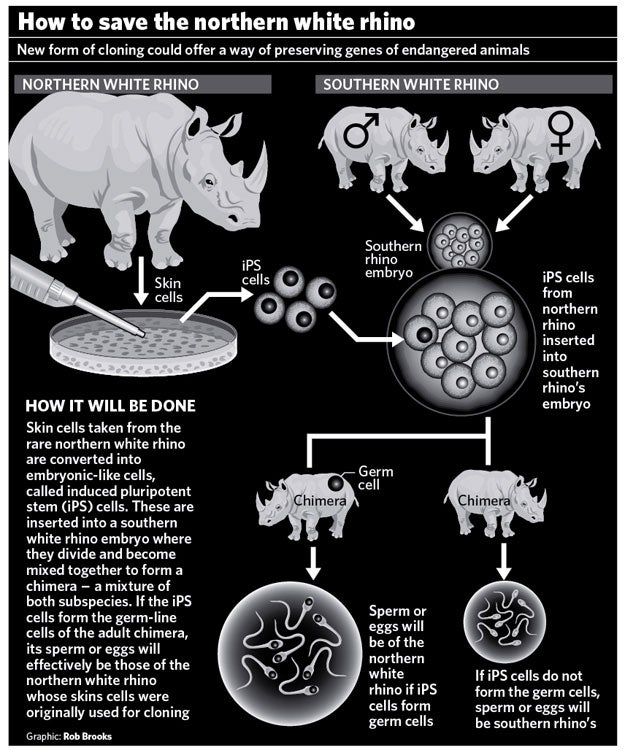
A revolutionary form of cloning is to be used as part of a last-ditch effort to save one of the world's rarest animals – the northern white rhino – which is on the brink of extinction with only a few individuals left in the wild.
British scientists are to spearhead an attempt to preserve the genes of a rhino in captivity by using a technique that mixes its skin cells with the embryos of a close cousin, the southern white rhino, which is not so endangered. The resulting offspring will be "chimeras" with a mixture of cells from both sub-species, but it is hoped that some of them will grow up to produce the sperm and eggs of the northern white rhino and so boost the animal's dwindling gene pool.
If the pioneering experiment is successful, the biologists hope to extend the technique to a wide range of other endangered species whose populations in the wild are severely depleted as a result of hunting and habitat loss.
Specialists at the Royal Zoological Society of Scotland and the University of Edinburgh are putting the plan together, with the help of conservationists in the field, who have warned the days of the northern white rhino are numbered with just three or four animals left in the grasslands of north-east Africa. Ian Wilmut, who led the team that cloned Dolly the sheep, is part of the research project and has stated that the new technique is more promising and practical than the cloning method he used in his famous breakthrough more than 10 years ago.
Professor Robert Millar, the director of the Medical Research Council's Reproductive Sciences Unit at Edinburgh University, who is leading the study, said: "There are a lot of African animals under the threat of extinction. We want to protect their genomes, but you have to protect their habitats as well. This is one of the ways of dealing with the problem, especially when the animals get to such low numbers in the wild. It is a method we need to start to get into place as an insurance policy – it's clearly do-able according to the laboratory work."
Scientists plan to take small samples of skin from the few northern white rhinos kept in captivity, as well as any animals temporarily captured in the wild, and transform them into embryonic-like cells using a new genetic-engineering technique extensively tested on laboratory mice.
The technique involves altering a few regulatory genes, which has the effect of "reprogramming" the adult skin cells back to an embryonic state so that it can then develop into any of the specialised tissues of the body – including the germ-line cells that give rise to sperm and eggs.
One scientist warned this week in an interview with TheIndependent that the technique of induced pluripotent stem (iPS) cells could even be used on human beings by maverick IVF doctors wanting to help infertile couples, because it has proved so easy to use on mice with few apparent side-effects.
Robert Lanza, the chief scientific officer of the American biotechnology company Advanced Cell Technology in Massachusetts, also said he is collaborating with Chinese scientists to use iPS stem cells on the giant panda as part of a conservation programme. "The technology could have enormous value in conservation biology. In fact, we have work currently underway using iPS cells to rescue endangered animals," Dr Lanza said.
"We also have an agreement with the Chinese Giant Panda Breeding Group to work with them to use reprogramming techniques to convert giant panda cells – skin or other tissue samples they have stored – into iPS cells in order to rescue genes that would otherwise be lost from the planet forever," he added.
The Medical Research Council's human reproductive sciences unit is going to work closely with Edinburgh Zoo on breeding technologies that could be used to conserve endangered species, such as the African wild dog, the Ethiopian wolf and the pygmy hippo. A new body called the Institute for Breeding Rare and Endangered African Mammals has been set up in the Scottish capital to bring a number of scientists together to share experience and resources.
Paul de Sousa, a stem-cell specialist at Edinburgh University, said that all mammals appear to share the same genes that can be engineered to reprogramme skin cells to induce iPS cells and that it should be possible to use the technique on the northern white rhino. "No one has done this before, but I'm confident that it can be done. You'd aggregate the cells in an embryo and what you would create would be a chimera of the rhino," Dr de Sousa said.
Conservation biology experts said the problems associated with using the tissue of endangered animals are formidable. "If it's going to work, it's still a long way off... It's going to be very difficult," said Professor Bill Holt, of the Zoological Society of London.
Join our commenting forum
Join thought-provoking conversations, follow other Independent readers and see their replies
Comments
Bookmark popover
Removed from bookmarks