The core of truth behind Sir Isaac Newton's apple
The manuscript that gave rise to one of science's best-known anecdotes is now online.
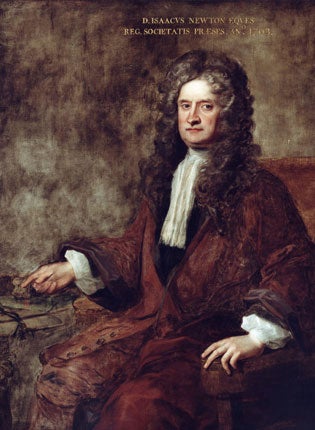
It is one of the most famous anecdotes in the history of science. The young Isaac Newton is sitting in his garden when an apple falls on his head and, in a stroke of brilliant insight, he suddenly comes up with his theory of gravity. The story is almost certainly embellished, both by Newton and the generations of storytellers who came after him. But from today anyone with access to the internet can see for themselves the first-hand account of how a falling apple inspired the understanding of gravitational force.
The Royal Society in London is making available in digital form the key original manuscript that describes how Newton devised his theory of gravity after witnessing an apple falling from a tree in his mother's garden in Lincolnshire, although there is no evidence to suggest that it hit him on the head.
It was 1666, and the plague had closed many public buildings and meetings. Newton had to abandon Cambridge for Woolsthorpe Manor, near Grantham in Lincolnshire, the modest house where he was born, to contemplate the stellar problems he had been pursuing at the university.
He was particularly obsessed by the orbit of the Moon around the Earth, and eventually reasoned that the influence of gravity must extend over vast distances. After seeing how apples always fall straight to the ground, he spent several years working on the mathematics showing that the force of gravity decreased as the inverse square of the distance.
But what evidence is there that Newton was really inspired by a falling apple? He left no written account suggesting this, although there were other documents suggesting that he had spoken to others about it when he was an old man.
Historians point to the one particular account written by one of Newton's younger contemporaries, an antiquarian and proto-archaeologist called William Stukeley, who also wrote the first biography of Britain's greatest scientist, entitled Memoirs of Sir Isaac Newton's Life.
Stukeley was also born in Lincolnshire, and used this connection to befriend the notoriously cantankerous Newton. Stukeley spent some time in conversation with the older man, and the pair met regularly as fellows of the Royal Society, and talked together. On one particular occasion in 1726, Stukeley and Newton spent the evening dining in London.
"After dinner, the weather being warm, we went into the garden & drank thea under the shade of some apple tree; only he & myself," Stukeley wrote in the meticulously handwritten manuscript released by the Royal Society.
"Amid other discourse, he told me, he was just in the same situation, as when formerly the notion of gravitation came into his mind. Why sh[oul]d that apple always descend perpendicularly to the ground, thought he to himself; occasion'd by the fall of an apple, as he sat in contemplative mood.
"Why sh[oul]d it not go sideways, or upwards? But constantly to the Earth's centre? Assuredly the reason is, that the Earth draws it. There must be a drawing power in matter. And the sum of the drawing power in the matter of the Earth must be in the Earth's centre, not in any side of the Earth.
"Therefore does this apple fall perpendicularly or towards the centre? If matter thus draws matter; it must be proportion of its quantity. Therefore the apple draws the Earth, as well as the Earth draws the apple."
This is the most detailed account of the apple anecdote, but it is not the only one from Newton's day. He had also used it to entertain John Conduitt, the husband of Newton's niece and his assistant at the Royal Mint, which Newton had run in his later years. Conduitt wrote: "In the year 1666 he retired again from Cambridge to his mother in Lincolnshire. Whilst he was pensively meandering in a garden it came into his thought that the power of gravity (which brought an apple from a tree to the ground) was not limited to a certain distance from Earth, but that this power must extend much further than was usually thought.
"Why not as high as the Moon said he to himself & if so, that must influence her motion & perhaps retain her orbit, whereupon he fell a calculating what would be the effect of that supposition."
Both accounts of the apple incident were recalled by Newton some 50 years later. Did it really happen, or was it a story that Newton embellished or even invented?
"Newton cleverly honed this anecdote over time," said Keith Moore, head of archives at the Royal Society. "The story was certainly true, but let's say it got better with the telling." The story of the apple fitted with the idea of an Earth-shaped object being attracted to the Earth. It also had a resonance with the Biblical account of the tree of knowledge, and Newton was known to have extreme religious views, Mr Moore said.
At Woolsthorpe Manor, now owned by the National Trust, the house steward, Margaret Winn, said that the same apple tree, a cooking variety known as Flower of Kent, still grows to the front of the house, in sight of Newton's bedroom window.
"He did tell the story as an old man but you do wonder whether it really happened," said Ms Winn, who has cooked with the apples. But even if the tale was the fanciful imaginings of an old man, the story of the falling apple has gone down in history as the second-greatest "eureka moment" in science, after Archimedes discovered how to work out the volume of objects while he was in the bath.
View the Stukeley manuscript at www.royalsociety.org/turning-the-pages
Eureka moments: How they 'got it'
*Archimedes is thought to have been the first scientist to shout out the Greek word "Eureka!" to mark a breakthrough, when he discovered his principle of buoyancy. Roman writer Vitruvius wrote that Archimedes was taking a bath when he realised that when he stepped into his tub, his body mass displaced a certain weight of water. The scientist is said to have jumped out of the bath and run naked through the streets of Syracuse in Sicily shouting: "Eureka, eureka!" ("I have found it!"). Doubt has since been cast on the authenticity of this story, given that Vitruvius was writing nearly 200 years later.
*Otto Loewi, the German physiologist, spent 17 years trying to come up with definitive proof that nerve impulses were transmitted chemically, and was finally struck by inspiration one night when he had a dream showing him how to carry out a key experiment using a frog's heart. He immediately went to his laboratory to conduct the experiment, noting that electrical stimulation of a frog's vagus nerve released a chemical, now known to be the neurotransmitter acetylcholine, which controlled the heart rate.
*Although it is commonly thought that Charles Darwin came up with his theory of natural selection while on the Galapagos Islands in 1835, he only started to believe in evolution after he returned to England. Instead of being struck by a single "Eureka moment", the scientist spent two decades pondering his observations, finally presenting his controversial theory in his 1859 book On the Origin of Species. Sofia Mitra-Thakur
Join our commenting forum
Join thought-provoking conversations, follow other Independent readers and see their replies
Comments
Bookmark popover
Removed from bookmarks