The Large Hadron Collider: End of the world, or God's own particle?
A bewildered Cole Moreton goes in search of the science behind the spin
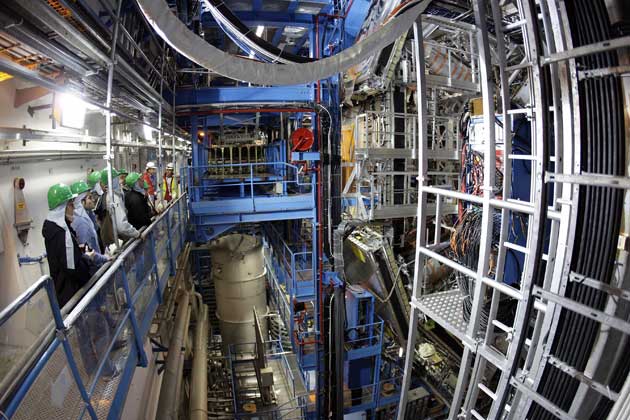
Yes, but what is it? That has been many people's reaction to the furore over the Large Hadron Collider, due to be switched on this Wednesday. The biggest, most expensive experiment in history is attracting both scientific hyperbole and hysteria. Some say it will reveal the universe's secrets and lead to the elusive Theory of Everything. A few fear that unleashing unimaginable power beneath the Swiss countryside will result in the end of the world. But how? And what do all these words mean?
Large
Is an understatement. A giant circular tunnel, with several loops, stretches for 27km under the land between France and Switzerland. One of its experimental chambers is bigger than the nave of Westminster Abbey.
Hadron
The name for one of the types of particle that make up an atom. These tiny bits of energy will be propelled by giant magnets around the tunnel circuit at almost the speed of light.
Collide
Is what they will do when they meet other hadrons being beamed in the opposite direction, at the same great speed. The resulting explosion will create 100,000 times more heat than the sun, apparently. Thankfully, it will only happen for a moment, in an area a billion times smaller than a speck of dust.
Cern
Pronounced "sern". The French acronym for the European Organisation for Nuclear Research, which built the £5bn collider. The money came from 20 countries, including Britain, which has played a leading role.
The Big Bang
Is what they are trying to recreate. Or rather what happened a trillionth of a second after the universe was created by an explosion, 13.7 billion years ago. For that tiny moment, it is believed everything was molten plasma. This cooled to create everything we see around us. The hope is that by remaking the moment, in miniature, the scientists will be able to see things that are invisible now.
The God Particle
Big name, very small thing; and the first great discovery they hope to make. It is believed we have only detected a quarter of the particles in everything. We don't, for example, know why things have mass. (To get a feeling for what that is, hit yourself over the head with an inflatable hammer, then a real one. The one that hurts has more mass.) In 1964 Professor Peter Higgs of Edinburgh University predicted an unseen particle that provided mass (its official name is a Higgs boson). The hope is it will be detected for the first time. Other possible revelations include so-called dark matter, which in theory "stretches through space like an invisible skeleton".
The Theory of Everything
The Holy Grail of science. A unifying theory providing one explanation for the forces at work in the natural world, from the nucleus of an atom to the movements of the planets. Sounds like alchemy to non-scientists, but some very respectable minds believe it is possible, and that the collider may show the way.
The End of the World
Some scientists, on the other hand, went to the European Court for Human Rights to try to stop the collider being turned on. They fear it may create a black hole – which would certainly violate our rights by sucking the planet into... well we don't really know. Professor Sir Chris Llewellyn Smith of Cern says: "The chance we produce a black hole is minuscule." Which is not all that reassuring. But he adds: "Even if we do, it can't swallow up the Earth." It would be too small, and disappear in moments. In any case, they will only send the hadrons in one direction this week. The collisions start in October. Until then, at least, we're not all doomed.
Join our commenting forum
Join thought-provoking conversations, follow other Independent readers and see their replies
Comments
Bookmark popover
Removed from bookmarks