The missing sunspots: Is this the big chill?
Scientists are baffled by what they’re seeing on the Sun’s surface – nothing at all. And this lack of activity could have a major impact on global warming. David Whitehouse investigates
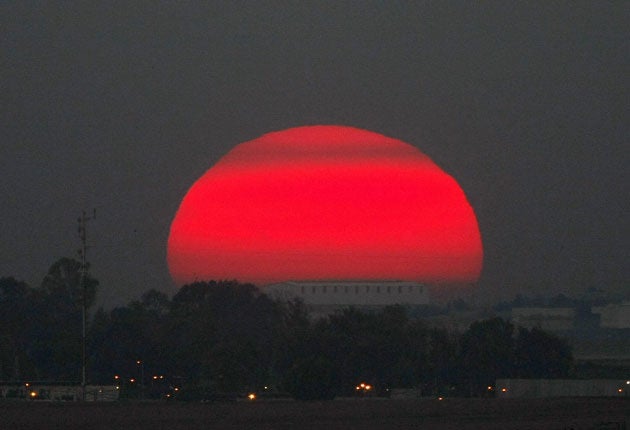
Could the Sun play a greater role in recent climate change than has been believed? Climatologists had dismissed the idea and some solar scientists have been reticent about it because of its connections with those who those who deny climate change. But now the speculation has grown louder because of what is happening to our Sun. No living scientist has seen it behave this way. There are no sunspots.
The disappearance of sunspots happens every few years, but this time it’s gone on far longer than anyone expected – and there is no sign of the Sun waking up. “This is the lowest we’ve ever seen. We thought we’d be out of it by now, but we’re not,” says Marc Hairston of the University of Texas. And it’s not just the sunspots that are causing concern. There is also the so-called solar wind – streams of particles the Sun pours out – that is at its weakest since records began. In addition, the Sun’s magnetic axis is tilted to an unusual degree. “This is the quietest Sun we’ve seen in almost a century,” says NASA solar scientist David Hathaway. But this is not just a scientific curiosity. It could affect everyone on Earth and force what for many is the unthinkable: a reappraisal of the science behind recent global warming.
Our Sun is the primary force of the Earth’s climate system, driving atmospheric and oceanic circulation patterns. It lies behind every aspect of the Earth’s climate and is, of course, a key component of the greenhouse effect. But there is another factor to be considered. When the Sun has gone quiet like this before, it coincided with the earth cooling slightly and there is speculation that a similar thing could happen now. If so, it could alter all our predictions of climate change, and show that our understanding of climate change might not be anywhere near as good as we thought.
Sunspots are dark, cooler patches on the Sun’s surface that come and go in a roughly 11-year cycle, first noticed in 1843. They have gone away before. They were absent in the 17th century – a period called the “Maunder Minimum” after the scientist who spotted it. Crucially, it has been observed that the periods when the Sun’s activity is high and low are related to warm and cool climatic periods. The weak Sun in the 17th century coincided with the so-called Little Ice Age. The Sun took a dip between 1790 and 1830 and the earth also cooled a little. It was weak during the cold Iron Age, and active during the warm Bronze Age. Recent research suggests that in the past 12,000 years there have been 27 grand minima and 19 grand maxima.
Throughout the 20th century the Sun was unusually active, peaking in the 1950s and the late 1980s. Dean Pensell of NASA, says that, “since the Space Age began in the 1950s, solar activity has been generally high. Five of the ten most intense solar cycles on record have occurred in the last 50 years.” The Sun became increasingly active at the same time that the Earth warmed. But according to the scientific consensus, the Sun has had only a minor recent effect on climate change.
Many scientists believe that the Sun was the major player on the Earth’s climate until the past few decades, when the greenhouse effect from increasing levels of carbon dioxide overwhelmed it.
Computer models suggest that of the 0.5C increase in global average temperatures over the past 30 years, only 10-20 per cent of the temperature variations observed were down to the Sun, although some said it was 50 per cent.
But around the turn of the century things started to change. Within a few years of the Sun’s activity starting to decline, the rise in the Earth’s temperature began to slow and has now been constant since the turn of the century. This was at the same time that the levels of atmospheric carbon dioxide carried on rising. So, is the Sun’s quietness responsible for the tail-off in global warming and if not, what is?
There are some clues as to what’s going on. Although at solar maxima there are more sunspots on the Sun’s surface, their dimming effect is more than offset by the appearance of bright patches on the Sun’s disc called faculae – Italian for “little torches”. Overall, during an 11-year solar cycle the Sun’s output changes by only 0.1 per cent, an amount considered by many to be too small a variation to change much on earth. But there is another way of looking it. While this 0.1 per cent variation is small as a percentage, in terms of absolute energy levels it is enormous, amounting to a highly significant 1.3 Watts of energy per square metre at the Earth. This means that during the solar cycle’s rising phase from solar minima to maxima, the Sun’s increasing brightness has the same climate-forcing effect as that from increasing atmospheric greenhouse gasses. There is recent research suggesting that solar variability can have a very strong regional climatic influence on Earth – in fact stronger than any man-made greenhouse effect across vast swathes of the Earth. And that could rewrite the rules.
No one knows what will happen or how it will effect our understanding of climate change on Earth. If the Earth cools under a quiet Sun, then it may be an indication that the increase in the Sun’s activity since the Little Ice Age has been the dominant factor in global temperature rises. That would also mean that we have overestimated the sensitivity of the Earth’s atmosphere to an increase of carbon dioxide from the pre-industrial three parts per 10,000 by volume to today’s four parts per 10,000. Or the sun could compete with global warming, holding it back for a while. For now, all scientists can do, along with the rest of us, is to watch and wait.
Dr David Whitehouse is author of ‘The Sun: A Biography’ (John Wiley)
The Sun explained...
Core The energy of the Sun comes from nuclear fusion reactions that occur deep inside the core
Radiative zone The area that surrounds the core. Energy travels through it by radiation
Convective zone This zone extends from the radiative zone to the Sun’s surface. It consists of “boiling” convection cells
Photosphere The top layer of the Sun. It is this that we see when we look at the Sun in natural light
Filament A strand of solar plasma held up by the Sun’s magnetic field that can be seen against its surface
Chromosphere A layer of the Sun’s atmosphere above the photosphere, around 2000km deep
Join our commenting forum
Join thought-provoking conversations, follow other Independent readers and see their replies
Comments
Bookmark popover
Removed from bookmarks