The secrets of evolution unearthed in Highlands
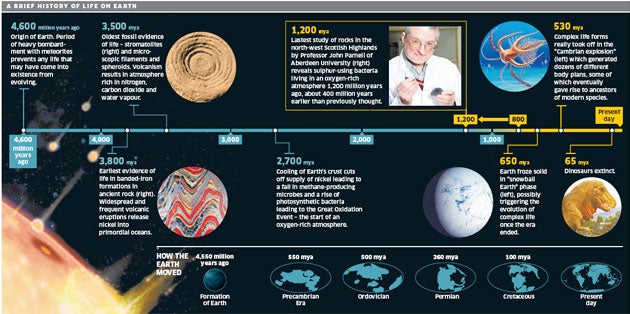
The key moment in the history of life on Earth – the tipping point at which there was enough oxygen in the atmosphere to support the evolution of complex animals and plants – occurred about 400 million years earlier than previously thought, a study has found.
Geologists studying rocks in Scotland believe that oxygen – the vital element for energy-hungry life forms – began to rise to useful concentrations in the Earth's atmosphere about 1.2 billion years ago rather than 800 million years ago, which was suggested by previous studies.
The discovery pushes back the point at which complex organisms could have begun to evolve from the simple microbes that had inhabited the planet for much of its history. But it raises the question: what was the ultimate spark that ignited the evolutionary explosion of life, leading to the immense diversity of species today?
Although the earliest fossil evidence of life on Earth goes back 3.8 billion years, for about 3 billion years of this time, living organisms consisted of simple microbes no more complex than "green slime". It was only relatively recently – less than 1 billion years ago – that life began to evolve into symmetrical, multicellular organisms with complex body plans.
"Our geochemical analyses have provided a clear signal that levels of oxygen in the atmosphere had increased to levels critical to the evolution of complex life – from which we ourselves emerge – much earlier than has been previously proven to date," said Adrian Boyce, of the Scottish Universities Environmental Research Centre in Glasgow.
"This opens the door to a new understanding of the evolution of our planet's atmosphere and the life it sustains," he added. The study, published in the journal Nature, analysed the chemical signatures of bacteria found in rocks near Lochinver in the north-west Highlands of Scotland, which showed that oxygen levels must have increased 1.2 billion years ago to allow certain sulphur-using microbes to exist in high numbers.
"Investigations revealed that these bacteria, which on a basic level use sulphur to obtain energy, were also using oxygen in a much more complex and efficient chemical reaction in order to generate their energy and survive," said Professor John Parnell of Aberdeen University, who led the research team.
He added: "Evidence of this chemical reaction tells us that the levels of oxygen in the atmosphere were at this key point for evolution, at this much earlier stage in Earth's history.
"Our findings, which shift this key point in the evolution of life on Earth to a much earlier date than previously proven, will give impetus to further investigations into the timescale of the development of complex life, which followed this event," he said.
Join our commenting forum
Join thought-provoking conversations, follow other Independent readers and see their replies
Comments
Bookmark popover
Removed from bookmarks