The Timeline: The Atomic Bomb
Purification of uranium, 1939-1945
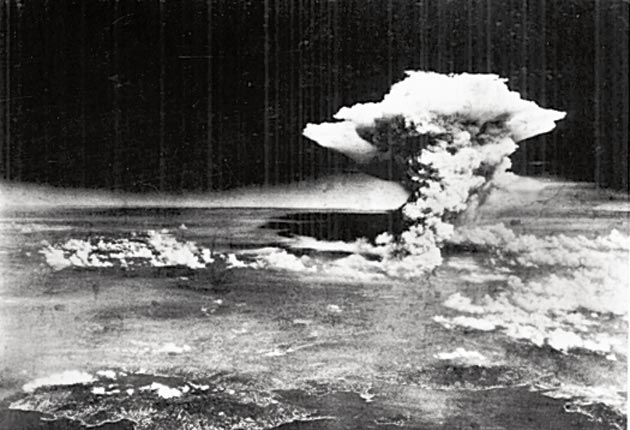
The first atomic bomb ever used in warfare was dropped on Hiroshima on 6 August, 1945 by the US – signalling the realisation of the six-year Manhattan Project. Albert Einstein had written to Franklin D Roosevelt in 1939 detailing the Nazi experiments that attempted to purify uranium, prompting the US to pump more than $2bn into its development. But it was Robert Oppenheimer – an American physicist working on the project – whose name became synonymous with the A-bomb. The success of the "gadget", the first atomic bomb, began the move into the "Atomic Age".
Hiroshima and Nagasaki, 1945
On 26 July, the US President, Harry S Truman, issued the Potsdam Declaration as an ultimatum to Japan, warning of the "inevitable [and] utter devastation" of Japanese homeland. Their refusal to surrender led to Enola Gay, a B-29 bomber, dropping the atomic bomb, known as Little Boy, on Hiroshima days later. Around 66,000 died instantaneously. The total reported number of deaths – from burns and radiation – varies from 90,000 to 166,000. Little Boy's brother, Fat Man, was dropped on Nagasaki three days later, killing 40,000 at once. On 10 August, the Japanese surrendered.
The Iron Curtain closes, 1946-1969
Relations between the East and West deteriorated severely as post-war Europe was carved up and the Iron Curtain descended and the Cold War began. The Soviet's expansion into the uranium-rich Eastern Bloc challenged America's monopoly over nuclear power and triggered the Arms Race, as the UK, France and China also developed weapons. The Korean War (1950-53) threatened atomic warfare once again. The defining crises of Berlin, 1961 and Cuba, 1962, narrowly avoided all-out conflict as the Cold War ran its course.
Nuclear Disarmament, 1970-1990
The Nuclear Non-Proliferation Treaty came into force in 1970, aiming to limit the powers with nuclear weaponry to five. The Campaign for Nuclear Disarmament argued for a more radical approach and gained widespread support. However, India, Pakistan and Israel all declined to sign the treaty, continuing to develop nuclear weapons. Mikhail Gorbachev's rise to power in Russia resulted in the end of both the Soviet Union and, ultimately, the Cold War, as the Berlin Wall fell. Relations between the US and Russia eased during this period.
The Modern Age, 1991-today
In 2003, North Korea became the first country ever to withdraw from the Non-Proliferation Treaty, as a US-led invasion of Iraq searched for weapons. Iran has continued to defy UN sanctions, with 21st-century nuclear policy increasingly dominated by the fear of "rogue states" developing weapons. The Liberal Democrats – during the 2010 election campaign – called for the cancellation of the renewal of the Trident missile programme.
Join our commenting forum
Join thought-provoking conversations, follow other Independent readers and see their replies
Comments
Bookmark popover
Removed from bookmarks