There's another Earth out there – and we'll find it
Habitable planet could be located in the next four years, scientists say
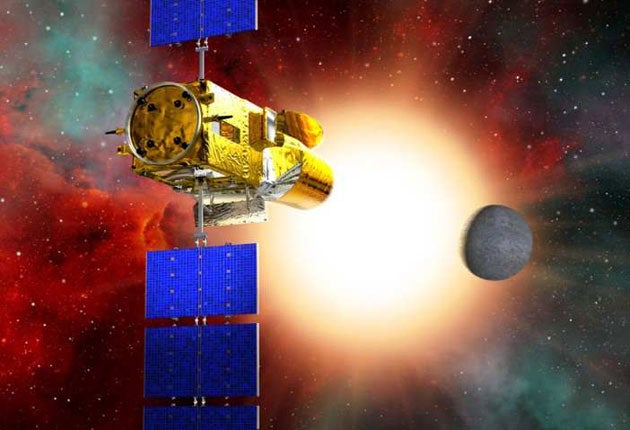
The first Earth-like planet orbiting a distant star could be discovered within four years, astronomers believe. None of the 300 "extra-solar" planets so far identified beyond our own system is thought to be suitable for life, so the discovery of an Earth-like planet made of rock rather than hot gas or frozen ice would significantly increase the chances of finding the second habitable world, scientists said.
A leading astronomer confidently predicted yesterday that the discovery of an earth-like planet – possibly in the water-friendly "habitable zone" around a nearby star – would soon be announced, after two satellite studies by the European Space Agency (ESA) and the US National Aeronautics and Space Administration (Nasa).
"Within about three or four years, there will be a press conference at Nasa headquarters and they will tell us just how frequently Earth-like planets occur and once we know that we will know how to take the next steps in the search for habitable planets," said Alan Boss of the Carnegie Institution for Science in Washington.
"I think it's inevitable that there are Earth-like planets out there. I suspect that every star we look at in the night sky has an Earth-like planet around it. We already know that most stars have planets," Dr Boss told the American Association for the Advancement of Science in Chicago.
"We've been able to find planets a few times the mass of the Earth around lower-mass stars but while they are not quite earth analogues, they are getting closer and closer to Earth. The fact that we can find them already implies we are seeing just the tip of the iceberg."
Scientists believe up to a third of the sun-like stars in the Milky Way galaxy have planets that are several times larger than Earth. Dr Boss said the figure could be even higher for smaller planets the size of Earth. "I think we are talking about a number that is very close to one, one Earth-sized planet around each sun-like star," he said. This would mean there could be 100 billion earth-like planets in our galaxy alone, and at least 100 billion galaxies in the Universe.
"What we're going to find is that the number of Earths is quite large and that's going to tell us how to build the next telescopes to go out and examine these finds," Dr Boss said.
At present, ground-based telescopes able to detect only planets that are substantially larger than Earth, which means the "gas giant" planets such as Jupiter or the ice-giants such Neptune which are both unsuitable for life.
But smaller, rocky planets could be identified for the first time with two space-based telescopes, ESA's Corot satellite, which began collecting data last year, and Nasa's Kepler mission, which is scheduled for launch next month. "I think we'll be absolutely astonished if Kepler and Corot did not find any Earth-like planets because basically we're finding them already, so I don't think it's possible that we won't find some," Dr Boss said.
Suggestions that there could be as many as 100 billion Earth-like planets in the galaxy, with a sizeable fraction of them orbiting with the habitable zone where liquid water exists, means that extraterrestial life is inevitable, Dr Boss told the meeting.
"If you have a habitable world that is sitting around for four, five or ten billion years around a star, how are you going to stop it from forming life? It's like taking a refrigerator, unplugging it, shutting the door and then coming back a couple of months later; you'd be amazed to find what's growing there," he said. "That's what life's like. The fridge analogy may not be the same as the origins of life, but life is so tenacious, it's hard to stop. If you had a planet sitting there at the right temperature with water for a million years, something's going to come out of it."
But finding a planet with life is not the same as finding intelligent life. "It is quite a bit harder to estimate what the likelihood is of finding intelligent life, probably because intelligent life, we believe, probably exists for only a fraction of the time period of when a planet may be inhabitable," Dr Boss said.
"Do you really think that our civilisation is going to last for a billion years? That's the timescale we talk about in astronomy. I don't think we are going to be around in a billion years. On the other hand, there are just real practical reasons why we may not have detected intelligent life. Maybe we haven't found them yet because we just haven't look far enough and long enough in the galaxy," he added.
... and there may be another form of life right here
We know that life evolved at least once in the Universe but could it have originated twice on the same planet – just not as we know it? That is the question posed by a scientist who believes that a second form of "weird life" which has yet to be discovered may have originated on Earth.
Paul Davies, a British-born physicist at Arizona State University in Tempe, said that the conventional view that all life on Earth originated once from a common ancestor may be wrong and that another form of microbial life may exist in parallel to life as we know it.
"There has been no systematic search for life as we don't know it on Earth. We're not talking about some kind of life we can't see for mystical reasons," Professor Davies said at the American Association for the Advancement of Science in Chicago. "We're talking about microbial life, and in this realm some little organisms may have an alternative biochemistry derived from a second or subsequent genesis event."
Scientists believe that the first lifeform originated between 3.5 and 4 billion years ago when the Earth was a very different place. It was being bombarded by comets and meteoroids and bathed in ultraviolet radiation to create a kind of "primordial soup" of pre-biotic chemicals that began to replicate and evolve. Professor Davies believes that genesis event may have occurred more than once and that it is possible that two or more forms of life came about which used quite different sets of biological molecules.
"If we imagine the origin of life on Earth some three and half to four billion years ago, we can imagine a series of stop-go experiments where life was formed and annihilated, formed and annihilated," Professor Davies said.
"As a result of that sequence it is entirely possible that another form of life was left, and then the issue is whether it would have survived today and formed a shadow biosphere," he said.
"It could be right under our noses, or even in our noses. It could be that weird life and regular life are intermingled."
View all comments that have been posted about this article.
Offensive or abusive comments will be removed and your IP logged and may be used to prevent further submission. In submitting a comment to the site, you agree to be bound by the Independent Minds Terms of Service.
- Print Article
- Email Article
-
Click here for copyright permissions
Copyright 2009 Independent News and Media Limited


Comments
Get with the programme - have you never heard of a Tardis?
In fact I would say that the term is pretty much self exclusive as psychopaths tend to be inward focused and probably wouldn't even consider life out there unless directly asked...
I think ol' Douglas Adams put it succinctly enough, that in an infinite universe, there must be an infinite amount of habitable planets, an infinite amount of intelligent life... QED
I always chuckle though when the Americans automatically think that Aliens would meet up with them first, if Aliens were observing the earth, it is more likely that the US's recent actions would make aliens probably move on without disturbing us, that is if they were moral Aliens, if they were conquering Aliens, it is very likely that they would take the Yanks out first... Of course, if they were tourist Aliens, no doubt Disneyland would welcome them, the same as anyone else :P
Logically speaking, given the fact that we are, as you said, merely a grain of sand on this big, beach universe, why would you then assume that we are alone? We have barely explored even Mars, the closest planet by a loooooooooooooong way and our brains and technology cannot comprehend the magnitude of the universe, hence why we haven't got very far and can't really see very far (in great detail, anyway), so I'd say it's more than a litle naive to claim to 'know' anything.
When writing your book, you may way to read a little bit about the universe and theoretical physics if you wnt your book to hold 'gravity' in the fantasy world (heh heh heh - couldn't resist...)
On that note, who do you mean when you mean 'we'? As in "we all instinctively know that we are totally alone in the universe and only psychopaths fantasise about mythical technologically advanced other being s being out there somewhere" (a quote from you, by the way). Are you including me in 'we all'? How about Steven Hawking? How about the other posters here who surmise we are not, in fact, alone?
So, let me get this straight:
claim 1: we all instinctively know that we are alone and only psychopaths fantasise about advances being out there.
claim 2: you are writing a book about a fantasy you have about aliens visiting the earth.
Corollary 1: you think of yourself as a psychopath.
Although, logically speaking, since being proven that claim 1 is not true, corollary 1 does not hold (phew, close call for you!).
And are you trying to claim that I have no right to deduce that there is 'life' on other planets because i have not been to other planets (fair point, I have not) but then... nor have you.... so how would you know, unless you had been to every other planet in the whole entire universe, that there is no life? Because someone would only have to find one tiny speck of life somewhere to prove you wrong, whereas you'd have to go to all the planets... It's just logic, buddy.
My personal view on it is that our brains as mere humans are 'naive' to comprehend the sheer magnitude of the universe which and also the conditions on a planet different to ours that would precure life and what that life would be like (looks, communication, numbers etc) and this, in turn, translates to a feeling of being alone
With respect to your comment about 'God' yes I agree, I'm not a believer in any of the traditional faiths myself as I find them bizarre, but would not rule out a higher 'power' than us (by power I don't mean someone that made us in his image, I mean a complex 'structure' of which we are a part of) whose rules are not about coveting someone's wife or not making images of the deity, but of little impact on nature and avoiding distruction wherever possible (yes, I realise that means we're already screwed!)) but as for my beliefs, that doesn't rule out life on other planets, but I realise that some people who hold different faith ideas might find the idea of extra-terrestrial life contradictory to that of a monotheistic faith.
I suppose what I'm trying to say is we all have our own idiosyncratic ideas and beliefs about the rhetoric, I just tend to get a bit defensive when I feel someone is trying to push their ideas on me, whatever they a be; life's hard enough without that!!
*by our, I mean 'their' really :-)
I just happen to sense that we are totally alone, needless to say I do not accept the theory of evolution in its entirety but it is awful persuasive and the anthropomorphic phraseology of some of its proponents interests me from a psychological point of view
As far as this premise is concerned the whole of the Universe is within our minds. There is nos such a thing as aliens, because we ARE the aliens. Our illusion of "out there" is what made us rivet the habit of considering "out there" and "other people" as something different from ourselves.
As long as we keep on thinking that there is us and the rest of the Universe we will be stuck on singleness, individuality and will keep spending zillions and pressing ourselves dry to find an answer to why we have never found the slightest trace of other living beings "out there" despite all the superb technologies we have device and built to look "Beyond" ourselves.
We ARE the aliens, we ARE outer space, ours IS the inhabited planet. Planets, man matter, light, energy are just ways of speaking. There is no more YOU than a part of ME. The faster we wake up to this realization, the more sober our behaviour will be towards man, towards the environment, towards animals.
WE ARE the Universe. We ARE all dimensions and there is nothing more than US out there.
Perhaps then we will understand that we've been unreasonably arrogant as a species.
You may doubt whatever you wish. It doesn't change the facts an iota, though. But perhaps you would care to ask a physicist about this.
I was a university lecturer in computing and wrote several training manuals for Microsoft Office products. My rule of thumb was to put myself in the position of my students, asking "do I understand what he is saying?" You may well be making valid points but why do I need a physicist to explain? This is The Independent, not a specialised magazine for boffins.
Space IS an illusion. Period.
So you've actually said there:
Space is an illusion...
Which, to me, implies 'to be continued' :-)
I do love it when people such as yourself get so het up about their 'superior' knowledge. Perhaps the rest of us will use our collective consiousness to will life to burst into existence on other planets and prove you wrong.
It would be far better to will Earth to grow larger to follow demographics or become healed or pour knowledge in our laps without the need to squander time and efforts and money travelling to search for Earth clone somewhere.
By the way mine is not superior knowledge. Mine are simple conjectures I happen to be persuaded of.
The problem, I guess, when getting into discussions like this, fit to topic, it's hard to know what is 'scientific' and what is 'philosophical'. Anyhoo, I read a bit about your William Tiller chap, he seems like a clever guy but I'd have to read more to be convinced, I'm always open to new ideas an concepts anyway!
According to them we actually make the Universe with or thoughts!
Almost 60 years ago, at school, I was enthralled by the exploits of Dan Dare in a new comic called Eagle. My religion teacher scorned us advising that God will never allow man to leave the earth. Today we all know that several men have walked on the moon. And I have a truly wonderful book of close-up photographs of the planets and their moons taken by the two satellites now billions of miles into deep space and outside our universe, possibly captured by very puzzled little green men. But all this is in my mind?
Do the maths. Suppose the chances of a planet with oxygen are one in a million, one in five million, the number does not matter. There are billions of stars out there in millions of galaxies. Look at the beautiful Hubble pictures and tell me they are all in my mind. Guess that the average star has 5 planets orbiting, the actual number does not matter. Then do the multiplications and divisions and the chances mentioned at the start of this paragraph are pretty generous for lots of life.
What that life is, who knows and will we ever find out? Certainly not with today's technology. We have just found out there is water on Mars, the essential for our life. I am willing to bet that the next successful explorer to Mars will find some evidence of life, now or extinct, maybe only very simple. This will explode your illusion theory.
I cannot get into deep discussion with you on this, I lack the education and, quite probably, the intelligence. My IQ is only 160. So lets agree to disagree but, in future, make it simple for us morons.
Don't get me wrong, I love theoretical physics, but there is a lot we don't know about yet, and there are also (to use what has become an incredibly useful 'gormless phrase') there are still many unknown unknowns, so it difficult for anyone (yes, that includes you :p) to claim anything for sure, especially about something which, by definition, has different concept of 'reality' to what we initially thought.
But, on the subject of aliens, what if we find a planet which has the same spatial-illusionary perceptions as us? Perhaps the universe is the collective consiousness of all of us (aliens included)?
There was a time when marine biologists and oceanographers would have laughed at the idea of some of the species of sea creatures we now know to exist, many of the conditions they live in were previously thought to be inhabitable and, what do you knoiw? We developed tech. to go down that far and found them. Who's to say the same won't happen with exta-terrestrial life?
So it's a one in a million find really.
Really.... Doh!
http://www.eurekalert.org/pub_relea
American Institute of Aeronautics and Astronautics
1801 Alexander Bell Drive, Suite 500, Reston, VA 20191-4344
Phone: 703.264.7558 Fax: 703.264.7551 www.aiaa.org
Books and Magazine articles
Single stage to orbit
Dec 1988/Jan1989
air and space smithsonian
page 44 -50
feb/mar 1994
Air and space smithsonian
page 44-50
Omni dec 1982
vol 5 #3
issn 0149 -8711
page 24 contiuned on 167-168
Interstellar travel:
magazine articles
Omni oct 1983
page 79-84
Oct/nov 1989
Air and Space Smithsonian
page 42-48
Discover aug 1998
page 70 -79
Ftl ( Faster than light)
magazine articles
Popular science
may 2001
page 46-51
Journal of the British interplantary society
nov 1995
page 453
Science digest may 1982
issn 0036-8296
vol90 #5
page 79-81
"I think it's inevitable that there are Earth-like planets out there. I suspect that every star we look at in the night sky has an Earth-like planet around it. We already know that most stars have planets"
Very scientific n' logical.. I can imagine a hundred years from now; when the whole world is living like sheep in the "new world order", there'll be UFO's attacking planet earth, n' we'll have our alleged star wars, who knows we could have something like al Qaida, or Saddam alien prototypes!
"I think it's inevitable that there are Earth-like planets out there. I suspect that every star we look at in the night sky has an Earth-like planet around it. We already know that most stars have planets"
Very scientific n' logical.. I can imagine a hundred years from now; when the whole world is living like sheep in the "new world order", there'll be UFO's attacking planet earth, n' we'll have our alleged star wars, who knows we could have something like al Qaida, or Saddam alien prototypes!