Under the Microscope: How many types of dinosaur are there?
Asked by: Natalie Emerson
Answered by: Professor Mike Benton, Department of Earth Sciences, Paleobiology and Biodiversity Research Group, University of Bristol
Discovering dinosaurs
Dinosaur discoveries are happening all the time. There are 25 to 30 new discoveries every year – which is getting on for one every 10 days. People expect that the rate of discovery will decline, but we've been saying that for a while and it hasn't slowed down yet!
I would estimate we are about halfway to discovering every type of dinosaur, based on the fact that we don't really find many new ones in Europe now – which has been thoroughly explored – but we are finding new ones in areas like South America and China.
Scientific advances
The reason there has been a high rate of discovery over the past couple of decades is two-fold. One, there have been a lot more palaeontologists active across the world. Two, there are many parts of the world that were rarely explored but which are now being opened up.
There has also been greater political openness; when I started, the idea of communicating with Chinese palaeontologists was unthinkable. What we have found is that really it is new territory that is the key to finding genuinely new discoveries. More people working will get you more new dinosaurs, but more new localities will get you genuinely new dinosaurian species.
Important finds
Within really recent times, the most important discovery was the feathered dinosaurs in China. It wasn't discovering a new species, but the preservation showed that they had feathers. That prompted a big, big change in our perception of things.
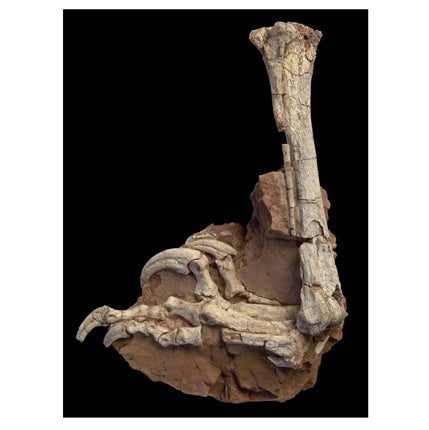
The discovery of Alxasaurus also stands out. It was a whole new group – a very bizarre animal, a most weird-looking thing, a mix of the massive bottom of a round sloth, with very short, stumpy legs, long arms with metre-long, scythe-like claws, and the inoffensive tiny head of a plant-eater. Bits and bobs of it had been found before, but the first complete Alxasaurus really showed us a major new dinosaur group.
With the 30 new discoveries a year, they may be important because they are found in an unusual or unexpected place, but they will all belong to the same 40 or 50 families of dinosaur. Like the one that just been found in Romania (Balaur bondoc, or the "stocky dragon"). It's similar to a Velociraptor, so not a whole new group, but it was interesting that it was found in Romania, in Europe, where we hadn't seen that type before.
It's a bit like discovering a new type of squirrel. They differ in subtle ways to ones you already know, and they all add to our information and understanding, but they aren't a big surprise.
What's in a name?
There are limited formal rules for the naming of new species. There is no committee that sets it or vets it – you can be as imaginative as you like, or use a local reference, or the mythology or history of the country it's discovered in. Or give it a Latin name, as with the Tyrannosaurus Rex, which means "tyrant king".
A genuine discovery?
There are about 700 or 800 species of dinosaurs that have been named and that are genuinely different from one another. About double that number have been named throughout history, when we thought, in an optimistic fashion, that they were different species.
When it comes to classifying a discovery as "new", you have to do the best you can to be sceptical; as a scientist, you have to test it, and test it, and test it. You look at the teeth, the shape of the bones, the shape of the skull. There are a number of very clear anatomical characteristics to classify it. You then look for features to put it into a "family", by looking at existing samples and seeing if the new one could fit.
The more scrappy the remains, the more careful you have to be. If you have a tooth, you can't do much; if you have a skull, that's quite useful; if you have a full skeleton, that's very good.
It is most often an existing species, so you've got to be jolly sure it doesn't belong to one that exists already before you go naming it as a new one.
We're maybe not always as sceptical as we should be. There's no question that throughout the history of science, people have always wanted to make dramatic new discoveries.
But making great findsis only half of what we do as palaeontologists. The other part, understanding the life of the past, is actually the more thoughtful part. That's when you ask the important questions.
Join our commenting forum
Join thought-provoking conversations, follow other Independent readers and see their replies
Comments
Bookmark popover
Removed from bookmarks