Vaccine could end the global scourge of polio
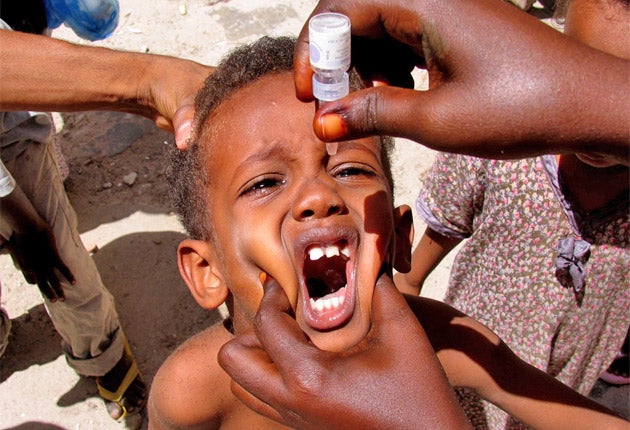
A new vaccine against the polio virus is so effective that it could become the final "game changer" which eliminates the disease from the world.
The plan to eradicate polio has produced startling results since it was first launched in 1988. Mass vaccination with a "trivalent" form of the vaccine aimed at all three viral subtypes led to a vast reduction in the number of countries with endemic polio, from 125 in 1988 to four in 2010.
A mass vaccination campaign across the world had led to the total number of poliomyelitis cases in the world falling from about 350,000 in 1988 to 1,606 in 2009, but the virus is still stubbornly hanging on in India, Pakistan, Afghanistan and, to a lesser extent, Nigeria.
The World Health Organisation (WHO) and other vaccine organisations are desperately trying to make a final push in these four countries to eradicate the disease forever.
The new "bivalent" vaccine is taken by mouth and works against two of the three strains of polio virus that still pose a problem – subtypes 1 and 3.
A study has found that the bivalent vaccine is between 30 and 40 per cent more effective at protecting people against infection, compared with the older trivalent vaccine, said Roland Sutter of the WHO in Geneva.
"With this new bivalent vaccine we feel we have an effective tool which for the first time gives us a single vaccine to deal with the type 1 and type 3 versions of the polio virus," Dr Sutter said. The study, published in The Lancet, tested both vaccines alongside monovalent vaccines aimed solely at either type 1 or type 3 viruses.
More than 800 newborn babies at three centres in India were vaccinated against polio using one of the three versions of the vaccine, with the first dose given at birth and a second dose after 30 days.
Dr Sutter said that the bivalent vaccine was 86 per cent effective at generating antibodies against type 1 polio virus and 74 per cent effective against type 3. The trivalent vaccine was 63 per cent and 52 per cent effective respectively against type 1 and type 3 viruses, a statistically significant difference with the bivalent vaccine.
"What we've seen is that the effect has been greater than expected but we don't know why this is at the moment," Dr Sutter told The Independent. "The combination in the bivalent vaccine seems to be doing very well and, in clinical studies, we get about 30 or 40 per cent more seroconversions [antibody production], which means it is 30 or 40 per cent more effective at inducing immunity than the trivalent vaccine."
The improvement in performance of the bivalent vaccine over the older trivalent product is even greater in the field, although there are not hard statistics to back this up, he added.
"It produces quite an improvement, but the biggest benefit is that we have something now that can address both types of the virus at the same time in one vaccine. My boss considers that this vaccine is a game changer," Dr Sutter said.
Vaccine experts are keen to eradicate polio completely from the four countries where it is still endemic as a failure to do so will be seen as a blow to other mass vaccination initiatives.
One problem is that eradicating the final hideouts of the virus will prove far more expensive on a case-by-case basis than earlier initiatives.
Yet, if polio is not eliminated completely and if vaccination is not continued for several years after the last confirmed case, there is always a danger that it may flare up again and spread to other parts of the world.
There have already been sporadic cases of the disease in central Asia, mostly Tajikistan, and Russia.
Nigel Crawford and Jim Buttery of the Murdoch Children's Research Institute in Melbourne said that the bivalent vaccine appears to be having an impact in India, where there are just 32 case of polio so far this year, compared with 260 cases in 2009.
"We believe that the next two years will provide evidence of whether the poliomyelitis endgame can be won," they write in a Lancet commentary.
However, they point out that there may still not be enough funding for the final push to eradicate polio.
Join our commenting forum
Join thought-provoking conversations, follow other Independent readers and see their replies
Comments
Bookmark popover
Removed from bookmarks