What a shower! Catch up on meteors with Twitter
News in pictures
News in pictures
On Facebook
From the blogs

Disclosure: We’d never even been to a club when we made our first single

For most of us, reaching eighteen years of age opens up a new world for exploration, spontaneity and...

Sepp Blatter: Penalty shoot-outs must remain, they’re football’s great leveller

As England supporters, we should scorn at any such deciding factor within football. On so many occas...

Why do some men consider the street as a female meat market?

Pronouncements on sexual inequality in the UK are normally met with an eye roll by my generation. As...

Political corruption reflects the widening chasm between the political class and the electorate

The corruption and hypocrisy which has come to characterise politics and politicians, and in particu...

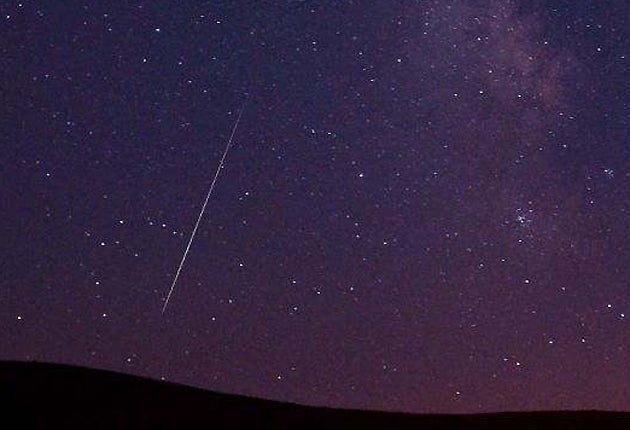
It has provided an annual light display for thousands of years and tomorrow it is being shown for the first time on Twitter as astronomers attempt to make it visible to a wider audience.

The Perseids meteor shower has already begun but is expected to reach its peak tomorrow night when up to 80 shooting stars are likely to be seen every hour. People living in the Midlands and the north of the country should get the best views with clear skies for much of the night.

Those in the south, however, are likely to have to turn to Twitter and other resources because rain and clouds will obscure the view.

In what has been described as the world’s first “star party”, the Royal Astronomical Society (Ras) has launched a programme to get as many of the shooting stars posted on the blogging site as possible. Amateur star-gazers around the world have been alerted to “live-tweet” the images they record as part of the Twitter Meteorwatch initiative led by astronomers in Newbury, Berkshire. They hope that using the technology will encourage people who wouldn’t usually pay much attention to the night sky to watch the meteor shower.

The Perseids meteor shower takes place each year as the Earth passes through fragments of debris left by the Swift-Tuttle comet, which orbits the Sun every 130 years, trailing space dust in its wake.

Each shooting star is caused by a speck of dirt burning up as it hits Earth’s atmosphere at 112,000mph. Most burn up in less than a second, often in eye-catching colours, and occasionally they split. Areas away from town lights are best to see the shower but even in cities, it should be possible to see some of the 50 to 80 meteors that burn up each hour.

Dr Bill Massey, from the Ras, said: “It’s such a violent event that you can see it from the ground. You would be unlucky not to see a few. ”

The shooting stars start near the Perseus constellation which starts tonight in the north-east and rises to a point overhead. They can be seen across Earth, except for parts of Antarctica. The northern hemisphere has the best displays.

It is the second time the Newbury Astronomical Society has used Twitter to popularise astronomy. It held an event focusing on the moon earlier this year.

The society president, Richard Fleet, said: “We used our array of telescopes and cameras to provide a constant stream of pictures which we uploaded straight to Twitter.

“We were amazed at how excited people were about our Twitter Moonwatch; we had thousands of people who had probably never looked through a telescope before asking us questions and viewing images.”

Catch a falling star... How to see Perseids

*The Perseids meteor shower is bright enough to be seen with the naked eye. Northern parts of Britain, the Midlands and North Wales will get the best views with cloud cover absent or sporadic. But the south is likely to miss out because of rain. Locations away from city lights are the best places to watch. Light from the moon, especially in the early hours tomorrow, will make it harder to see the meteors. Astronomers advise turning away from the moon to minimise its influence.

Independent Comment
blog comments powered by Disqus
Career Services

Day In a Page

Is Ridley Scott the most macho man in movies?

Ridley Scott: The most macho man in movies?

His cinematic CV is unparalleled. Yet the Alien director is still obsessed with beating his rivals.
Being Gary Lineker: The clean-cut anchorman is this summer's Mr Sport

Being Gary Lineker

The clean-cut anchorman is this summer's Mr Sport...
Gallic gourmets are putting French cuisine back on the culinary map

Gallic gourmets put France back on culinary map

Overdone, out of touch and old-fashioned: French cuisine has never been at a lower ebb...
So Moorish: Mark Hix offers his own take on classic Moroccan dishes

So Moorish: Mark Hix's Moroccan dishes

Why not create a north African-inspired feast to share with your friends?
Sin and the single mother: The history of lone parenthood

Sin and the single mother

Maureen Paton explores the history of lone parenthood.
The outsider: Margaret Howell is British fashion's queen of minimalism

The outsider: Margaret Howell

The designer tells Susannah Frankel why she has never felt part of the fashion industry.
The 50 Best luggage

The 50 Best luggage

From chic cases to compact baggage, pack it all in this summer
For men only: A pilgrimage to Mount Athos in Greece

For men only: A pilgrimage to Mount Athos

On a secluded peninsula in north-east Greece lies an enclave that's way off the tourist map, especially for women...
48 Hours In: Faro

48 Hours In: Faro

More than just the gateway to the Algarve, this city has much to tempt you off the beach.
Here, the coast is always clear: Celebrating sixty years of Pembrokeshire's National Park

60 years of Pembrokeshire's National Park

Mick Webb reveals a land of puffins, tanks and Hollywood blockbusters.
Free Range: Meet the designers of tomorrow

Free Range

Meet the artists of the future
Feeding a hungry world – or meddling with laws of nature?

Feeding a hungry world – or meddling with laws of nature?

As scientists at Rothamsted's GM trials plead with activists not to sabotage their work, Michael McCarthy visits the battle field
Monkey meat that could be behind the next HIV

Monkey meat that could be behind the next HIV

Deep in Cameroon's rainforests, poachers are killing primates for food. Evan Williams reports from Yokadouma on a practice that could create a pandemic
Catcalls, whistles, groping: just another day for a young woman

Catcalls, whistles, groping: just another day for a young woman

Government urged to take abuse more seriously as London study shows 41 per cent are harassed
Jailing of Maori separatists stirs colonial-era resentment

Jailing of Maori separatists stirs colonial-era resentment

Militant Tuhoe tribe members defiant amid claims race relations had been set back 100 years