Why the dinosaurs died (and it wasn't because they were stupid)
Extended winter brought on by gigantic asteroid strike wiped largest-ever land creatures from face of the Earth
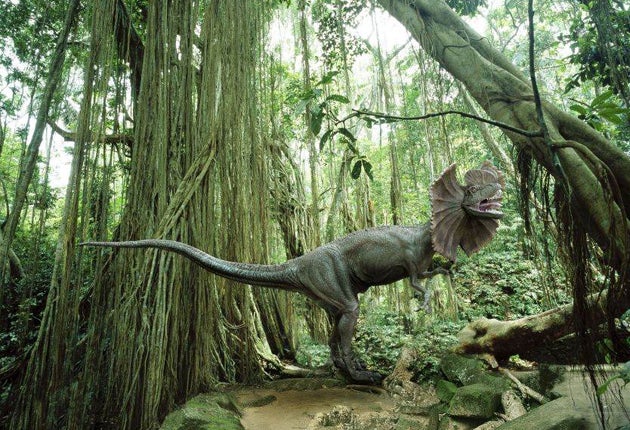
Some say they died out from general stupidity, others argue that they drowned in their own dung or suffered slipped discs and chronically bad backs. But the real reason why the dinosaurs became extinct 65 million years ago has now been identified – a collision with a gigantic asteroid that blocked out the sun and caused an extended global winter.
Arguments about the sudden demise of the dinosaurs – the largest-ever land creatures – have raged for decades with no conclusion. Now, an extensive investigation by 41 leading experts from around the world has found that the asteroid explanation is the only one that stands up to rigorous scientific scrutiny.
The scientists reviewed more than 20 years of evidence from various scientific disciplines and found that the only serious contender to the asteroid theory – a series of massive volcanic eruptions – could still not account for the sudden disappearance of not only the dinosaurs but about half of all species that lived at the same time in prehistory.
Eruptions of ancient supervolcanoes called the Deccan Traps in what is now India would have produced enough lava to fill the Black Sea twice over, but still not enough poisonous gases over a long-enough period of time to kill off the dinosaurs and the other marine and terrestrial species that became extinct with them, the scientists concluded.
"If you combine all the evidence together it's pretty strongly in favour of a giant asteroid collision," said Jo Morgan, an earth scientist at Imperial College London, one of the experts who carried out the study published in the journal Science. "We now have great confidence that an asteroid was the cause of the extinction. This triggered large-scale fires, earthquakes measuring more than 10 on the Richter scale, and continental landslides, which created tsunamis."
She added: "The final nail in the coffin of the dinosaurs happened when blasted material was ejected at high velocity into the atmosphere. This shrouded the planet in darkness and caused a global winter, killing off many species that couldn't adapt to this hellish environment," she said. Photosynthesis would have stopped in the dusty atmosphere and the dinosaurs would have starved.
The theory that the dinosaurs died out because of an asteroid collision goes back to the early 1980s when Walter and Luis Alvarez, a father-and-son team of geologists, discovered a layer of iridium, a rare mineral, in a sedimentary layer formed 65 million years ago. The same iridium layer – known as the K-T boundary – was found at more than 100 sites around the world and because asteroids are rich in iridium this suggested a collision that had spread debris around the globe. Furthermore, fossils older than the iridium layer suggested an abundance of species, yet fossils after the K-T boundary suggested a mass extinction.
A few years later, geologists on the Yucatan Peninsula in Mexico discovered gravitational and magnetic anomalies suggesting a huge, submerged crater on the Mexican coast that had been filled in with sediment. Subsequent studies suggested this was the giant, 200km-wide crater resulting from the impact with an asteroid estimated to be 15km wide.
Scientists also found nodules of glass-like rock in the crater that could only have been formed by the immense temperatures and pressures resulting from the shock of an impact. It is estimated the asteroid released a force equivalent to one billion Hiroshima bombs and ejected a few thousand cubic kilometres of debris into the atmosphere where it would have formed a thick blanket cutting out sunshine for months.
"The asteroid was about the size of the Isle of Wight and hit Earth 20 times faster than a speeding bullet. The explosion of hot rock and gas would have looked like a huge ball of fire on the horizon, grilling any living creature in the immediate vicinity that couldn't find shelter," said Gareth Collins, a Natural Environment Research Council fellow at Imperial College.
Some scientists had suggested the asteroid impact in Chicxulub had occurred 300,000 years prior to the mass extinction and so could not have killed off the dinosaurs. However, the latest study found that this was based on flawed evidence and the timing of the collision was indeed perfect to explain the extinction.
"Combining all available data from different science disciplines led us to conclude that a large asteroid impact 65 million years ago in modern-day Mexico was the major cause of the mass extinction," said Peter Schulte of the University of Erlangen in Germany, and lead author of the study.
Once the dinosaurs had been wiped out, it left room for small, shrew-like creatures to replace them. Mammals – particularly a primate with a large brain – have since dominated the terrestrial biosphere.
The great extinction: Rival theories
There are perhaps as many theories about the extinction of the dinosaurs as there are scientists working on the problem. Many experts believe that these massive land creatures, which dominated the terrestrial ecosystem for 160 million years, were in decline for several million years before the asteroid collision 65 million years ago.
But it is clear that the dinosaurs were wiped out relatively quickly in a mass extinction that killed off the flying reptiles, the pterosaurs, as well as the large marine reptiles. Some experts have suggested that this could have been due to a rise in infectious diseases carried by blood-sucking insects, or a decrease in sexual activity, making the dinosaurs vulnerable to a population crash. Other experts suggest mass starvation, food poisoning or even that the creatures were overwhelmed by increasing volumes of dino dung. However, the most serious contender to the asteroid theory is the suggestion of a series of volcanic eruptions known to have occurred over a period of 1.5 million years, spewing out enough sulphur gases to choke the atmosphere and turn the seas acid.
Join our commenting forum
Join thought-provoking conversations, follow other Independent readers and see their replies
Comments
Bookmark popover
Removed from bookmarks