Why tsunamis were smaller than expected
Monday 01 March 2010
Latest in Science
On Facebook
From the blogs
More than half of Afghanistan’s families live in extreme poverty
Leila is watching her baby intently, as his mouth moves trying to swallow the small blob of yellow p...
Time for a new approach to alcohol
Ambulances were called and three drunk teenagers were brought to my care. One was so drunk we had to...
Bahrain: One year on
I am used to endless lies and criticism from the BNP and its favourite blogster, as well as Islamist...
Paul Volcker stands tall against the banking lobby
Why is Europe, which likes to present itself as an opponent of speculative "Anglo-Saxon" finance, li...
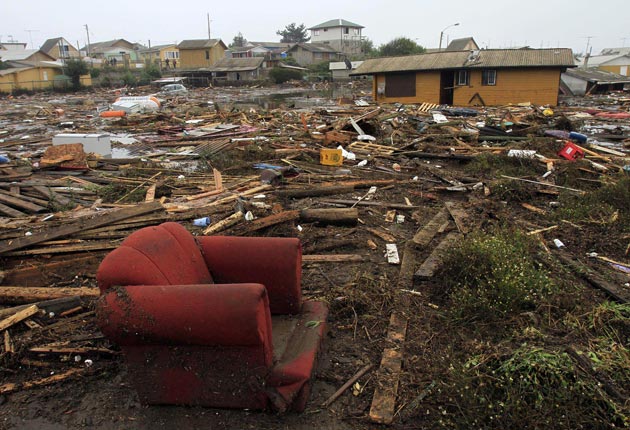
It is fortunate that one of the biggest earthquakes in recent history has generated only relatively small tsunamis that crossed the Pacific Ocean from Chile to Japan. This is almost certainly because the rupture that generated the earthquake occurred quite deep in the Earth's crust.
The size of a tsunami, which means "harbour wave" in Japanese, is directly related to the volume of water that is displaced during the movement of the seabed during an earthquake. The bigger the amount of water that is moved up or down, the bigger the tsunami that is likely to be created.
Roger Musson, an earthquake scientist at the British Geological Survey in Edinburgh, explained that there are two factors to consider. The first is whether or not the movement of the seabed occurred in an area of shallow water – the shallower the water above the rupture, the smaller the tsunami. The second is how deep under the seabed the rupture occurred, with shallow quakes causing a greater displacement of water.
"In this case I suspect the relatively small size of the tsunamis travelling across the Pacific Ocean was because the rupture occurred relatively deep in the ground," Dr Musson said.
"If it had occurred at the top of the slope where the two tectonic plates meet we would have got a much bigger tsunami," he added.
Many Pacific islands in the path of the Chilean tsunamis have well-drilled emergency preparations for the risk of tsunamis.
For instance, Robinson Crusoe island, which is part of the Juan Fernandez archipelago 400 miles off the coast of Chile, has a concrete road running up a hill from the shore where residents are trained to flee when a tsunami warning is issued.
- 1 No secularism please, we're British
- 2 Apple admits it has a human rights problem
- 3 'Drunk tanks' and minimum prices to help Britain sober up
- 4 Working as a jail torturer ruined my life
- 5 Lightning kills an entire football team
- 6 Reinstate Knox's murder charge, Italian court told
- 7 Caught in his own blast: an Iranian targeting Israel
- 1 Spotify: 1 million plays, £108 return
- 2 How Koscielny became prince of the Emirates
- 3 Apple admits it has a human rights problem
- 4 Mark Steel: If religion is 'marginal', I'm the Pope
- 5 No secularism please, we're British
- 6 Lightning kills an entire football team
- 7 Matthew Norman: There's always the Human Rights Act, Trevor
- 8 Special report: The hungry generation
- 9 I was born to be a killer. Every night I see the Devil in my dreams
- 10 Six Grammys, five years off: Adele puts love before career
Free trial of new Independent iPad app
Get your daily dose of the best of British journalism, sponsored by American Airlines
Win a three-week coastal jaunt
Spend three weeks exploring every nook and cranny of gorgeous Atlantic Canada.
Amazing restaurant offers
Three glasses of free champagne and a special menu at 46 top London restaurants.
Latest Independent competitions
Win anything from gadgets to five-star holidays on our competitions and offers page.
Commercial thought leaders
Watch the best in the business world give their insights into the world of business.
Career Services
Day In a Page
How an abortion divided America
Did they all live happily ever after? That's up to you...


Comments