Will DNA unlock the Elephant Man's final secret?

Skeleton could hold key to century-old puzzle of what caused Joseph Merrick's terrible disfigurement
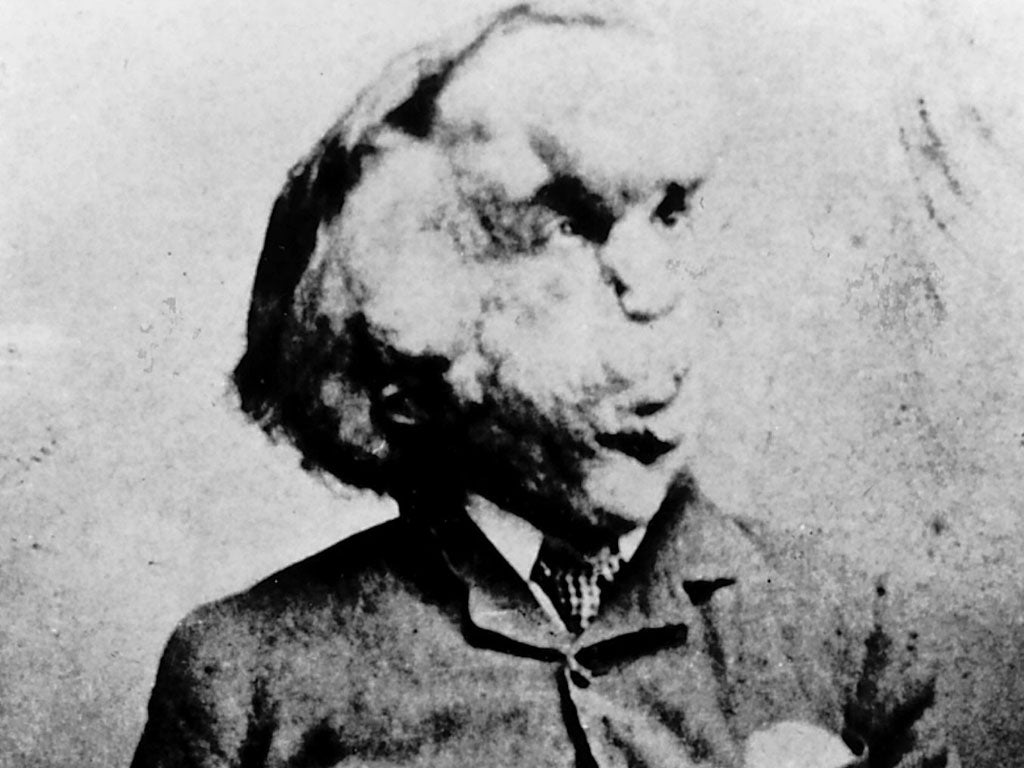
He was the thing of children's nightmares, outcast by a Victorian society unable to comprehend his grotesque deformities, but was later immortalised in films and plays. Joseph Merrick, better known as the Elephant Man, is one of medical history's enigmas: 122 years after his death, no one knows exactly what caused his extreme disfigurement. But scientists will attempt to solve the puzzle next month by extracting DNA from his bones for analysis.

Merrick came to the attention of the medical profession in the 1880s. Ever since, scientists have struggled to explain the huge growths that caused him to be first shunned and finally celebrated by society – by the end of his life his courage and humility had, at last, been recognised. Merrick became a folk hero for speaking up for others who were similarly afflicted.

It was initially thought that he suffered from Elephantiasis, a parasitic infection characterised by the thickening and enlargement of skin and tissue, hence his nickname.

Then, in 2001, some scientists suggested that Merrick had suffered from a rare disease called Proteus syndrome – a congenital disorder that causes skin overgrowth and abnormal bone development. But other experts questioned the diagnosis, saying that the way his disease manifested was not typical of that condition. It is hoped this latest research will finally prove conclusive.

Scientists will extract DNA from Merrick's skeleton, which has been kept at the Royal London Hospital at Whitechapel, east London, since his death, aged 27, in 1890. Tests will then be carried out to see if it is possible to sequence Merrick's genome thereby identifying any gene alteration. The already complex technique has been made harder by the fact that Merrick's skeleton has been poorly preserved, and years of bleaching to keep it clean have degraded the remains.

Researchers hope that, by finally diagnosing his condition, they will be able to treat other sufferers.

Professor Richard Trembath, vice principal and executive dean at Queen Mary, University of London, who is overseeing the research and who holds responsibility for the safe keeping of Merrick's skeleton, said: "This is going to be extremely demanding. We know we can get genetic material out of the bone of Merrick. We now need to know whether we can get sufficient from what we believe to be abnormal bone as well as sufficient from normal bone.

"In doing it, we have an absolute regard to make sure we preserve the skeleton. We can't just mash a whole amount of it up. We have to preserve it for future generations because it's an important historical record."

Merrick was born in Leicester in 1862. Because of his deformities, he was rejected by his father and stepmother and was forced on to the street to earn a living. He wore a cap and hood in an attempt to hide his disfigurement. He finally took a job as a sideshow "freak", exhibited as a curiosity. It wasn't until the surgeon Frederick Treves took him under his wing and brought him to the London Hospital, where he lived out his final years, that he became something of a celebrity – he was even visited by Alexandra, Princess of Wales.

Such is the power of Joseph Merrick's story, that adaptations of it continue to run today. The American actor Bradley Cooper is currently starring in a stage adaptation of The Elephant Man, and David Lynch's 1980 film of the same name, where Merrick was played by John Hurt, earned several Oscar nominations. An opera has also been composed that tells the story of Merrick's life.

Science Made Simple

Buy the new Independent eBook - £1.99 Why is the sky blue? A compendium of fascinating answers to the simple, scientific questions posed by Independent readers

kobo iBooks Amazon Kindle
Independent Comment
blog comments powered by Disqus
Top stories
News in pictures
World news in pictures
UK news in pictures
UK news in pictures
More stories
       
Independent
Travel Shop
Lake Como and the Bernina Express
Seven nights half-board from £749pp Find out more
Dubrovnik and the Dalmatian coast
Seven nights half-board from only £859pp Find out more
Prague city break
Three nights from only £199pp Find out more
 
Independent Dating
and  

By clicking 'Search' you
are agreeing to our
Terms of Use.

iJobs Job Widget
iJobs General

Senior Electrical Engineering Consultant – Renewable Energy Grid Connections.

Negotiable Depending on Experience: The Green Recruitment Company: The Green R...

BREEAM Consultant

£25000 - £30000 Per Annum: The Green Recruitment Company: The Green Recruitmen...

Design Engineer - ProE, Hand Calcs

Negotiable: Progressive Recruitment: Dear Sumadhab, A growing engineering comp...

Year 6 Teacher / Year Group Leader

Negotiable: Randstad Education Ilford: We are currently recruiting for a Year ...

Day In a Page

Beards, brawn and body art

Beards, brawn and body art

Meet London’s new batch of male models
Scandi-geeks descend on Nordicana for fan-convention

Scandi-geeks descend on Nordicana for fan-convention

British love of shows such as The Bridge, Borgen and The Killing shows no sign of fading
Behind the rhetoric what is really being done to combat desertification?

The Great Green Wall of Africa,

Behind the rhetoric what is really being done to combat desertification?
Laughter Inc: the cheering growth of the chuckle industry

Laughter Inc

The cheering growth of the chuckle industry
The bad science scandal: how fact-fabrication is damaging UK's global name for research

The bad science scandal

How fact-fabrication is damaging UK's global name for research
To the manor born: The female aristocrats battling to inherit the title

Female aristocrats battle to inherit the title

A passionate protest is gathering pace among the women of Britain's aristocracy, who believe that men should no longer automatically inherit the family pile and title.
Love struck: Photographs of JFK's visit to Berlin 50 years ago reveal a nation instantly smitten

In pictures: JFK's visit to Berlin in 1963

Photographer Ulrich Mack accompanied Kennedy on the entire trip. The results are an astonishing record of a watershed moment.
Eat shoots and leaves: Mark Hix gets creative with fresh peas, mangetouts and sugar snaps

Mark Hix gets creative with English peas

English peas and their offsprings, such as mangetouts and sugar snaps, are great tossed into a salad, says our chef.
Ceviche with a smile: Chef Martin Morales has turned South America's elegant cuisine into one of London's hottest food trends

Chef Martin Morales: Ceviche with a smile

Morales has turned South America's elegant cuisine into one of London's hottest food trends
Incredible edible: Guerrilla gardeners are planting veg for the masses in West Yorkshire

Incredible edible: Guerrilla gardeners

Holly Williams joins the volunteers who have turned a small town into a thriving community with a guerrilla gardening scheme that has provided a blueprint for sustainability.
Seasoned to taste: The restaurants that draw happy diners back year after year

Seasoned to taste: Food institutions

In an industry famed for short-lived success and pop-up pretenders, it takes something special to stick around.
Anatomy of a waiter: Service staff spill the secrets of their trade

Anatomy of a waiter: Staff spill their secrets

Next Sunday is the first ever National Waiters' Day. To celebrate, we share tales from the restaurant trenches by those in the front line.
Drink in the sun: The season's best wines

Drink in the sun: The season's best wines

From complex English sparkling wine to juicy Sicilian reds...
Iran election: Farewell Mahmoud Ahmadinejad, we’ll miss you – but not that much...

Robert Fisk

Farewell Mahmoud Ahmadinejad, we’ll miss you – but not that much...
India sends its final telegram -(Stop)-

After 163 years India sends its final telegram -(Stop)-

Mobile phones and the internet have superseded the once-essential service