A bomb that was just a blast from the past
David McKittrick explains why dissident republicans decided to attack Newry
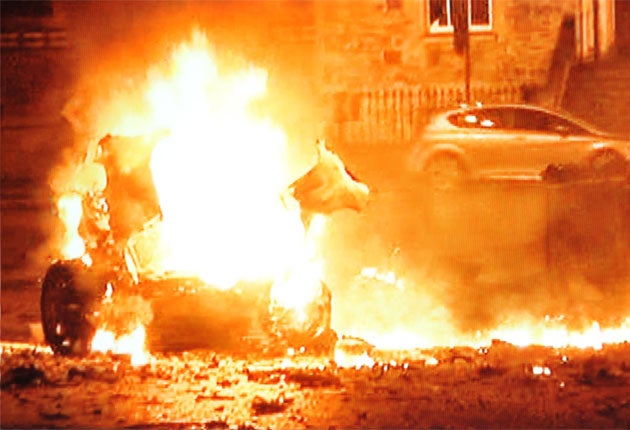
The sheer recklessness of dissident republicans in Northern Ireland was demonstrated once again on Monday night by the car bomb attack launched at the courthouse in the County Down border city of Newry.
The fact that nobody was injured came down to luck rather than judgement: the device went off as police were evacuating the area, just 17 minutes after a warning was received. During that time, a coach carrying a church badminton club passed by the scene.
In Northern Ireland, such attacks conjure up unwanted memories of the troubles, when such incidents were commonplace. This one in particular served as a painful reminder of the 1998 Omagh dissident bomb, which killed 29 people.
On that occasion, a telephone warning said a device had been left at the Omagh courthouse, when in fact it had been parked some distance away. Tragically, many of those killed had moved towards it in search of safety.
Dissident violence fell in the aftermath of Omagh, but in the last few years it has picked up again. Incidents are running at a high level, with three members of the security forces killed last spring and many other gun, bomb and rocket attacks being reported.
As the Newry bomb shows, dissidents are quite prepared to risk another Omagh, with its multiple civilian casualties. But the attack was reckless even in terms of their own interests, in that Newry is a mostly Catholic city.
Furthermore, it has enjoyed spectacular economic improvement in recent years. Regarded for decades as a dismally depressed area, it has now started to attract shoppers, with tens of thousands travelling from Dublin and further afield to take advantage of the lower prices.
"Newry was an area with historically high unemployment, but it has thrived in the last 15 years, with an expanding and dynamic business community to match a very dynamic community spirit," said Seamus McAleavey, a leading community activist.
The explosion of a bomb near the city centre will probably cost jobs as southerners are deterred from shopping there. Although some or all of the bombers probably came from the surrounding areas, they are impervious to such economic considerations.
They are also impervious to standard political calculations, since their philosophy begins and ends with the belief that setting off enough bombs will eventually cause the British Government to capitulate and leave Northern Ireland. This view is held by only a small handful of republicans. During the troubles republican organisations, principally the mainstream IRA, were responsible for more than 2,000 of the 3,700 deaths.
But the lesson drawn by almost all of these incidents was that violence on such a scale had not broken the British will, and was unlikely to in future. The mainstream IRA is now inactive, as are a variety of smaller groups, their members instead hoping to achieve a united Ireland through the political activities of Sinn Fein.
The three small groups still active are the Real IRA, Continuity IRA and ONH. They have separate structures but occasionally co-operate. Some of their most senior "operators" are currently in prison, while those outside are a mixture of old IRA veterans and recently recruited youngsters. The influence of the old hands can be seen in some of the techniques being used today, with many following classic IRA procedures.
It takes only a handful of veterans to pass on bombing and shooting skills to the younger men, who are often on the outer fringes of society. This mixture of old and young was commented on by the senior Sinn Fein representative John O'Dowd.
"They're interlinking with criminal and anti-social elements; their support base appears to be people who are disaffected," he said. "They have a mixture of recruits. There are people going to them that are misguided; there are others falling under their influence because they are involved in a range of other activities."
Those activities, he said, included car theft, general anti-social behaviour, and taking in those who sell and use drugs. He added: "I offered to speak to the so-called dissidents over a year ago. I was told no, they weren't interested in talking."
The dissidents are uninterested in dialogue, compromise or seeking a way into the political system: they oppose the entire system, indeed the entire idea of politics.
This puts them close to where the mainstream IRA found itself in the early 1970s – pursuing a goal of outright victory. It took them decades to lower their sights and conclude that a negotiated settlement was a more sensible way forward.
A large majority of republicans have gone along with the journey which has made Sinn Fein the second largest party in Northern Ireland. The dissidents regard this not as progress, but as a betrayal of ancient republican ideals.
The trouble for all involved is that the peace process is built on the principle of inclusion, but the dissidents have shown no desire to become involved in new structures. Instead, they make their commitment to force increasingly evident with every new explosion.
Because of this, there is no obvious way to deal with them politically, so any response is primarily in terms of security. In the absence of a political dimension, the authorities have no choice but to devote large-scale security resources into dealing with them.
Bookmark popover
Removed from bookmarks