Hot metal: the new scrap racket
Iron, bronze, copper and aluminium are providing rich pickings for thieves – as soaring global commodity prices fuel a crime epidemic across Britain. Cahal Milmo investigates
The steam engines designed by George Stephenson that drive the Bowes Railway were once hailed as marvels of Victorian engineering. More recently, they have attracted a less welcome type of admirer – the sort that comes equipped with cutters capable of slicing up their 2.5cm-thick iron sheeting and carting it off to a smelting works.
Along with visitors to the Sainsbury's website, telephone users in a Surrey street and the managers of a Welsh cemetery, the owners of the railway museum near Sunderland were this week in the front line of a plague of scavenging which is inconveniencing the daily lives of millions and taking a heavy toll on the British economy – metal theft.
John Young, the operations manager of the Bowes Railway, a scheduled ancient monument and Britain's only remaining rope-hauled railway, said raids by thieves looking for anything metallic were now so frequent that he has to run a "decoy" train ahead of its regular passenger services to ensure that none of the track first laid in the 1820s has been stolen overnight.
He said: "It has reached epidemic proportions. We have thieves on the site every week and often every night. They come for any piece of metal they can lay their hands on and it is a massive problem for us to protect the integrity and safety of the museum. One of the engine sheds has been systematically stripped. They come in with whatever equipment they need to break up the engine and any other equipment and simply carry it away.
"One day we found they had stolen a length of track. If one of the passenger trains had gone down the line it would have been disastrous. Now we have to send an engine down separately just make sure the track is there. It is getting so bad that it is a genuine threat to the business – if our insurers tell us they can't cover us any more then we'll have to shut."
After two years of sharply rising global commodity prices which has seen thieves who once specialised in car radios switch their attention to bronze sculptures worth millions, police revealed yesterday that 2008 is already the worst year on record for stealing metal. The cost to the British economy in material loss and delays is put at more than £360m a year.
But it is the sheer scale and variety of the knock-on effects of the crime wave that is proving the greatest concern for police and the Government, which has launched a multi-agency crackdown in an attempt to stem the flow of thefts.
On a single day last week, users of major websites including Sainsbury's were unable to place their online shopping orders after thieves broke into a Hertfordshire warehouse run by the internet service provide Cable & Wireless to steal server parts and materials that could be sold on the scrap metal market; 1,000 British Telecom customers in the West Clandon area of Surrey lost their service when copper cables were pulled up; and 60 homes in Swindon were left without power after a back-up generator was cannibalised for parts made from copper.
Managers of a cemetery in Swansea revealed on Tuesday that everything metal in the graveyard, including name plaques, taps, railings and 63 drain covers, had been stolen over a six week period. Mervyn Jones, a local councillor, said: "The problem has escalated out of all proportion. Anything that is metal and can be sold as scrap metal is being taken. You would expect graves to be cared for, not desecrated."
According to figures produced by the Association of Chief Police Officers (Acpo), there has been a 150 per cent rise in the theft of all metals in the last 24 months across Britain with copper from railway power cables, telephone lines and power stations the most common targets. Alongside copper comes a list of items that would be more at home in an architectural salvage yard than on the wanted list of serious criminals – drain-hole covers, iron railings and some 400,000 aluminium beer kegs.
Figures released to The Independent show that so far this year there have been 1,500 incidents of metal theft on the rail network, much of it copper signalling cable that causes hundreds of hours of delays when it is removed. The statistics have already surpassed 2006, when there were 1,142 offences, and have nearly reached the total of 1,928 thefts recorded last year. Passengers travelling on train services between Bristol and London this week were delayed at Didcot, Oxfordshire, because of a signal failure caused by stolen cables.
Assistant Chief Constable Paul Crowther, of the British Transport Police, who heads an Acpo taskforce on metal theft, said: "We have already surpassed the crime figures for 2006, which is when we first noticed a notable rise in offences of this nature. This is a crime trend that is still increasing and will do so for the foreseeable future. It is no coincidence that the marked increase in worldwide prices for metals like copper has been matched by a similar rise in thefts.
"On one level what we are seeing is a matter of supply and demand that is a global issue. But this is very far from being a victimless crime. When thieves strip the metal from a school or church roof, or pull up telephone cable they are disrupting people's lives and the cost of repairing the damage they cause is completely disproportionate to what the criminals are paid."
The cost in disruption and repairs to private homeowners, companies and local authorities is now running at £362m a year. One estimate puts the value of the metal stolen at barely a tenth of that figure.
Police sources said there is growing evidence of the involvement of organised crime in the trade, with the targeting of major infrastructure projects such as the £5.4bn renewal of the West Coast Main Line, which has been "significantly impacted" by metal thieves. Work sites are raided to steal drums of unused cable, sometimes using accomplices employed by contractors to gain access.
The acceleration in the scale and prevalence of metal theft has prompted a new programme of action by police, government bodies including the Environment Agency, HM Revenue & Customs and the British Metal Recycling Association, a trade body representing about 95 per cent of the UK's 2,000 scrap metal processors.
A 48-hour operation by 38 police forces earlier this month saw 219 scrap metal dealers visited by officers, resulting in the seizure of five tonnes of suspected stolen metal, 122 arrests and the confiscation of 107 vehicles. The haul included £50,000 of copper telephone cable stolen from British Telecom. Particular hotspots for metal theft include north-east England and Cambridgeshire.
It is also a crime boom in which increasingly little is considered sacred. Along with a £3m Henry Moore sculpture stolen from Hertfordshire, thieves have stolen bronze plaques from a memorial in Plymouth commemorating the city's war dead and the spare propellers from the royal yacht Britannia.
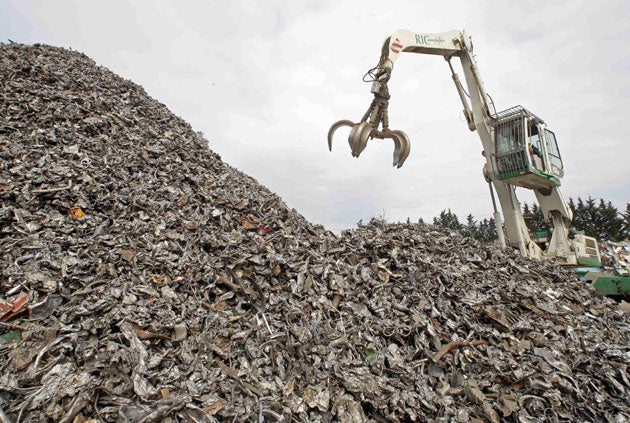
Ultimately, the procession of copper, lead, aluminium and other metals makes its way to container ports for transportation to the booming economies of China and India, where insatiable demand for raw materials has provided the key reason for the thefts – rocketing prices. The price of copper has tripled on the London Metal Exchange since January 2003, meaning that a tonne of scrap copper is now work £2,500. Lead is worth £1,800 a tonne and aluminium has recorded a 75 per cent price increase since 2006.
Bookmark popover
Removed from bookmarks