Judge backs infidelity defence for killers
Overhaul by Harriet Harman that ensures 'crimes of passion' suspects face murder trial is criticised by Lord Chief Justice
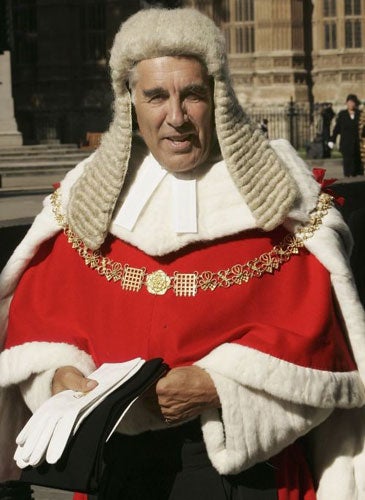
Government plans to overhaul England's murder laws to stop husbands and boyfriends using the defence of infidelity to escape conviction have been attacked by the country's most senior judge.
Under the controversial reforms, men would be tried for murder rather than manslaughter for "crimes of passion" while women who kill abusive husbands because of years of abuse would be treated more leniently.
But last night Lord Phillips, the Lord Chief Justice, stood up for the defence of "sexual infidelity", which he said could help show whether a husband or wife had been provoked into killing a spouse.
The government proposals, which have been characterised as being part of a feminist agenda, are aimed at ending what ministers call sexual discrimination in murder cases, where men get away with lighter sentences by claiming their wife's adultery had provoked them into an act of violence.
Introducing the proposed changes, Harriet Harman, the minister for Women, said that for centuries the law had allowed men to escape a murder charge in domestic homicide cases by blaming the victim. "Ending the provocation defence in cases of infidelity is an important law change and will end the culture of excuses," she said.
But Lord Phillips, at the London headquarters of the law firm Clifford Chance, said: "I must confess to being uneasy about a law which so diminishes the significance of sexual infidelity as expressly to exclude it from even the possibility of amounting to provocation. Nor have ministerial statements persuaded me that it is necessary for the law to go that far."
Instead, he said, he favoured an end to mandatory life sentences for murder. "There is a case for treating provocation in relation to murder as a factor solely relevant to mitigation rather than as a partial defence and I believe that it would be a very strong case if murder could result in a determinate sentence rather than in an automatic life sentence." Lord Phillips also challenged ministers' contention that men who killed their wives were being "let off lightly" by the courts.
"As far as not letting men off lightly is concerned, I have some difficulty with this proposition. The current law requires provocation to be conduct that would cause a reasonable man to act as the defendant acted. If juries are declining to hold that infidelity meets this test I cannot understand why it should be suggested that they are stretching the laws to its limits."
Ministers claim the law of provocation has operated in the domestic context in a way that has discriminated unfairly in favour of men and against women. Ms Harman has argued that it is unfair that men can rely on their anger about a wife's infidelity as a partial justification for killing them, but women who have been physically abused by their husbands and who have killed them out of fear of further abuse, have been denied the defence of provocation.
The judge said he supported a more structured approach to the reform of homicide, the first for 50 years, rather than a piecemeal change which focused on provocation. But the Government rejected proposals for a system of first- and second-degree murder and instead concentrated on the law of provocation.
Under the proposals, men who kill wives or girlfriends will be less likely to escape murder convictions by pleading jealous anger. The law change is designed to help women who kill abusive husbands because of years of abuse. People will also be able to claim they killed for fear of future violence against them.
The change would replace the present defence of "provocation" with a new defence based on "words or conduct" which made defendants feel "seriously wronged" or fear violence against them. The new defences will allow killers to be sentenced for manslaughter instead of murder.
Ms Harman said: "For centuries, the law has allowed men to escape a murder charge in domestic homicide cases by blaming the victim. Ending the provocation defence in cases of 'infidelity' is an important law change and will end the culture of excuses. There is no excuse for domestic violence, let alone taking a life."
The Government will consider Lord Phillips' views and other responses before finally legislating.
Case law: Women who killed
* Ruth Ellis was the last woman to be hanged in Britain for shooting dead her boyfriend in 1955. Her relatives failed, 48 years later, to have her murder conviction reduced to one of manslaughter on the grounds that her lover, David Blakely, beat her. But under changes being proposed by the Ministry of Justice, (the first changes to the homicide law since 1957), Ellis would be the more likely to have her sentence reduced to manslaughter. That is because premeditated killings will no longer be considered murder when committed "in response to words and conduct which caused the defendant to have a justifiable sense of being seriously wronged", as Ellis was.
* The case of Sarah Thornton, right, led to calls for a change to the defence of provocation. She was jailed for life in 1990 for the murder of her husband, who had beaten her repeatedly. In 1996, she won a retrial and was freed after being convicted of manslaughter.
* Emma Humphrey's case established that provocation to murder could be cumulative. She was 17 when she killed her pimp, Trevor Armitage. She heard him tell two friends they would gang-rape her. She slashed her wrists. He taunted her about her injuries and she knifed him in the heart.
Bookmark popover
Removed from bookmarks