Madman's notes throw new light on Ripper case
The medical records of a key suspect finally go public, 117 years after he was locked up
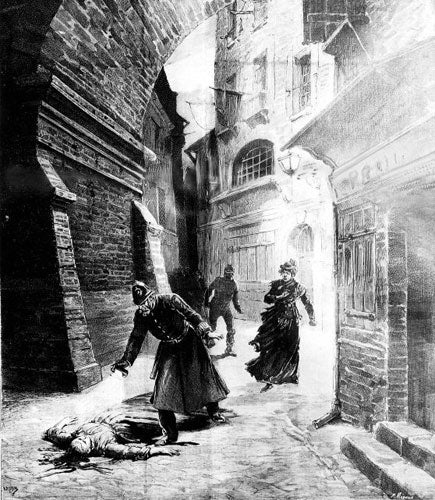
After years of secrecy, the Broadmoor authorities have released the medical records of a Victorian madman who was suspected of being the serial killer known as Jack the Ripper.
Thomas Hayne Cutbush was a strange, disturbed and violent youth who was diagnosed as insane in 1891 and remained in Broadmoor until his death in 1903. During the period when the Ripper was on the rampage in Whitechapel, east London, Cutbush was wandering the area's streets. And the Ripper, whoever he was, did not kill again after Cutbush was locked up.
Visitors to the Berkshire Records Office in Reading can inspect the 26 documents that make up the records Broadmoor kept about Cutbush, as well as the letters from Ripper investigators pleading to see the documents.
Disappointingly, the documents do not prove that Cutbush and Jack the Ripper were the same man. There is not even evidence that the Broadmoor attendants or medical staff believed he was a murderer. But there is enough to keep Cutbush on the suspect list.
He was – to quote an entry on his medical records – "very insane", a danger to the staff, other patients and even to his adoring mother. He was convinced that others were plotting to harm him and fantasised aloud about getting his hands on a knife so that he could "rip" the staff and patients.
Until he was arrested and diagnosed, Cutbush had lived his whole life in Kennington, south London, within walking distance of the scene of the Ripper murders. He was born on 29 June 1864, which would mean that he was 24 when Jack the Ripper started killing. His father died when he was young and he was brought up by his mother, Kate, and her sister, who evidently adored him.
He worked as a clerk but in 1888, about the time the Ripper killings began, he went insane. It has been assumed that he contracted syphilis. His death certificate says that he died from "cronic [sic] kidney disease" – although the document attributes his insanity to "heredity and overstudy".
There was certainly madness in the family. His uncle, a superintendent in the Metropolitan Police, shot himself in 1896 in front of his daughter. The reference to "overstudy" refers to the evenings young Thomas spent poring over medical textbooks after he came home from work, until madness took hold. He took to wandering the streets at night, returning sometimes covered in mud or – according to one report – in blood.
He also became convinced that his doctor, Dr Brooks, or Brookes, was trying to poison him. He wrote to Lord Grimthorpe, one of London's leading lawyers, demanding action, but then concluded that Grimthorpe was in on the conspiracy. He was taken to a Lambeth clinic but escaped. While on the loose, a girl was stabbed nearby and another threatened. A memo in his medical notes says: "Through the carelessness of the attendant he escaped. Smeared his face with mud so as to avoid detection. Came home at midnight. Man at Cottons Wharf says he was there when assault alledged [sic] was committed."
Cutbush was never convicted of a crime because the jury at his trial in April 1891 concluded that he was insane. His mother protested that he had done nothing. But the medical notes accompanying his arrival in Broadmoor suggest that he was dangerous: "Is dazed and at times incoherent, strange and shifty in appearance. Has ideas of persecution, specially against Lord Grimthorpe".
"His aunt, Clara Hayne, says at times he has been violent or destructive, breaking glass and chandeliers. He has at times said he is poisoned and has refused all food except what she would prepare for him."
In May 1891, an attendant wrote: "At 8.20, I was talking to Gilbert Cooper in the gallery. Cutbush came up and without a word struck Cooper a violent blow in the face." Another report warned: "Thomas Cutbush told Att. [attendant] Slater at dinner twice that he would stick a knife into any of us if he had one."
A few days later, Mr Bailey, the night attendant, reported: "[Cutbush] was using some very disgusting and threatening language: said that if he had a knife suitable for the job he would rip up the Atts or anyone else that upset him as soon as look at them."
He also threatened his mother, who visited him in April 1903, two months before he died. As they left, "Mrs Cutbush tried to kiss her son. He tried to bite her face and then commenced to swear at them".
The finger of suspicion was first pointed at Cutbush in 1894, by a tabloid newspaper, The Sun, which was no relation to its modern-day successor. The report claimed that despite the popular supposition that the Ripper was dead, he was in fact a mental patient. The Sun's detailed description was clearly that of Cutbush. The suspicion was that the Met covered up his guilt to avoid the embarrassing outcry that might have followed the revelation that the country's most feared serial killer was Superintendent Henry Cutbush's nephew.
One book has named Cutbush as the No 1 Ripper suspect but others have poured cold water on this theory. Its main weakness is that the last known Ripper victim died in November 1888, at the end of a killing spree that lasted 11 weeks. If Cutbush was the killer, it seems odd that he should commit five murders over so short a period and then stop for more than two years before committing one more assault, which his victim survived. But there is almost no chance that the case can ever be solved and so for as long as the 120-year-old myths persist, Thomas Hayne Cutbush remains on the suspect list.
Bookmark popover
Removed from bookmarks