Three cleared of aiding 7/7 bombers
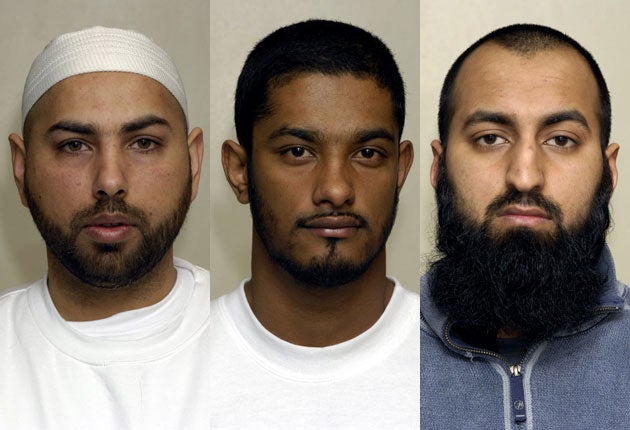
Three men were today cleared of helping the 7 July bombers plan their attacks by carrying out a reconnaissance mission in London.
But two of the men, Waheed Ali and Mohammed Shakil, were convicted of a second charge of conspiracy to attend a place used for terrorist training.
Ali, Shakil and Sadeer Saleem, who were being re-tried at Kingston Crown Court after an earlier jury failed to reach verdicts, were accused of visiting the London Eye, the Natural History Museum and the London Aquarium while pinpointing potential targets seven months before the 2005 atrocity.
But the jury found the trio, all from Beeston, Leeds, not guilty of conspiring with the four bombers and others unknown to cause explosions between 17 November, 2004 and 8 July, 2005, following the three-month long re-trial.
Ali, 25, Saleem, 28, and Shakil, 32, were the first people to face charges in connection with the attacks, which killed 52 people and injured up to a thousand more.
Suicide bombers Mohammed Siddique Khan, Shezhad Tanweer, Hasib Hussain and Jermaine Lindsay detonated rucksack devices packed with explosives on three tube trains and a bus.
The trial heard that the three defendants travelled from Leeds to London on 16 December 2004 with Hussain, who went on to detonate his bomb on the No 30 bus in Tavistock Square, claiming 13 lives.
There they met Jermaine Lindsay, who killed 26 people on a Piccadilly Line underground train.
The prosecution alleged they conducted a "hostile reconnaissance" of potential targets during a two-day visit, claiming it was "an important first step in what was, by then, a settled plan to cause explosions in the UK".
Detailed "cell site analysis" of mobile phone use, including calls to the London Tourist Board and various attractions, allowed the group's movements across London to be mapped.
The three defendants admitted making the visit but claimed it was an entirely innocent social outing and the purpose was for Ali to visit his sister.
They said they had used the opportunity to see some of the capital's landmarks at the same time.
What the jury did not know was that Ali was present when Khan and Tanweer held meetings with terrorist Omar Khyam, who is now serving a life sentence for heading a plot to blow up a nightclub or shopping centre with fertiliser bombs.
Security services, who were monitoring Khyam and his associates, secretly watched his meetings with the 7 July bombers and bugged conversations about plans to fight in Afghanistan on four occasions in early 2004.
They photographed the group, including Ali, meeting at a McDonald's car park and filmed them walking down a south London street.
The jury were not told Khyam's real identity and he was referred to as "Ausman" during the trial for fear of prejudicing the case.
Despite their links with Khyam, MI5 dismissed Khan and his group as "peripheral figures" and never fully investigated their activities, allowing them to slip through the net.
The three defendants, the court heard, grew up in the same tight-knit Asian community in Beeston as Khan, Tanweer and Hussain.
Much of their activities centred around the Iqra bookshop in Leeds of which Khan, Tanweer, Saleem and Ali were all trustees.
The court heard that between 2001 and the 7 July bombings, there were a number of trips organised to training camps in Pakistan.
Ali travelled with Khan in 2001, while Shakil joined him on another trip in 2003 where they met Khyam and trained in the use of light machine guns, rocket-propelled grenade launchers and AK47 assault rifles.
In November 2004 Khan and Tanweer left the UK expecting to "fight jihad" on the frontline in Afghanistan. Following a change of plan during this trip, the 7 July plot was hatched, jurors were told.
Before he left, Khan made a number of home video recordings, including a goodbye message for his baby daughter which was made public during the trial. In one clip he introduces her to her "uncle" Ali.
Following the 7 July attacks two address in Leeds - 18 Alexandra Grove and 111 Chapeltown Road - were identified as the locations where the majority of the bomb construction and preparation took place.
The DNA of Ali and Saleem was found on items at Alexandra Grove but both defendants said they had never been to either of the properties.
Police also found keys relating to Shakil's car, a Mitsubishi Carisma, at Alexandra Grove, jurors were told.
Ali and Shakil were arrested in March 2007 at Manchester Airport as they were about to board a flight to Pakistan. Saleem was detained at his home hours later.
Detectives, who had the pair under surveillance, had watched as they went shopping for outdoor equipment and had their hair cut short the day before.
The court heard when police seized their computers they found a variety of extremist material including images of the devastation wrought by 9/11 and a long tract glorifying in the achievement of those responsible.
All three defendants made no secret in court of their support for jihad and defending Muslim lands. But they claimed they did not advocate suicide bombings and had no idea about the 7 July plot.
Neither Ali or Shakil denied the intention to travel to Pakistan in 2007, but they insisted the visit had religious motivations, refuting those specified in the charge.
Bookmark popover
Removed from bookmarks