WI members taste life in UK's roughest jails
Concerned women go behind bars as part of their campaign to keep mental health sufferers out of custody
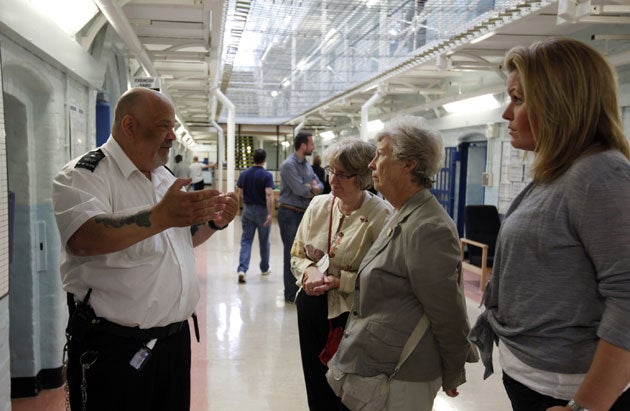
The women gathered outside Wandsworth don't look much like the wives and girlfriends usually seen at the gates of the country's biggest prison. While their ages range from 25 to 65, they all look very, well, wholesome. Standing under the imposing barbed-wire-topped walls – which the train robber Ronnie Biggs famously scaled back in 1965 – is a clutch of Women's Institute members, who are about to find out all about life on the inside. It is a long way from jam and "Jerusalem".
A few minutes and numerous security checks later, and the WI members are whisked out of the summer sunshine and on to the stark corridors of "E" wing, where they struggle to be heard over the endless slamming of heavy metal doors. The Victorian institution was designed so that, in an emergency, the sound of a guard's whistle would travel the length of the corridors; and, boy, does the sound of 1,661 prisoners carry. Noise is not the only thing to travel along the wing: it is lunchtime when we arrive, and the unmistakable smell of institutional food wafts down the hall.
None of the women has set foot in a prison before, but they are impressively unfazed and sit happily in claustrophobic cells, mingling calmly with tracksuit-clad prisoners and heavily tattooed guards.
"It is important that people get inside prisons and see what is going on," says Pam Knott. The pensioner is a representative of the Essex branch of the WI. "The Women's Institute care about their communities, and prisons are a part of those communities."
For the past six months members of the WI have been rubbing shoulders with convicts in some of the nation's roughest prisons, in an attempt to find out what services are available to inmates with mental health issues. The investigation is part of their ongoing "Care Not Custody" campaign, which is calling for an end to the inappropriate detention of people with mental health problems.
The women's visit to Wandsworth is timely: the night before, an inmate with mental health issues poured a kettle of scalding water over his head, and was rushed to hospital with terrible burns as a result. Such incidents are not uncommon: it is estimated that 70 per cent of Wandsworth's inhabitants have mental health problems, and last month a 25-year-old prisoner was found dead after hanging himself in his cell. However, the prison's psychiatric wing has just 12 beds.
"Prison can be very stressful," says Michael (not his real name), an inmate. "I am three years into a 10-year sentence for dealing cocaine. I'm doing an IT course, which helps. It is five days a week and it gives me something to aim towards, gets me out of my cell, and might help me secure my future."
Clive Harlow, a prison guard, says: "The early period in custody can be incredibly traumatic, and the first few days in custody are when people are at greatest risk of suicide. Inmates with mental health problems can get very aggressive and confrontational. One of our inmates gets really frustrated when he doesn't have cigarettes and starts cutting himself."
While not quite as sexy as Hampshire WI's recent call for the legalisation of brothels, with their latest campaign the national organisation is tackling not one but two taboo subjects: mental illness and prisons. The investigation is a topical one. In April, Lord Bradley, a former Home Office minister, published a report which found that too many offenders with mental health difficulties and learning disabilities are ending up in prison without access to treatment. The WI is keen to see greater funding for alternative custodial schemes for mentally ill offenders.
"These visits mean that now we know what we are up against," says Ruth Bond, chair of the WI. "The campaign stems from the fact that one member's son was convicted, not sent to the right place, and ended up committing suicide. The issue captured the women's imaginations."
The Prison Service is now the second biggest provider of mental healthcare in the country, after the NHS. It is estimated that more than two-thirds of the country's 83,611 prison inmates have two or more mental health problems, ranging from schizophrenia to depression and anxiety.
Jazz Domino-Holly, 25, London: 'I want to see what we can do'
This visit was quite personal for me, as my uncle was a schizophrenic who was imprisoned and killed himself while in custody. It is a sensitive issue for my family, so they don't talk about it much. I really want to see what can be done for people who get put in this position. I'm also interested in ways that nutrition and alternatives to traditional treatment can be used to help people with mental health problems. I'm a member of the Shoreditch Sisters WI group. While our group is primarily craft-based – we are interested in reclaiming the traditional crafts done by the WI – we are also interested in the campaigns. We worked on the violence against women campaign, and it is great to get to go into prisons on this one. It is the only chance a lot of women will get, unless they are convicted of something.
Bookmark popover
Removed from bookmarks