A royal welcome for the £50bn Emir buying Britain brick by brick
First Harrods. Then the US embassy. What's next for Qatar's monarch?
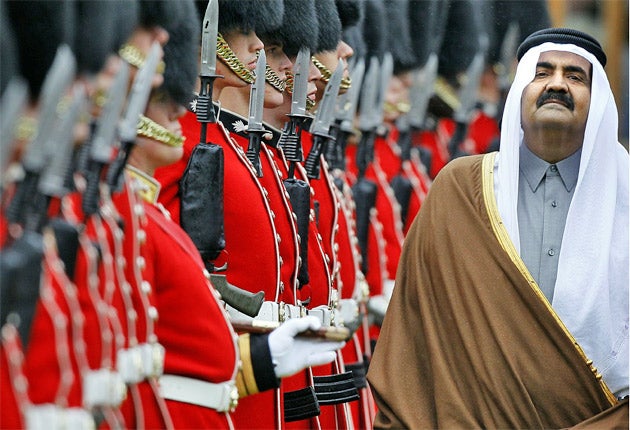
"Thank you for reminding me about Christie's," one of the world's richest monarchs, the Emir of Qatar, said casually on the eve of his state visit to Britain, which began yesterday with a spectacular horse-drawn carriage procession to Windsor Castle.
It is easy to forget about something as trivial as buying one of the world's top auction houses when you have an investment portfolio as big as that of Sheikh Hamad bin Khalifa al-Thani. The Qatari monarch, who owns one third of the world's natural gas reserves, is five times richer than the Queen. In recent times he has been using considerable quantities of that wealth to buy up trophy assets in London. Christie's – if he does decide to buy it – will be added to Harrods, the US embassy building in Grosvenor Square and the capital's most expensive property development, One Hyde Park in Knightsbridge. The Emir acquired the Chelsea Barracks site for a record-breaking price and also owns considerable chunks of Barclays, Sainsburys and Canary Wharf.
But if Sheikh Hamad is the most aggressive and adventurous buyer of British property, he is far from alone. Arabs, primarily from the Gulf states, have tripled their share of investment in UK commercial property in the past five years. Last year they spent £1.48 bn – representing 16 per cent of all foreign investment in the sector.
The most prolific Gulf shoppers are:
* Prince Alwaleed bin Talal of the Saudi royal family, who owns the Savoy Hotel, which reopened last week after a three-year, £220m refurbishment.
* The Abu Dhabi royal family, directly or indirectly, are believed now to own Berkeley Square, and the ExCel exhibition centre in the Royal Docks, and to have recently spent £640m on three blocks in Knightsbridge.
* Sheikh Mansour bin Zayed al-Nahyan of the Abu Dhabi United Group, who last year bought Manchester City for £210m. His fresh investment in the club has reached £570m. He can afford it. Around the same time as he bought the club he purchased £2.2bn-worth of Barclays Bank, and spent £1.7bn acquiring a 9.1 per cent stake in Daimler.
Investors from the Gulf states have been among the most prolific deal-makers in recent years. British household names like Madame Tussauds, Aston Martin and the hotel chain Travelodge are now in their hands.
So many billions have been splashed around that whenever another trophy asset comes up for sale – or even when one is rumoured, in the case of football clubs – shadowy sheikhs are perceived to be hovering in the background.
The emir of Qatar, and his £54bn sovereign wealth fund, were said to be behind a takeover bid for Everton FC last year. Another Saudi royal, Prince Faisal bin Abdullah, was linked with Liverpool. And various Gulf royal families and sovereign wealth funds from Dubai, Abu Dhabi and Kuwait were said to have made an offer for Manchester United earlier this year. Dubai International Capital has tried to buy both Liverpool and Newcastle United.
Behind all this activity lie three factors. Over the past two years oil prices have doubled, bolstering the fabled wealth of Arab families and states.
At the same time, since the global financial crisis, there have been sharp falls in the price of British property and companies. Britain looks a good place to invest, given its low tax rates, its expertise in financial services and its handy time zone, midway between the Middle East and the US. The British horse-racing summer season, from the Derby to Royal Ascot, panders to an Arab obsession and takes place when the Gulf sun is at its unpleasant hottest.
More than that, as the third factor, oil-rich investors have learned from their earlier mistakes. In the past they did not diversify their national and household economies sufficiently, and found themselves at the mercy of wild fluctuations in oil price. Even Qatar was almost bankrupted. They have not focused only on Britain. The emir of Qatar last year ploughed £6.3bn into Volkswagen and Porsche. He reopened another grand hotel, the iconic Le Royal Monceau in Paris, last week. He has just bought the historic Raffles Hotel in Singapore, famed for its colonial grandeur and the Singapore Sling cocktail. The Emir says that his various funds invest "everywhere" – with a £3.2bn real-estate for energy deal with Malaysia, a £632m joint venture with Indonesia and a £1.7bn investment in the Brazilian arm of the Santander banking group. "We are investing in a big deal with China, with India, Taiwan and Japan," he said recently. "Actually we are going anywhere anybody has good projects and approaches us... We are trying to create a Qatari standard: you win, we win, and we go for the long term." London is particularly attractive to Arab investors because of sterling's slide against the US dollar. So it has become the prime target for the investments the oil sheikhs know their children will need to sustain their lifestyles when the oil runs out in decades.
"Real estate in London may get sick but it doesn't die," said the Emir. One of those who manage his funds, Stephen Barter, chief executive of the UK office of Qatari Diar, said: "There is no shortage of opportunities. The objective is to invest smart money. The UK is attractive and probably over the worst of the downturn."
London is bucking the trend on a falling pattern of foreign direct investment elsewhere in Europe, with US, China and India also investing big in the UK capital. The same is not true of many other British cities. The recession is widening the gap between the capital and cities like Belfast, Liverpool and Sheffield, which are now among the least-favoured places in Europe to invest in property, though places like Manchester are surviving, and not just because of Sheikh Mansour's purchase of the city's second football club.
Even so, the British Government is pleased with the development. Expanding UK business and political ties with the Gulf states was an early priority set out by the Coalition government. Qatar invested more than £2bn in Britain last year, and ministers hope to persuade Arabs to buy more here to help an export-led recovery. They also hope that this week's state visit will bring more secure energy supplies to the UK. Qatar helped rescue Britain from energy shortages during last winter's exceptional cold by supplying more than 10 per cent of the country's gas needs.
Ministers also see the tiny Gulf state as having a strategic role in bringing peace to the Middle East. The Emir, 58 and educated at Sandhurst, has built a reputation as a canny statesman, maintaining good relations with the US, which has bases in Qatar, and with Israel – but also with Iran and Syria. He is even trusted by the Palestinian Hamas and Lebanese Hizbollah groups. As a mediator he has already played a key role in bringing Lebanon back from the brink of civil war.
A decade ago he also launched the Arabic television station Al Jazeera, which has brought much freer speech to the Arab world, and annoyed the Americans in equal measure.
As he buys up great swathes of London it is not hard to see why everyone is comparatively relaxed about the idea.
Emir by numbers
£50bn The current value of his sovereign wealth fund.
£1.5bn The Emir's personal fortune.
£37.4m The value of the mansion he owns on Park Lane in London.
436ft The length of his super yacht, the 'Al Mirqab'.
Join our commenting forum
Join thought-provoking conversations, follow other Independent readers and see their replies
Comments