Afghan war is bad for security, voters say
<i>Independent</i> poll casts doubt on key justification for Britain's involvement in conflict
The main justification offered by the Government for keeping troops in Afghanistan is rejected by the majority of British people, a new opinion poll for The Independent shows today. Four out of five of those questioned do not believe that British involvement in the conflict, with its rising toll of casualties, is keeping the streets of Britain safe from terrorist attacks.
The findings come as senior commanders have begun warning that the next few months will see intensifying military action, and that British forces will be expected to play a full part. There is no question of British troops "retreating to safer areas", senior Nato officials stressed.
In direct contradiction of the Government's position, almost half, or 46 per cent, of those surveyed held that the presence of British forces in the US-led war actually increased the threat of attacks in the country by creating anger and resentment among the Muslim population.
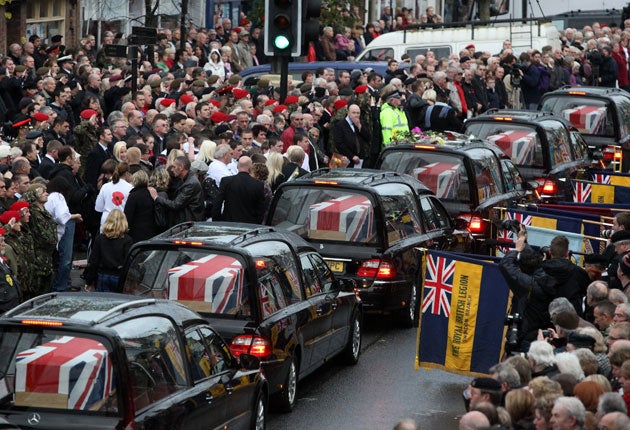
The findings of the survey, by GFK NOP and commissioned by Colin Francome, Emeritus Professor at Middlesex University, will intensify the political dilemma facing Gordon Brown. Yesterday was a day of deep emotion with the return of the bodies of six fallen soldiers, but the Prime Minister must now also contend with the risk of mounting anger if the core argument for continuing the deployment of British forces eight years after the overthrow of the Taliban lacks conviction for the public.
The Prime Minister, who has been subjected to personal attacks over misspellings in a letter of condolence written to the mother of a dead soldier, faced rebellion over the direction of the war from within his own party. A former minister, Frank Field, will today seek an early House of Commons debate on Afghanistan. Mr Field who has the backing of 19 Labour MPs, says that the debate should cover the UK's role, the objectives of the intervention and "the time scale over which these goals will be achieved".
Although the Government says it is committed to "staying the course" in Afghanistan, Mr Brown signalled yesterday that plans were being drawn up to hand control over a significant part of Helmand province to Afghan forces from mid-2010. British troops aim to transfer authority "district by district" as the Afghan army and police forces are trained and local government structures put in place. "We think that, by mid-next year, probably two parts of Helmand can be transferred from our responsibility," Mr Brown said.
But in Kabul, Brigadier General Eric Tremblay, a Canadian officer in the International Security Assistance Force, said the south of Afghanistan would remain the focus for the Nato campaign. "No one is pulling out and we continue with our military strategy. In fact towns like Musa Qala are the sort of population centres which we are protecting and where we need security to grow, and British troops will, of course, play a crucial part in that." He said 68 per cent of violent incidents occurred in Helmand and Kandahar and so the region is obviously of key importance.
Separately, a senior American officer who played a key role in the plans drawn up for a military "surge" by General Stanley McChrystal, the US commander of Nato forces, said British operations in Helmand would continue. "Forces like the British in Helmand and the Canadians in Kandahar are needed for combat. Getting involved in operations means there will be more casualties. That applies to all of us."
The Prime Minister's official spokesman said the transfer Mr Brown referred to would "not necessarily" mean British troops coming home, suggesting the initial plan would mean UK forces withdrawing to an oversight role in areas handed over to the Afghans.
Public disillusionment with the war has been reinforced by the massive fraud which characterised the recent elections in Afghanistan. Questions are being asked in all the countries supplying troops for the Nato mission as to why soldiers should die for the government of Hamid Karzai which has been internationally labelled corrupt.
Britain with its force of 9,100 is the second-biggest contributor after the US to Nato's Afghan mission, and Mr Brown has already pledged to send reinforcements of another 500 troops.
Brigadier General Tremblay said that instead of the scale of the combat diminishing, the Taliban are trying to open up other fronts around the country. One of the most senior commanders in the British forces also told The Independent that there would be no withdrawal from the town of Musa Qala, which gained iconic significance after being retaken by British forces from the Taliban. "Even if we planned to do this, it simply would not be politically acceptable because of the sacrifices which have been made there," he said.
Join our commenting forum
Join thought-provoking conversations, follow other Independent readers and see their replies
Comments
Bookmark popover
Removed from bookmarks