Ancient royal tomb found in Scotland
Archaeologists stunned as dig unearths 4,000-year-old burial treasures unrivalled anywhere in Britain
Hidden beneath a four-ton slab of rock and surrounded by ancient carved symbols of prehistoric power, a spectacular high-status potentially royal tomb, dating back 4,000 years, has been discovered by archaeologists in Scotland.
The find – of international importance – is unique in Britain. The excavations at Forteviot, near Perth, have yielded the remains of an early Bronze Age ruler buried on a bed of white quartz pebbles and birch bark with at least a dozen personal possessions – including a bronze and gold dagger, a bronze knife, a wooden bowl and a leather bag.
The discovery has huge implications for Scottish history. Forteviot has long been known to have been a great royal centre in the early medieval period. It was a "capital" of a Pictish Kingdom in the 8/9th century AD – and one of Scotland's earliest kings, Kenneth MacAlpin, is said to have had a palace there.
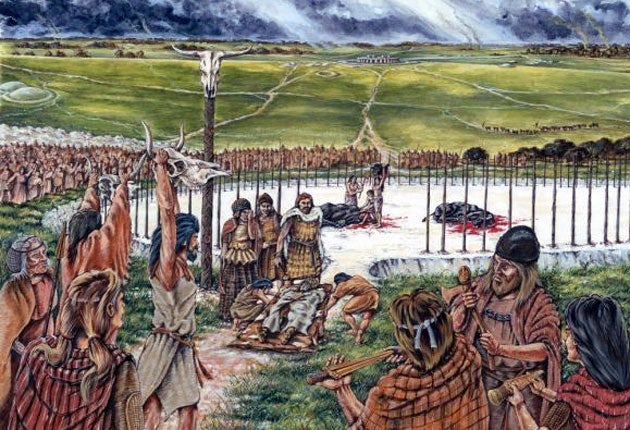
But up until now nobody suspected that Forteviot's royal roots might be thousands of years older. The newly discovered prehistoric tomb is of particular importance because it lies at the very heart of Scotland's largest pre-historic ritual/religious ceremonial complex. The excavations are now revealing that back in around 2600 BC, local Neolithic people constructed a giant 250m diameter circle of 200 timber obelisks with a ceremonial processional way leading to its entrance and an inner timber circle at its centre. Each oak obelisk was up to a metre in diameter. Then, by 2400BC, a massive earthwork enclosure with a 10m wide, 3m deep moat was built inside that inner timber circle.
At roughly the same time two other similar earthwork enclosures – "henges" – were built, north of the large timber circle. And finally in around 2000BC the tomb was built underground in what was probably the most prestigious location – immediately opposite the entrance to the henge at the centre of the entire complex.
Uniquely, the tomb's stone wall, at the head end of the grave, was decorated with carvings of two bronze axes. What's more, the tomb's great 2m by 2m, four-ton stone roof was decorated with a much older carving of a probable Neolithic stone battle axe or ceremonial mace head – a fact which suggests that it was removed from an older monument specifically for use in this ultra-high-status prehistoric tomb.
The use of white quartz pebbles and white birch bark as bedding for the dead man may well have been seen as a way of helping to guarantee rebirth in the next world.
The excavation is being directed by Professor Stephen Driscoll and Dr Kenneth Brophy of the University of Glasgow and Dr Gordon Noble of the University of Aberdeen.
"The sheer size of the stone slabs used to construct the tomb, the extremely rare rock engraving, the rare preservation of the leather, wood and bark items and the high status location make this a find of both national and international importance," said prehistorian Dr Noble.
"In terms of preservation, location and scale, this tomb is unparalleled in Britain," he said.
The excavation is continuing on site – and in Edinburgh where archaeologists are examining large blocks of excavated earth from the tomb under laboratory conditions.
2000BC: A snapshot of prehistoric Britain...
*In 2000BC Stonehenge was in its heyday as a ritual centre.
*Society in Britain was becoming more hierarchical and the change brought a greater concentration of power in the hands of fewer people.
*It is likely that during this time Silbury Hill in Wiltshire, the world's greatest ancient man-made mound, was undergoing expansion to make it even more impressive.
*Gold extraction was in full swing in Ireland – much of it was being sent to Britain. Simultaneously there was a big increase in bronze production in Britain.
*Continental influence was increasing substantially in southern Britain.
... while in Egypt
*Ancient Egyptian civilisation was more than 1,000 years old by the time the Forteviot burial took place in Scotland.
*By 2000BC the Great Pyramid at Giza was, at more than 500 years old, already an ancient structure. The other great pyramids were completed by 2150BC.
*The world's first calendar, based on the timings of the Nile floods, had been used by Egyptians for more than 1,000 years. It split the year into 12 months and 365 days.
*Hieroglyphic writing had been developed at least 1,300 years earlier and by 2000BC ancient Egyptians used 800 different symbols.
*The successful mummification of bodies had been carried out for more than 500 years.
*The first Book of the Dead texts had been created to describe the Ancient Egyptian concept of the afterlife and to provide instructions on how the deceased could overcome obstacles to reach it.
View all comments that have been posted about this article.
Offensive or abusive comments will be removed and your IP logged and may be used to prevent further submission. In submitting a comment to the site, you agree to be bound by the Independent Minds Terms of Service.
- Print Article
- Email Article
-
Click here for copyright permissions
Copyright 2009 Independent News and Media Limited


Comments
Are you suggesting that there were humans on earth 300 million years ago?
http://paleo.cc/paluxy/hammer.htm
The serpent is another one pops up everywhere in every age on every continent
Scotland was not Scotland when Skara Brae was constructed, there were no Scots....to claim that the Scottish (who, if you know anything about ancient british history, came for Ireland) built the highly impressive Skara Brae, is akin to claiming that the English built Stone Henge!!
Oh, as for there being picnics in the Paleozoic? I hear the Eifell tower's for sale; get in touch, I can get you a great deal for cash.
Why the Egyptian timeline was deemed relevant to this find is beyond me. A short statement that this was post pyramid era would have sufficed to place it in perspective but even that was not needed. What was happening in the Isles at that time was separate from development anywhere else. They had to start from scratch. Mesopotamia, Egypt, Babylon followed in the footsteps of Ur, or so some have claimed and some 100,000 stone tablets purported to be from a library of sorts in Ur supposedly tell the stories which the Quoran, Bible, Torah and basically, all religions were derived along with a history of man and civilization going back thousands of years and supposedly copied from more ancient texts. None of which seems to be able to be verified except through the authors.
Since it's evident that the further back you go in time, the more advanced his knowledge, it's very possible that there were more advanced civilisations prior to Egypt and Sumeria, possibly prior to the last ice age, but owing to the eons of time, practically everything has been eroded away.
Maybe, just maybe, something will be found to turn history upside down.
http://en.wikipedia.org/wiki/Radiocarbo
Pyramids were built with concrete:
www.timesonline.co.uk/tol/news/world/eur
Also,
A linear approach, based on Physics(Astronomic dating) & Maths(Topological textual-analysis):
http://books.google.com/books?q=fom
If the great migration to North America took place 10,000 years ago via the Bering Bridge, then how did the "Kenniwick' man, a European get to the state of Washington. And what of the European "Red Paint" people of Maine? And the 13, 00 year old buildings in South America. One one hand the tell us that men of 100,000 years ago were just as smart as we are today. Then they say that they lived in caves, yet
know nothing of what happened 5,000 years ago! Earlier civilizations could have just as easily gone to
the moon, Mars, etc. And why not? Because it goes beyond conventional thought? As it has been said,
"think outside of the box".
Craig
(charges of racism are often levelled at anyone who mentions this stuff, but that would mean that the maori elders themselves are racist too, becuz this stuff is in their legends, and i am sure that the elders believe it is true. I think its racist to say the elders and nz legends are wrong, when it looks like there is evidence to back it up, personally.)
QUOTE BELOW:
In 2004, Member of Parliament, the Hon. Chris Carter, was asked, under an “official information” request, how many archaeological “embargoes” were presently in place. He forwarded a written response that there were 105 current embargoes, mostly concerning burial sites. It was stated that “DOC administers the New Zealand Archaeological Associations Central file ...of which, 105 ... were classified as sensitive records”. The response stated: “File keepers may create sensitive files ....if this is requested by the site recorder...”
One of these embargos of recent years included a 75-year suppression of information related to a cache of large stature skeletons at Waikaretu, 12-miles SSE of Port Waikato. The very tall people (measured to be 7-feet or more) were laid out on cut shelves in a cavern, which was exposed during road widening excavations. Anthropologists from Auckland and Waikato Universities were called in and, to the dismay and disgust of the roading contractors, they slapped a moratorium over the find, requiring that it be kept secret from the New Zealand public. Maurice Tyson of Tuakau, a contractor in the area for 50 years, recalls how this upset the men who had discovered the cave. They could not understand why such a valuable, history-changing, archaeological site should be kept secret. In 1988, archaeologist, Michael Taylor slapped an embargo on any release of information concerning the ancient, stacked stone structures in the Waipoua Forest, but that embargo was partially broken by a private citizen’s legal challenge after 8-years.
Original Post is http://www.abovetopsecret.com/forum/thr
1) Michael A. Cremo's books which prove many unexplainable artifacts suppressed and ignored
http://www.amazon.com/Michael-A.-Cr
2) Lloyd Pye, humanities genetic inheritance record misconstrued -
http://www.amazon.com/Lloyd-Pye/e/B001J
http://www.youtube.com/user/OfficialLlo
3) Michael Tellinger - Adam's calendar - 75,000 year old "henge" in South Africa
http://www.amazon.com/s/ref=nb_ss_0_9?u
4) Zecharia Sitchin proof that the Sumerian culture which officially came instantly from the human stone age to the pinnacle of classical human society, had its origins in extraterrestrial contact and intervention
http://www.amazon.com/Zecharia-Sitc
None of these facts are "comfortable" for either the religious or the academic establishment and they will never admit to the truth, in my personal view, for them these alternative views undermine their influence and control over society.
Keep an open mind, read, investigate and consider before you make up your own mind.
Something here to offend nearly everyone ..
1) Acharya S is the pen name of D. M. Murdock - The Christ Conspiracy: The Greatest Story Ever Sold
http://www.amazon.com/Acharya-S/e/B001U
2) Zeitgeist the Movie
http://www.zeitgeistmovie.com/
Pushes those Christian "hot buttons" like nothing else
3) David Livingstone - Terrorism and the Illuminati: A Three Thousand Year History
http://www.terrorism-illuminati.com/con
Online book also documents how Christianisty developed out of mithraism; a scholarly mini-tome.
4) Barry Chamish -debunking Israel's current leadership
http://www.amazon.com/Barry-Chamish/e/B
Nothing really good and concise yet on debunking the ancient religion of Judaism - nothing that clearly enough lays out how the Sumerian's and the Egyptians created the fiction of the ancient Hebrew people and got that all started.
I'll take a pass on equally offending Moslems at the moment. But if your looking for a really good religion, in harmony with our times and world environment check out Jainism, except the nudity part.
First off, I like to ask why the subhead "English Heritage" is so prominently displayed with this story? I see no reference to England or the English in this article.
Secondly, I'd like to ask if there is any credibility whatever in suggesting that the Egyptians authored the "first" calendar? (I believe it's utterly dicey for any author or archaeologist to use the word "first" with respect to a find or human construct without appending the word "known"... as in "first-known.") And in the case of the Egyptians and calendars, I don't even believe that's true.
Third - there are seemingly some interesting parallels here with votive burials from various other Irish/UK sites through the millenia (ie. Lindow Man). Sometimes great ceremony and effort went into creating burial circumstances for an individual not because the person was so great (which he/she may also be), but because the death's occurrence and accompanying rituals were in propitiation against a natural circumstance: a plague, crop die-off, weather disaster, volcanic sun-blocking, tsunami or other cataclysm. I would (as some other posters) like to see a link to the researchers' own work, journal articles, photos of artifacts, site surveys, etc. Volcanic eruptions from Iceland and elsewhere, for instance, caused abrupt shifts in weather patterns between 8000 and 1000 BCE, and rapidly rising sea levels (and tsunamis) that must have absolutely unnerved people... as well as made life very, very hard for several generations in a row.
And lastly, the trade in gold and tin-for-bronze from Scotland/Ireland/Britain/Cornwall was not only to a domestic market in 2000-1500 BCE but also was highly stimulated by Phoenician traders making regular visits to both Ireland and several stops in Anglia/Pictish Alba or whatever else it might have been called at the times.
These people were not isolated hicks - no matter who is interpreting the "history." Set upon by frequent traumatic circumstances, they managed to keep recovering fairly well while sometimes being forced to turn upon one another when circumstances reduced food resources to almost zero. And, as another poster said, they nonetheless kept alive a spiritual culture of sophisticated monuments and calendrical/sun-following megaliths that still awe us... those which were not made of perishable wood and have utterly disappeared, that is.
Michael Cerulli Billingsley
Irish Spiritual Heritage Association