Blackpool uneasy at prospect of 'fracking' boom on its coastline
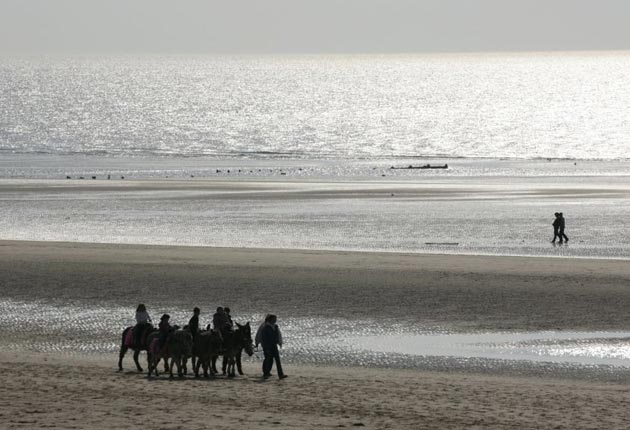
The allure of Blackpool rock and the rejuvenating effects of its sand and water once made it a magnet for the toiling classes as they took a break from the drudgery of the Lancashire cotton mills.
Click here to upload the graphic - How Hydraulic Fracturing Works (72.65kb)
Today, as the resort battles to cope with the allure of cheap flights to Spain, those three elements are once again attracting outsiders to this part of the English coast in search of a fourth: gas.
Cuadrilla Resources, a British company specialising in the development of shale gas wells, has been hard at work in the resort's rural hinterland since August last year after being given permission by the Government.
Whitehall is due to hold a new round of licensing for shale drilling at the end of the year. So far two wells have been sunk. The first at Preese Hall and the second at the village of Singleton in the picturesque Fylde countryside, an area until now best known for its bracing sea walks and world-class links courses.
The first drill has already penetrated 7,500ft down into the Bowland shale and fracking – the process of releasing natural gas from the sedimentary rock by blasting it with water, sand and chemicals – is already under way.
A third site is expected to be opened this summer and the company has permission to probe another three nearby, before beginning explorations in the Netherlands and Poland.
But following claims over the safety of the process in the United States, some locals are concerned, with councillors petitioned to object. Blackpool's Green Party chairman Philip Mitchell said an industry was being introduced without adequate investigation by the authorities.
"The potential is catastrophic," he said. "We don't know the science of this or how it will affect people. We are introducing something that we do not know the full dangers of."
Greens claim that there is the risk of explosive well blow-outs, fire, traffic disruption and noise. They fear that, so significant are the deposits and so huge the rewards, the industry could be on the verge of major expansion not just across Lancashire but the whole of the UK.
To add to the sense of unease this week, France's National Assembly voted to ban the process after a sustained protest by green groups. The Senate is expected to follow suit next month making France the first country to ban fracking. (French environmentalists are furious though that a last-minute deal means that research employing the technique will continue.)
Cuadrilla Resources, currently the only holder of a UK fracking licence, believes the process is entirely safe. At present operations are regulated by the Department of Energy and Climate Change (DECC) as well as the Environment Agency. The official line is that no one knows how much gas is there until the exploratory phase is completed nor how much it will cost to recover.
In the meantime the company has been conducting a charm offensive inviting local people, journalists and MPs to tour the site. This week the chief executive Mark Miller, from Pennsylvania, compared modern drilling technology to keyhole surgery. He said a dozen wells could be drilled on an area the size of a football pitch with each site capable of feeding gas into a generator capable of producing 100 megawatts of local electricity for the next 30 years.
"We have shown many people around our first shale gas wells in Lancashire and most people comment how quiet and low-profile they are. They make little impact on the surrounding countryside and will hopefully fulfill a useful local function," he said.
A DECC spokesman said: "We support industry's endeavours in pursuing such energy sources so long as tapping of such resources proves to be economically, commercially and environmentally viable. All onshore oil and gas projects, including shale gas exploration and development, are subject to a series of checks, including local planning permission, before they are able to move ahead with drilling activities."
How Hydraulic Fracturing Works
Fracking, or chemical fracturing, is the process by which water, sand and chemicals are used to increase the quantity of gas that can be extracted from the ground.
The mixture is pumped at high pressure into natural gas or methane gas fields, cracking open the rock deep beneath the surface to release trapped reserves.
Gas then flows out of the fissures, which are kept open by the sand and chemicals, and into pipes that lead to the surface.
Drilling companies claim that chemical additives make up less than one per cent of the liquid poured into the gas field. However, the quantities involved are so large that a typical well is likely to pump about 34,000 gallons of chemicals into the ground.
One of the chemicals used is diesel, which contains toxic substances. Other chemicals used can include hydrochloric acid, formaldehyde and arsenic.
Lewis Smith
Join our commenting forum
Join thought-provoking conversations, follow other Independent readers and see their replies
Comments