Broke Britain 'can no longer afford role in Afghanistan'
Cash, not casualties, could be the factor that finally forces a scaling down of military commitment
British soldiers in Afghanistan are "horribly over-extended" and being killed for "no good reason", a senior military figure admitted last night. He said talks are now under way with US commanders that would pave the way for Britain to begin scaling down its commitment to the war, bringing about a change of emphasis in its deployment.
Britain's 10,000-strong force is suffering "appalling" casualty rates and is set to be given a break from the worst of the fighting, according to the source. "The Americans know the Brits have been giving more than they can afford, and agree that they should be kept out of harm's way as far as possible. But McChrystal [the American commander of international forces in Afghanistan] is keen to have the input of some ground troops and special forces," the source said. "Essentially, the Americans know we are broke and we are getting blokes killed for no good reason. Whatever the MoD says, it absolutely isn't business as usual."
He added: "The problem is that the Afghan troops are not yet ready to take over, and training them up is not something the Afghan government can afford." And the reputation of British forces is suffering. The source told the IoS that one senior figure in the International Security Assistance Force (Isaf) had commented recently: "There is no point in sending British troops into places where they need helicopters, because they ain't got 'em."
With the Ministry of Defence facing a £36bn budget black hole over the next decade and savage cuts likely under the defence review, politicians are warning that the war has become financially untenable.
"It is unsustainable for this number of troops to be in Afghanistan and Pakistan for an indefinite period. The forces just aren't large enough, and I know the Secretary of State for Defence is more than aware of this," said the Conservative MP Patrick Mercer.
So far this year, 41 British soldiers have been killed in action and 137 seriously wounded, with hundreds more admitted to hospital.
The US will continue to take on the bulk of the burden in Afghanistan, and the next few months will be a tipping point. Fighting is set to intensify as coalition forces try to retake the Taliban stronghold of Kandahar in what commanders are calling the "most difficult and most important" operation since the war began. Their success, or failure, will be crucial in determining whether President Barack Obama carries out his stated intention of reducing US forces from 2011.
Yesterday insurgents made their third major attack on Nato forces within six days, firing at least five rockets into Kandahar air base and launching a ground assault – a rarely employed tactic – on the perimeter fence. Firing continued for several hours.
On Tuesday, a suicide bomber attacked a Nato convoy in Kabul, killing six soldiers, and on Wednesday dozens of Taliban militants, some clad in suicide vests, sustained an assault upon Bagram airfield, the main US base in Afghanistan, for eight hours.
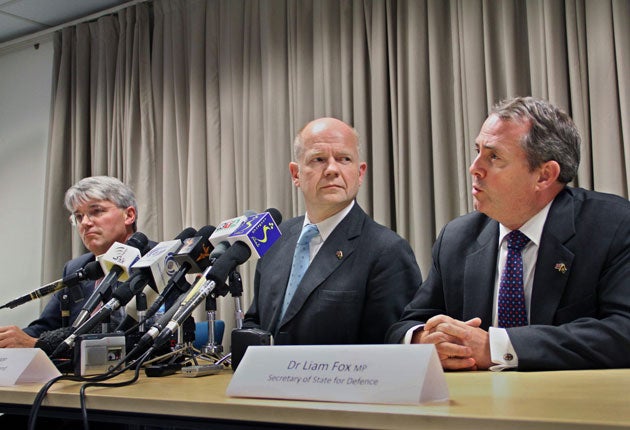
A shift in UK government policy was outlined by Liam Fox, the Defence Secretary, on Friday, when he said that Britain was not a "global policeman", that he would like to see troops return "as soon as possible", and that Britain needs to "reset expectations and timelines". He added: "We are not in Afghanistan for the sake of the education policy of a broken, 13th-century country. We are there to see our global interests are not threatened."
The comments are a clear statement of intent, according to General Sir Hugh Beach, former deputy commander of British land forces. "Words like 'timelines' and 'expectations' – if that isn't a clear message that we're planning to get out early then I don't know what would be."
Lord Bramall, a former chief of the defence staff, said: "I think it is the beginning of the end, but it is a question of how long it takes. The Americans are talking about a review and a possible run-down in about a year. If they start withdrawing, we'll consider we're in the clear to do the same."
But it is premature to talk about withdrawal until there is military success, according to Colonel Bob Stewart. "Once we have mastery of the situation, then we can start thinking about an endgame, but we're not there yet."
Mr Fox, William Hague, the Foreign Secretary, and Andrew Mitchell, the International Development Secretary, arrived in Afghanistan yesterday for talks with Hamid Karzai, the Afghan President, and General Stanley McChrystal.
Speaking yesterday, Mr Fox clarified his earlier remarks: "What I was pointing out is that the primary reason for sending our armed forces to Afghanistan was one of national security... But, clearly, if we are to make the long-term gains that will provide the stability to maintain the momentum when our armed forces eventually hand over to Afghan forces, we will require a long period of development in concert with the international authorities, the NGOs and our and other countries' aid programmes." He refused to set a timescale, but added: "When you're looking at one of the poorest countries in the world, the help it will require will be over a very long period indeed."
Tension is rising in Afghanistan, with the Taliban stepping up its actions as summer approaches, when fighting reaches its peak. Yesterday Afghan police uncovered a cache of almost 300 rockets outside Kabul.
While military success in Afghanistan remains in the balance, neither Britain nor the US is in control of the two key factors on which ultimate success rests: a reduction in the corruption that plagues President Karzai's regime, and the country's ability to sustain the hundreds of thousands of police and soldiers that will be needed to secure its stability.
Killed in action: 286th British soldier dies in Afghanistan
The latest British soldier killed in action in Afghanistan was last night named as Corporal Stephen Walker. Cpl Walker, 42, was serving with 40 Commando Royal Marines. He was killed on Friday by an explosion while on a foot patrol with the Afghan National Army in Sangin, Helmand province. Cpl Walker, from Exmouth, leaves a wife, a son and a daughter. His wife, Leona, said in a statement: "Steve was passionate, loyal and determined. He enjoyed the role he had in the Marines but he was a family man at heart. Life goes on, but it will never be the same for us." He is the 286th British soldier to have died since the war began in 2001.
Join our commenting forum
Join thought-provoking conversations, follow other Independent readers and see their replies
Comments