City pay culture has spread to charities, union says
Research shows that more than 50 bosses earn in excess of £100,000
PA
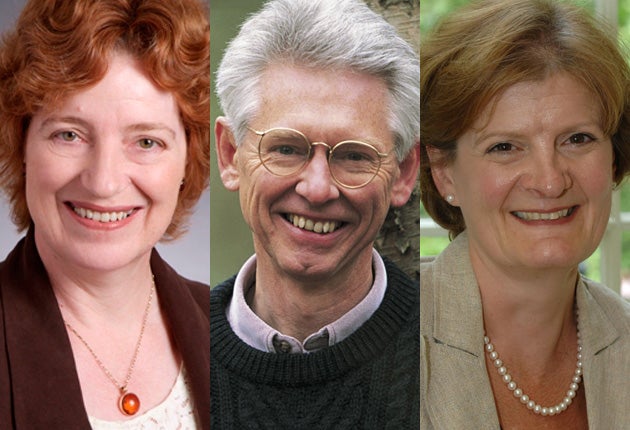
l-r Deborah Shackleton of Riverside Housing Group, Graham Wynne of the RPSB, and Fiona Reynolds of the National Trust
The leaders of Britain's charities face accusations that their six-figure pay packets are excessive and part of a culture of greed polluting the voluntary sector.
Research seen by The Independent shows that more than 50 charity chief executives received between £100,000 and £210,000 last year. In one case, a charity paid its chief executive nearly £400,000.
Unite, the union which represents 60,000 charity workers, said too many charity bosses were paying themselves more than the Prime Minister's salary of £197,000.
Rachael Maskell, Unite's national officer for the not-for-profit sector, said: "The excessive City pay culture is seeping into the remuneration packages of charity bosses and should be curbed. This is to be deplored, as it corrupts the ethos of the voluntary sector and is an insult to those, often on average incomes, who donate to charity.
"I think the general public will be shocked by the scale of the packages that some executives are being awarded. This sector is losing its sense of what real value is."
But Unite's attack on charity pay immediately drew a fierce response from the organisation representing charity chief executives.
Stephen Bubb, chief executive of the Association of Chief Executives of Voluntary Organisations (ACEVO), accused the union of gross hypocrisy over the issue of pay. He said: "We were not surprised to see that the joint general secretaries of Unite earn a combined package of £308,000. They are running a complex organisation with millions of members and a broad range of stakeholders, just like other third-sector leaders.
"To mention third-sector CEO remuneration in the same breath as City pay is insulting – a cheap shot at people running serious organisations in a time of social crisis." He added that the union did not realise that top charities needed to attract "high-calibre" candidates to run modern and sophisticated organisations.
"Unite seems to think the charity sector is stuck in the Victorian age, where our organisations are run by volunteers who rely on jumble sales and raffles – we have moved on from those days."
He said his organisation's research showed that 28 per cent of charity chief executives have experienced a remuneration freeze in response to economic conditions over the last year, while the pay of chief executives of smaller charities fell by an average of 9 per cent.
"The CEOs of the sector left to mop-up the effects of recession have taken a responsible path. It seems that they and the organisations they represent are shouldering much of the financial burden of the recession," said Mr Bubb.
But the survey also revealed that more than 200 members of ACEVO earned more than £70,000 last year. While the overall pay levels had fallen from last year, the median total salary of chief executives had risen by about £8,000 over the last six years to £57,264.
Unite is calling for charities to look closely at the rates of pay of all their employees and to iron out inequalities. According to a recent Charity Commission report, 17 per cent of charities had experienced rising demand for their services during the recession, while 31 per cent reported a drop in income from grants and 26 per cent experienced a decrease in fund-raising income.
Last night, the Commission said it was the responsibility of trustees to set the salaries of their organisation's employees, including the chief executive.
A spokeswoman said: "These decisions should be based on a reasonable and prudent management process. There are almost 180,000 registered charities in England and Wales, ranging from small, local organisations to large charities working around the world. This diversity is reflected in the salaries of charity employees."
High earners: Charity bosses
*Riverside Housing Group: Deborah Shackleton, chief executive, received a salary of £231,000 for 2008-9.
*Barnardo's: Its chief executive, Martin Narey, earns a salary of £166,532.
*National Trust: Fiona Reynolds, the director general, is paid between £160,000 and £169,000.
*British Heart Foundation: Peter Hollins, chief executive, enjoys a salary of £153,000
*Action for Children: Its boss Clare Tickell was paid between £130,000 and 140,000 last year.
*Guide Dogs for the Blind: Bridget Warr, chief executive, earns between £120,000 and £130,000.
*Age Concern: Its director general Gordon Lishman earned £117,488 in 2007-8.
*RSPCA: Mark Watts, chief executive, received £105,500 in pay and perks in the year to April 2009.
*The RSPB: Chief executive Graham Wynne's pay and benefits were up to £100,000 for 2007-8.
*Victim Support: Gillian Guy, the group's chief executive, earns a salary of £100,000.
*World Vision: Justin Byworth, the chief executive, received £99,994 in pay and perks in 2008.
*Greenpeace: The current salary of the organisation's chief executive, John Sauven, is £65,000.
The following charities were contacted by The Independent but refused to name their highest earners:
*NSPCC – highest earner received pay and perks of between £110,001 and £120,000 in 2009.
*Anchor Trust – Jane Ashcroft, deputy chief executive, stepped in as acting chief executive after the resignation of John Belcher who earned nearly £400,000. The charity said it did not know who will be the permanent replacement and how much they will be paid.
View all comments that have been posted about this article.
Offensive or abusive comments will be removed and your IP logged and may be used to prevent further submission. In submitting a comment to the site, you agree to be bound by the Independent Minds Terms of Service.
- Print Article
- Email Article
-
Click here for copyright permissions
Copyright 2009 Independent News and Media Limited


Comments
30th September 2009
159600 Registered Charities.
Don't where you got 180,000 from unless you are some how including all the charities we pay for in the public sector and beyond?
I do not consider the top executives to be such so now all contributions with the exception of The Salvation Army are cancelled
Too many of these top executives live off Planet Earth and I feel sure that takings will drop considerable as more facts are disclosed at the greed of these leeches
I can understand your anger and have felt the same way myself, but the truth, as ever, lies somewhere in between. To start with, it's interesting that it is a Union which has brought this up. Many unions are turning on the 'third sector': charities and social enterprises, because politicians of all persuasions have, rather naively, been courting the these organisations to try get assistace to dig public services out of a hole after the next election. Union bosses can see their members' jobs on the line and their own anti-democratic gravy train grinding to a halt as the massive waste within areas of the public sector is exposed. The best form of defense is attack, so let's smear the charities early eh?
However, the other side of the coin is that some, (not all) charities do operate a very heirarchical system where a few of the elite at the top get rewarded very well, and often more on the basis of cronyism than merit. I worked for a large UK charity for ten months, and left in disgust at the incompetence within its senior management (it has since been reorganised) It had thousands of committed volunteers and raised millions in gifts and legacies and the vast majority of that money went to hard working researchers making medical breakthroughs on a regular basis. Overall: immensely good value for the donors. BUT, some parts of the operation were far more efficient than others and the lack of transparency in reporting on such a huge organisation meant that there was a lot of deadwood and wasted money towards the top of the tree that was hidden from view. In future, if you want to give to a charity, ask for a written statement on the proportion of YOUR donation that will be used in admin costs, not the overall percentage, just your donation. If you give by direct debit the costs are minimal and gift aid means that the charity's salary bill will most likely be met from the tax rebate from Mr. Darling.
Some may be justified, but many are not (like managers in higher education on the same salary scales as professors - who may be world-class, Nobel prize-winners).
We urgently need all tax returns to the published on-line like the Norwegians so that unjustified high earners can be identified (as well as those avoiding tax!)
The many be other good ones like Medecins Sans Frontieres, who after the Indonedia tsunami, asked donors if the wanted their money back when they found that they had received too much money (or the option to place their donation to one of their other campaigns).
Do they really have to use 5* hotels for their week long seminars?
Charities should quote a clear percentage figure that states their admin costs. They should then place their services on the comparison websites so that we have to informed choice to select the more effective ones.
The salaries you are discussing here are not obscene, they are very cheap market rates for skilled professionals. Turn your bile and vitriol on the bankers, who financially rape you every time you do business with them. Rather than hurt those who need it by withdrawing your donations in a fit of petulance, use your energy to research your bank's practices and direct your anger at the top people there.
Terry Godman
Even though he used the fastest plane on the planet, when he got back Diana was still dead.
I have never put a penny into ANY charity since.
Do YOU know of anyone getting help from ANY charity? Neither do I.
As a kid My gran used to get a box of food for Harvest Festival; You saw goods going into the scheme, you saw goods coming OUT of the scheme. No office blocks, no CEO, no paid managers, no advertising budgets.
I would wholeheartedly support overseas projects, as our problems should be addressed by OUR government; It's just that I do NOT trust that my money is not soaked-up by organisers who are competing to build the biggest and swankiest HQ.
It is time for these to be rationalised and for many to lose their tax advantage status where empire builders seem to be at the very least profligate.
Minimal hours maximum pay, first class trips abroad, etc etc there should ne some form of minimum percentage of income/turnover which is the starting point for the application for charitable status, management/directors should understand this status is hard to earn & those who do it are there for all the right reasons.
However its not all bad news there are a number of charities out there with many volunteers who do a sterling job but somehow aren't 'sexy' enough to be part of the mainstream, we've arranged significant donations for a later date but first ensured that:
1 They are something we believe in.
2 Do good & genuine work.
3 Keep operating costs to a minimum & voluntary work at the helm
4 Has no poltical, belief, ethnic, agenda asking no question of the beneficiary other than their genuine need.