Disabled workers 'worst hit by cuts in recession'
Charity accuses employers of targeting disabled for redundancy
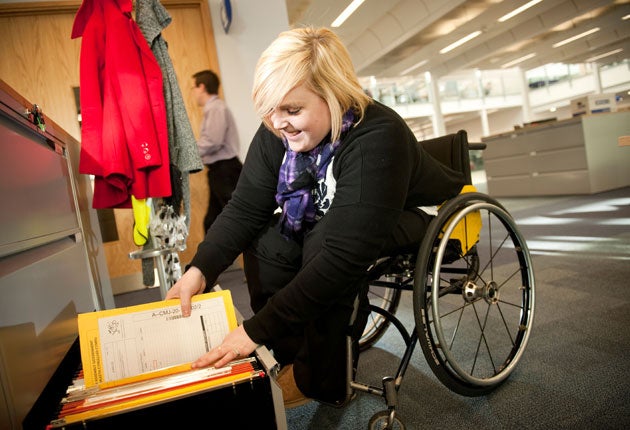
One in 20 disabled people has lost their job in the last 12 months as the recession hits the most vulnerable the hardest – and the worst is yet to come.
The job prospects and standard of living of disabled people could worsen even further as public services are cut.
Discrimination against disabled people is increasing in the workplace as employers target them for redundancy and unfairly turn them down for new jobs, according to a report by Leonard Cheshire Disability.
The report, Disability and the Downturn, warns that the employment gap between disabled and able-bodied employees is growing as more people compete for fewer jobs during the recession.
More than half of respondents (52 per cent) had experienced discrimination in the workplace in the past year, an increase of 11 per cent since 2007. More than four in ten (43 per cent) believed that they had been turned down for a job because of their impairment, seven percentage points up on 2008.
The charity described the trend as "worrying" and warned that current regulations for tackling disability discrimination were proving inadequate.
Only around 50 per cent of disabled people are employed, compared to around 75 per cent of the overall working age population. Of those disabled people in work, the proportion which are low-paid employees is 10 per cent higher than it is for non-disabled workers.
Disabled people were also more likely to work in temporary, part-time and vulnerable jobs, which were more likely to be affected by the recession than other types of work.
The report noted: "The gap is indicative of the extent to which disabled people continue to encounter multiple barriers to equality in the field of employment. These barriers may include physical inaccessibility, in terms of transport and premises, and attitudinal barriers such as a lack of awareness of disability or inappropriate attitudes on the part of employers and colleagues."
The study also warned that the job prospects and standard of living of disabled people could worsen even further as public service are cut.
Disabled workers are more likely to work in public administration, health or education than the working population as a whole. They are also more likely to make use of their services. Figures from 2007 suggest that almost one in three of the disabled workforce is employed in the public sector, meaning that public spending cuts could have a disproportionate effect on disabled workers.
Disabled people losing their jobs are also less likely to have savings to fall back on than other workers. More than half (55 per cent) of disabled people reported having no savings compared to around 12 per cent of the general public. Forty-two per cent of respondents revealed that they were finding it difficult to manage on their present income, an increase of 10 per cent since 2007.
The study was compiled using the detailed responses of 1,253 disabled people drawn from across the UK.
The report's authors said the research highlighted disabled people's "entrenched employment disadvantage". They concluded: "Not only are disabled people more likely to be out of work, and experience a higher incidence of in-work poverty, they face additional financial costs arising as a result of an impairment. They are also less likely to have savings and are therefore at greater risk of immediate poverty during an economic downturn.
"Unemployment has a disproportionately penalising effect on disabled people, a destructive dynamic that is of increasing concern in times of national economic crisis."
Neil Crowther, disability programmes director at the Equality and Human Rights Commission, warned that it was unlawful for employers to discriminate against disabled people.
"There is evidence that disabled people, as defined by the Disability Discrimination Act, have a very poor employment rate that predates the recession," he said. "Only about 33 per cent of disabled people are employed and, as a group, disabled people have an unemployment rate of 12 to 14 per cent.
"The Commission is working to extend protections for disabled workers in the Equality Bill, currently before Parliament, by seeking the abolition of pre-employment health questionnaires. These questions could be used to discriminate against disabled candidates."
Join our commenting forum
Join thought-provoking conversations, follow other Independent readers and see their replies
Comments
Bookmark popover
Removed from bookmarks