Dodging national service: a dishonourable tradition
Alan Clark has been exposed for failing to don khaki when it was required of him. But he was far from alone, reports Andy McSmith
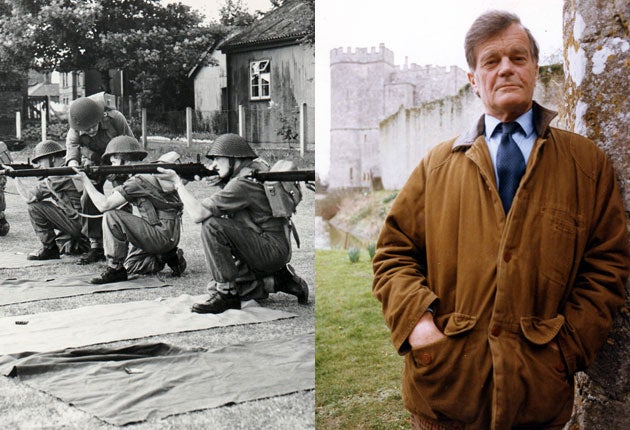
Having already been exposed as a lecher, liar, snob and Nazi sympathiser, it was difficult to imagine that the former Conservative defence minister Alan Clark could have had any secrets left in his scandalous life that would lower his reputation any further. But now his official biographer Ion Trewin has turned up documentary proof that, as a young man, Clark dodged the draft.
Previously, his deeply flawed character was reckoned to have had two redeeming features – he wrote beautifully, and he had a real empathy with the ordinary serviceman. As a military historian, he popularised the phrase "lions led by donkeys" to describe the men who fought in the trenches in the First World War.
But when it came to experiencing the discomfort and monotony of military life for himself, the young Alan Clark, whose family was extremely rich and well connected, found a way out. As a schoolboy at Eton, he joined a training regiment a short walk away in Windsor, which he left before he went up to Oxford University. Three years later, he used this short, painless encounter with military life as a pretext to get himself exempted from National Service.
"It's dreadful," the former defence secretary Denis Healey, who served in the army throughout the war, told The Independent yesterday. "It shows that he was even more of a twister than he appeared. He always tried to present himself as some sort of military hero."
His widow, Jane Clark, who came from a military family, told the Sunday Times: "If I had known, I would probably have lined him up against the wall and shot him for deserting."
Though Margaret Thatcher never took Clark seriously, she did reward his loyalty to her by giving him a succession of junior or middle-ranking government jobs. The one he enjoyed most was his post as defence minister.
Before he became a minister, Clark made a name for himself as an outspoken champion of the armed forces. During the Falklands war, in 1982, he gave so many interviews, and was so gung-ho, that the journalist Alan Watkins named him as "the leader of the war party".
One of the few obscenities in the celebrated political diary that he kept in the 1980s is a passage about the defence secretary, John Nott, who was trying to pare down the defence budget. "That fucking idiot Nott and his spastic Command Paper," Clark wrote. Unlike Clark, John Nott did his national service, which included a long period in the Malaysian jungle with the Gurkha Rifles.
One comfort for Alan Clark's admirers is that he is not the only draft dodger to have got on in politics. Michael Heseltine, who rose to be defence secretary under Margaret Thatcher, did his utmost to avoid being called up, but was eventually ordered to report for duty.
He found it so dull that after nine months, he obtained leave to stand as a Tory candidate in the 1959 election, in a hopeless seat. When the campaign was over, he got his solicitor to persuade the War Office that he didn't need to return to barracks.
He could at least claim to have been in the army longer than the former Liberal leader Jeremy Thorpe, whose stint lasted two weeks. Richard Ingrams, who duly completed his two years of national service, claims Thorpe found an unusual way to escape the army. He said: "I was told by a very good friend that he wet his bed."
The film director Michael Winner, now aged 74, claimed in his memoirs that he wriggled out of national service altogether by pretending to be gay. He claimed that when the Colonel asked how long he had experienced homosexual urges, he replied: "About three months."
Harold Pinter, the future playwright, chose the more direct route of registering himself as a conscientious objector when he reached the age of 18. Bernard Crick, another intellectual of the same generation, made himself unavailable by going to study in North America.
Famous, or rather infamous, draft avoiders from abroad include Joseph Stalin, the future Soviet Generalissimo, who was declared unfit to fight in 1914 because one of his arms was shorter than the other.
The future US President Ronald Reagan was excused war service overseas because of his poor eyesight. Bill Clinton refused to be drafted during the Vietnam War, and George W Bush enlisted in the National Guard, a device often used by young men from influential families who wanted to avoid fighting in Vietnam.
National service
*National Service was introduced at the end of the Second World War to help look after Britain's interests abroad.
*Between 1945 and 1963, 2.5 million young men were called up to do their time. One of the main jobs was to help with the occupation of Germany and Austria, but Britain had a military presence in Palestine, Cyprus, Singapore, Hong Kong and other countries.
*Initially the public supported the idea, but by the end of its 18-year run, it was regarded as an annoying interruption of education, work and marriage plans.
Clark: man and myth
*Alan Clark spent his early life in the shadow of his famous father, Kenneth Clark, a multimillionaire lecturer and art expert. Educated at Eton and Oxford, he became Conservative MP for Plymouth Sutton in 1974, just before his 46th birthday, when he was already well-known as a military historian.
*He was on the right of the Conservative Party and adored Margaret Thatcher. He was a minister, but never a cabinet minister. His diary of the years 1983-90 were a bestseller. He left the Commons in 1992, returned in 1997, but died two years later from a brain tumour.
Join our commenting forum
Join thought-provoking conversations, follow other Independent readers and see their replies
Comments
Bookmark popover
Removed from bookmarks