Families vent fury at PM over Army cuts
Grieving relatives have Brown in their sights as he prepares for Chilcot inquiry
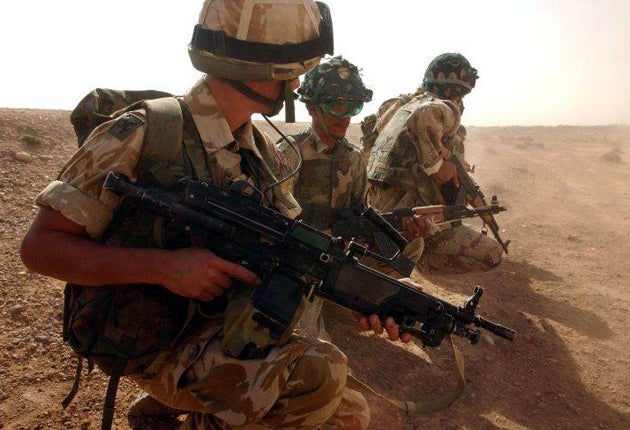
A dangerous lack of equipment and a disregard for the human cost of the Iraq war, were two of the accusations levelled at Gordon Brown yesterday by former soldiers and their relatives as he prepared to face the Chilcot inquiry.
The Prime Minister is expected to face claims today that he "guillotined" the military budget while he was chancellor, starving the armed forces of resources.
While Mr Brown's appearance has not generated the same level of excitement as that of his predecessor Tony Blair in January, with only 300 people applying for tickets compared to 3,000, it will be closely scrutinised by those most deeply affected – the military, the injured, bereaved families and Iraqi refugees.
"The question I would like to ask him is why he values the lives of our soldiers so little?" said Roger Bacon, whose son Major Matthew Bacon, 34, of the Intelligence Corps, was killed by a roadside bomb in Basra in 2005. The helicopter he was due to be travelling in developed a fault and he was forced to take a lightly armoured Snatch Land Rover.
He added: "He was in charge of the money. He could have released the money but he refused, knowing they were short of equipment. He had the purse strings. If he didn't believe we could afford it, if he had doubts, he should have expressed his opinion more strongly."
His comments were echoed by Captain Doug Beattie MC, who was a Regimental Sergeant Major of the 1st Battalion, Royal Irish Regiment, during the war.
"The cuts were so deep when we were training in Kuwait we were given weapons without ammunition. That had an effect on the ordinary soldier," he explained. "People went to war, not just ill-equipped but scandalously ill-equipped. When we crossed from Kuwait to Iraq, we didn't go in armoured vehicles. My men were in the back of four-tonne trucks as if they were going for a day out in Blackpool."
He continued: "During the war Brown was the chancellor when funding for the armed forces was being cut and cut and cut. I would want to ask him, did he realise the funding cuts that he was inflicting would result in the armed forces not being fit for the task or equipped for the fight. Did he think of the consequence of those funding cuts?"
Mr Brown is expected to be asked by the inquiry how closely he was involved in developing government policy on Iraq, whether he voiced concerns to Mr Blair and whether he provided enough resources to the armed forces as chancellor.
Karla Ellis, whose brother Private Lee Ellis, 23, of 2nd Battalion, The Parachute Regiment, was killed in Al Amarah in February 2006, accused him of failing to protect the soldiers not only in war but when they came home. She said that he had let down bereaved families and traumatised soldiers.
"My brother was an honourable person who served his Queen and country. These men were pushed into a war they knew was not necessary. They sent them out there to do their dirty work and now they are not looking after them," said the 29-year-old.
Frances Shine, whose son Trooper Stephen Shine, of the Royal Tank Regiment, lost his leg in a roadside bomb, said: "Why didn't he release more money? I remember getting an apology from [the then Defence Secretary] Des Browne on behalf of the Government. He said 'you were right, we were caught short'. There was nothing in place for the families or the injured troops."
Lance Corporal Mark Dryden, who was serving for the second time in Iraq in November 2005 when he lost his arm to an improvised explosive device that killed his friend and fellow fusilier, Sergeant John Jones, added: "In the beginning the facilities for the injured were shocking. I don't think they realised how many injured personnel would be coming back. And I still don't think that a person who pays his taxes should have to give money to charities to give a wounded soldier what he deserves."
The Iraqi people paid an even higher price, as Muhsin Kareem, of the International Federation of Iraqi Refugees, pointed out. Mr Kareem, who emigrated to the UK in 2004, said he wanted to know whether Mr Brown had thought through the consequences of the invasion.
"They never thought of what would happen after the war to the Iraqi people when the state fell and there was no alternative," he said. "They say they overthrew a dictatorship in Iraq and released the people and brought freedom. But now Iraq is in chaos. Before we had just one Saddam now we have a lot of different militias and it is worse. I would ask Mr Brown, who participated in the decision to go to war, with Mr Blair, if he thinks he is responsible for the chaos."
Tomorrow the Stop the War Coalition will try to hand the Prime Minister a bloodstained cheque. Its convenor Lindsey German said: "The cost of the war in Iraq stands at an estimated £8.5bn for Britain alone. Most British public opinion shows opposition to the war and the desire for more money to be spent on welfare. How can Mr Brown, as a Labour chancellor and Prime Minister, justify these priorities?"
In numbers: The war in Iraq
179 British servicemen and women killed in Iraq
222 British servicemen and women seriously injured
100,000-655,000 Estimated number of Iraqi civilians killed
4,000,000 Iraqis have been displaced by the war
6 Years before Britain ended combat operations in Iraq
17 People killed in a string of bombs in Baghdad yesterday
Join our commenting forum
Join thought-provoking conversations, follow other Independent readers and see their replies
Comments