Intrepid treasure-hunters – or archaeological vandals?
A marine exploration company has found HMS <i>Victory</i>'s remains. But not everyone is pleased
At 3.30pm on 4 October 1744, the Royal Navy flotilla accompanying HMS Victory caught what was to be their last glimpse of their flagship as it drifted over the horizon in stormy seas off the Channel Islands.
Laden with four tons of Portuguese gold, the pride of the British navy – and direct predecessor to Admiral Nelson's vessel of the same name – sank with all 1,150 of its crew. Only the shattered remains of its top-mast were found on a Guernsey beach as evidence of its terrible fate.
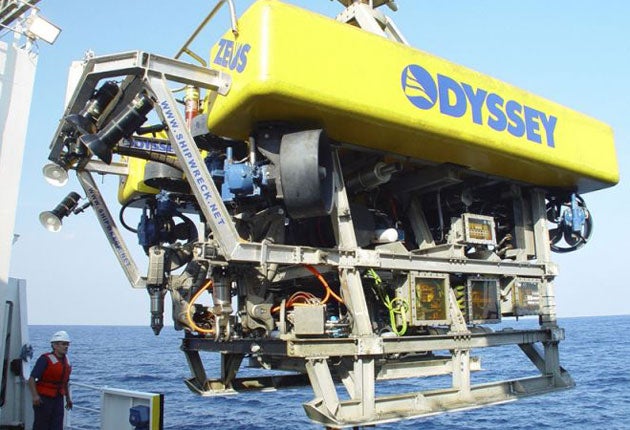
But yesterday the ability of that majestic and – for its time – technically advanced man-of-war to evoke dreams of vast riches was revived when an American treasure-hunting company announced that it had found the Victory and is planning to salvage its precious cargo from the depths of the English Channel.
Archaeologists accuse the Florida-based Odyssey Marine Exploration of combining hi-tech surveying methods with commercial ambition. They have also attacked the Ministry of Defence for "indulging in hypocrisy", after it emerged that the ministry is in negotiations with Odyssey to share the proceeds. If all the bullion being carried by the Victory is recovered, it is estimated that it could be worth as much as £700m.
To its supporters, Odyssey is a reputable, publicly listed company that follows strict archaeological guidelines in a legitimate search for sunken vessels around the globe.
But its detractors, ranging from leading archaeological bodies to the Spanish government, claim the treasure hunters hide behind a veneer of scientific probity as they harness technology to profit from the world's sunken heritage.
"If Odyssey is allowed to go ahead with this operation, it will cause uproar," said Mike Williams, a specialist on maritime law at the University of Wolverhampton and secretary of the Nautical Archaeology Society. "There are very hard questions to be answered about whether these sites should be recovered, and in particular whether the British government should be sanctioning that recovery."
Odyssey is already locked in a bitter legal dispute with the Spanish authorities over 500,000 gold and silver coins recovered from a wreck it has labelled Black Swan, and which Madrid insists is the Nuestra Señora de las Mercedes, a treasure-laden Spanish frigate sunk in 1804.
Odyssey unveiled its latest find at press conferences held simultaneously in London and New York yesterday. It revealed it had recovered a four-ton bronze cannon emblazoned with the crest of George I – a weapon that only the Victory, the last Royal Navy vessel to be armed entirely with bronze guns, was allowed to carry.
The company, which threw a veil of secrecy over its operations after the find last May, claimed the wreck is vulnerable to fishing trawlers and unscrupulous salvagers and that urgent action is therefore needed to recover the remaining 39 cannons, worth at least £30,000 each, and other "items of value". Odyssey has declined to state whether it has found any of the Portuguese bullion.
Greg Stemm, a former advertising executive who is Odyssey's CEO, said the value of the goods on board the Victory was secondary to the historical importance of the find: "HMS Victory was the mightiest vessel of the 18th century and the eclectic mix of guns we found on the site will prove essential in further refining our understanding of naval weaponry used during the era."
Under international law, the wreck and its contents remain the property of the Government. The Independent understands that Odyssey is in negotiations with the Ministry of Defence to strike an agreement on similar lines to a deal signed in 2002 following the discovery of the remains of another Royal Navy gunship, the HMS Sussex, which sank off Gibraltar in 1694 with £300m-worth of gold on board. Under the terms of that deal, Odyssey gets a sliding share of the proceeds from the sale of any recovered property, up to £250m.
But archaeologists and lawyers said yesterday that a similar deal for HMS Victory would amount to the abandonment of Britain's obligations under Unesco's Convention on the Protection of the Underwater Cultural Heritage, a convention which in 2005 the Government agreed to respect, without formally signing it.
Dr Williams said: "For the Ministry of Defence to now enter into a deal to recover the remains of HMS Victory would be to indulge in hypocrisy.
"The annexe to the convention makes it clear that a site should be left undisturbed wherever possible – as this one has been for 265 years – and that if artefacts are recovered they should not be used for commercial sale. At the same time, there is a public education campaign, funded by the Government, which seeks to tell anyone diving on a wreck never to remove anything from it. If they then exploit the Victory it will mean the complete dilution of that message."
Odyssey said it was abiding by stringent archaeological guidelines and retained the right to seek financial reward for its work.
Mr Stemm said: "Odyssey, not the taxpayer, spends its own money on the archaeological side of things. Once the entire collection is properly accounted for, it is handed over to the Government. At that point it is up to the Government to decide how to compensate us."
The company's stance was defended by Sir Robert Balchin, a direct descendent of Sir John Balchin, a much-revered 18th-century admiral who went down with the Victory in 1744, and who was blamed for sailing the ship on to rocks off Alderney.
The location of the wreck, which is being kept secret, shows that it did not founder because of navigational error.
A former director of St John Ambulance, Sir Robert said: "I can't tell you what I felt when I saw that cannon. It was as if a piece of not just my family history, but national history, had come alive again. I am very clear that the artefacts that are down there should be brought up from the deep. [They] will add enormously to our knowledge of Britain's 18th-century navy."
Odyssey wrecks
Black Swan
A colonial-era galleon discovered in the Atlantic in 2007 with 17 tons of silver and gold coins, which were flown out of Gibraltar to Florida. The Spanish government has since filed a claim that the Black Swan is in fact its own vessel Nuestra Señora de las Mercedes, and demanded the return of the treasure. Odyssey disputes the claim.
HMS Sussex
The Royal Navy ship sank off Gibraltar in 1694 with up to 10 tons of gold coins on board, making it one of the most valuable wrecks ever. Odyssey signed a deal with the Government to recover the bullion, but Spain's authorities have prevented it from returning to the site.
Join our commenting forum
Join thought-provoking conversations, follow other Independent readers and see their replies
Comments