Modest Gurkhas relive heroic deeds done on behalf of Britain
The High Court victory that gives veteran Nepalese soldiers the right to settle in the UK is the last chapter of a battle that began during the war, as Kim Sengupta explains
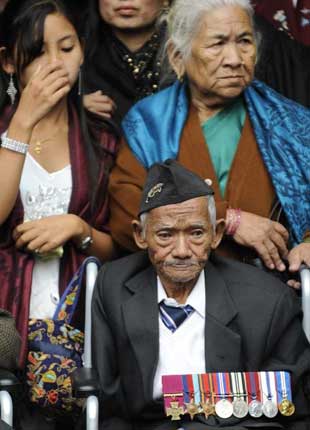
They had shown great courage in the face of extreme danger fighting for Britain, and last week they celebrated one of their most famous victories.
Lachhiman Gurung, 91, and 86-year-old Tul Bahadur Pun, both holders of VCs, became the iconic faces of the Gurkhas' stand at the High Court. They had been told that they would not be allowed to settle here because they had failed to "demonstrate strong ties" to the UK.
In his High Court ruling Mr Justice Blake said the grounds being used by the Government to deny the Gurkhas who had retired before 1997 the automatic right to settle in the UK are discriminatory and must be reviewed.
Now, after the landmark decision, the remarkable tales of how the two old warriors won their most prestigious of honours and what had happened to them since can be told.
Lachhiman Gurung and Tul Bahadur Pun grew up near each other in the Nepalese highlands before both trekked across the mountains to the recruiting centre for the British Raj and joined the Gurkha Rifles.
The two young men were sent to the Burmese front, where British and Indian troops were engaged in the long and bloody counter-offensive against Japanese forces.
On the morning of 12 May 1945, during intense fighting beside the Irrewady river at Taungdaw, Rifleman Lachhiman Gurung, then 27, was manning the most forward and vulnerable post of his platoon. A Japanese attack came, with around 200 enemy soldiers charging through swirling mist on to the Gurkha trenches.
Grenades were flung into the trench injuring two of his comrades, including his platoon commander. Twice Mr Gurung threw back the grenades, but the third exploded in his hand, blowing off his fingers, shattering his right arm and cutting open his face, chest and right leg. Mr Gurung reloaded his rifle with his left hand for the next four hours, waiting for the next enemy wave to come towards him and then firing at point blank range. His comrades could hear him shouting, "come and fight a Gurkha".
Mr Gurung lost the use of his arm and the sight of one eye. But his actions saved the lives of British, Indian and Gurkha soldiers by keeping the enemy at bay for so long. Afterwards 31 dead Japanese were found around the position, dispatched by him, literally, single-handed.
Rifleman Gurung received his VC from the viceroy of India, Lord Mountbatten, at a massive ceremony at the Red Fort in Delhi, with bagpipes playing and flags flying.
Mr Gurung, like so many of his compatriots, is modest about his gallantry. "I had to fight because there was no other way," he said. "I felt I was going to die anyway, so I might as well die standing on my feet. All I knew was that I had to go on and hold them back. I am glad that helped the other soldiers in my platoon, but they would have all done the same thing."
Tul Bahadur Pun's heroism had taken place just over a year earlier on 23 June 1944 at Mogaung, when his unit was ordered to attack a railway bridge. Intense Japanese fire from two enemy positions wiped out everyone in Mr Pun's section apart from him and two others, including his section commander, who was severely wounded.
Armed with a Bren gun, 21-year-old Rifleman Pun charged the enemy position 40 yards away through ankle-deep mud. With dawn rising behind him he made a perfect target for the Japanese, but he kept going forward, eventually killing three and putting six more to flight. Then, he used two captured light machine-guns to provide sustained fire which saved the lives of his comrades.
Among those who owed their life to Mr Pun was Major James Lumley, the father of the actress Joanna Lumley who turned up at the High Court to show her solidarity with the Gurkhas. "He has been a hero to my family, his photograph hung on the wall," she said of Mr Pun.
By the early 1980s Mr Pun was living at a house which did not have a proper roof, electricity or running water. He had to be driven for three hours and then walk for a day to collect his British pension of £132 a month. He suffered from heart problems, asthma and diabetes, and was having difficulties getting adequate medical treatment.
In 1986 Mr Pun applied for a visa to settle in the UK on grounds of health. An entry clearance officer refused his application on the ground that he had "failed to demonstrate strong ties with the UK". However, after a public campaign, in June 2007 the-then asylum and immigration minister, Liam Byrne, announced that Mr Pun would be granted a settlement visa.
Mr Pun arrived in Britain last year to a guard of honour provided by the British Army. This week he recalled: "So many people showed so much kindness, but I had to remind myself at the time that so many others have been left behind in Nepal, other soldiers who were also suffering and needed help.
"But what happened at the court case is very good and perhaps all these things will now be settled and these men can get the chance to live in this country."
Join our commenting forum
Join thought-provoking conversations, follow other Independent readers and see their replies
Comments
Bookmark popover
Removed from bookmarks