MS sufferer who wants husband to help her die wins landmark ruling
'I love my husband and I will not put him in a situation where he could end up in prison'
Thursday, 12 June 2008
A multiple sclerosis sufferer who wants her husband to aid her in ending her life has won a landmark review of the law on assisted suicide.
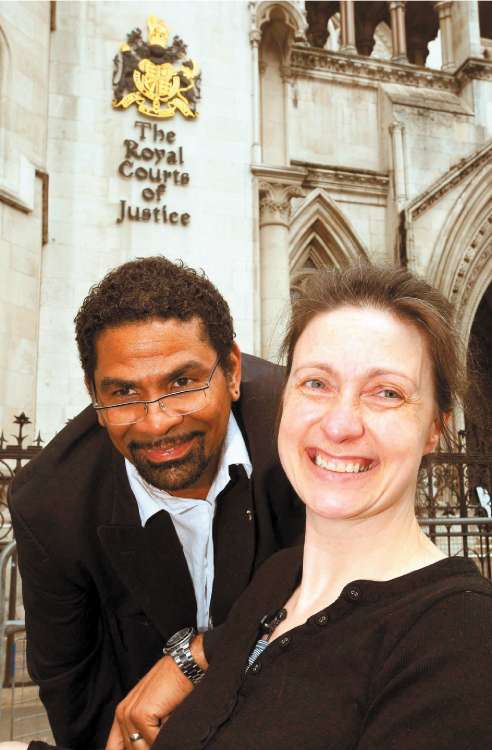
Two judges gave permission yesterday for Debbie Purdy to bring a High Court challenge forcing the Director of Public Prosecutions to clarify under what circumstances people can be prosecuted for helping a loved one to die.
Lord Justice Latham, sitting with Mr Justice Nelson at the High Court, said that "without wishing to give Ms Purdy any optimism", she did have an arguable case that should go to a full hearing.
Ms Purdy, who was diagnosed in 1994 with primary progressive MS, believes she may have as little as a year left before she is unable to perform day-to-day tasks unaided. She wants her husband, Omar Puente, to accompany her to a Swiss clinic to end her life once her suffering has become unbearable.
However, she fears he would face prosecution and up to 14 years in jail if he returned to Britain and was found guilty of assisting, aiding or abetting her suicide. She claims the refusal of Sir Ken Macdonald, the Director of Public Prosecutions, to issue guidance on whether, and in what circumstances, people might be prosecuted in such cases means she will have to make her final journey much sooner than she would like, so that she can travel alone and guarantee that Mr Puente will not face trial.
Ms Purdy, 45, of Bradford, was in court yesterday to hear the judges order a judicial review. Her lawyers had argued that Sir Ken's decision breached Article 8 of the European Convention on Human Rights, which guarantees the right to respect for personal and family life.
She is the latest in a succession of terminally ill people who have sought to clarify the law. In 2001, Diane Pretty, a motor neurone disease sufferer, failed to secure immunity from prosecution for her husband if he helped her to die in Britain.
Ms Purdy, a former journalist and marketing executive, led an active life before MS struck and still water-skis despite her condition. She has no desire to end her life prematurely and plans "to live to the full and for ever if I can". She is even planning a parachute jump.
But she says she cannot bear the thought of her husband, a Cuban musician, being prosecuted if he accompanies her abroad. By then, she said, her illness would be at the stage where she is unable to complete such tasks as gathering medical documents, buying train tickets or even pushing her wheelchair.
Ms Purdy said: "I am delighted to have won this ruling. I am not being overly dramatic when I say we are talking about saving my life. I am in an impossible situation. I do not want to die and I want to live for as long I possibly can, until the last possible moment before my illness becomes unbearable. But my condition means the day will come when I am wheelchair-bound and unable to do things that would enable me to make the journey on my own.
"I love my husband and I will not put him in a situation where he could end up in prison. The law as it stands means I have to make that journey on my own and I may not have much more than a year before I am unable to. I will have to make this journey before I should. It is time for the judiciary to confront this issue and change the law so that people like me do not have to die without our loved ones beside us."
Ms Purdy is a member of Dignitas, which runs a clinic in Zurich where terminally ill people take lethal doses of barbiturates prescribed by doctors. Ninety-two Britons have ended their lives at the centre. In at least eight cases, their relatives were questioned by British police about their involvement in the deaths. Despite investigations lasting several months and one arrest, no one was prosecuted.
Sarah Wooton, of the Dignity in Dying group, which is backing Ms Purdy's case, said: "If the DPP issues a policy on the law, Debbie may be able to live longer. Of course, the decision to travel abroad is far from ideal. People who are terminally ill and mentally competent should have the option of requesting a medically assisted death in the comfort of their own country, surrounded by the people they love."
Last night, the Crown Prosecution Service said it was beyond Sir Ken's remit to grant immunity from prosecution and that position was unchanged by the ruling. The judicial review will be heard in October.
Euthanasia in other countries
*Switzerland: Since 1941, it has been legal to hasten death by assisting someone who is terminally ill or severely mentally ill but competent enough to opt for suicide. Only Switzerland lets foreigners use its non-profit clinics. Doctors can issue a lethal dose of drugs once they are satisfied of a patient's condition. Police must be informed.
*Belgium: A 2002 law permits euthanasia. The lethal drugs can be administered by injection or a prescribed overdose and the patient must be a Belgian resident. The law requires two doctors to be involved, and a psychologist where the competence of the patient is in question.
*Netherlands: Voluntary euthanasia and doctor-assisted suicide has been permitted since 1984, although it was not made law until 2002. Like Belgium, any decision must be made by two doctors and a psychologist where necessary.
*Oregon: The only US state where assisted suicide is legal. A patient with an illness that will kill them within six months can request lethal drugs from a doctor. The request must be confirmed by two witnesses, one of whom cannot be related or known to the patient. Only when the patient has waited a further 15 days and reconfirmed the request can the lethal dose be given.

so where is the organised pressure in uk for voluntary euthanasia/ assisted suicide these days?
hardly a peep from the fading 'exit'-style groups; still far too many solicitors who will have nothing to do with drawing up a living will; and far too few doctors one could trust not to 'strive / officiously keep alive' ;
dying is far too important to be left to the medical trade, whose true business is with those wishing to live; the only professionals at present with a business interest in death are the undertakers; surely there is a crying need for the gap between the two to be filled- the nearest we currently have are the splendid macmillan nurses, making cancer now a good thing to die of;
in the meantime I suggest that cruise companies be lobbied to set up one way sunset cruises asap;
sincere apologies to Debbie Purdy if she feels i am making unkind mock of her dilemma - one just feels so frustrated by the inhumanities of all those in opposition , especially those in the churches
Posted by jaff | 13.06.08, 09:47 GMT
It is interesting to read previous comments from someone who suggests that "seriously ill people like these should volunteer themselves for medical research..." In America, we consider it humane to stop the suffering of family pets via euthansia, yet our society does not consider this an option for terminally ill people. This seems to me to be a rather large "disconnect." Certainly there is need for caution and many safeguards for assisted suicide. There is plenty of room for abuse and misuse. I think there is a very good chance I would avail myself of this option were I in a situation in which there was no outcome possible other than great suffering for the rest of my life. I also believe that if we all spent some time with those who suffer with sever terminal illness, we might be more supportive of the option of assisted suicide.
Posted by Jim | 12.06.08, 15:42 GMT
James,
I assume you are a religious zealot of some persuasion or another - or at least you have a marked disregard for the suffering of others consistent with being one. I would say it's anyone's objective right to decide when to take their own life, and once that decision is freely taken, no-one helping them out of a sense of care and compassion and love should be punished for it. It is not "another attempt to push roll back [sic] ethical boundaries in the interests of a secular agenda". Rather, the resisting of it is another attempt to bolster cruel, catch-all 'ethical' imperatives in the interests of a religious agenda. What it boils down to is self-determination - something religious people tend to be uncomfortable with when it comes to life itself.
Posted by John Gregor | 12.06.08, 14:08 GMT
There is something rather disingenuous about this woman's protests that the reason she is doing this is because she loves her husband "and will not put him in a situation where he ends up in prison" (I could break into tears).
If this were genuinely her concern why could she could not simply employ others to make the necessary arrangements without telling them of her intentions? Much less trouble than going to the High Court I would have thought.
What we see here is yet another attempt to push roll back ethical boundaries in the interests of a secular agenda (further corrupting in the process the concept of human rights which ought properly to ensure the highest standards of morality, but which more often than not in these days of woolly conscience is used to undermine it.)
It is unfortunate that we speak these days of human "rights" as though moral behaviour were something we could exact from other people as our due. If it is real, let it be objective, if not forget it !
Posted by James Johnson | 12.06.08, 12:56 GMT
Everyone I'm sure can see why the safeguards have to be there, but why prolong the suffering of people who expressly wish to end their life with dignity, with their loved ones close by? It is a relic from a puritanical religion that most people no longer believe in.
Posted by Dave | 12.06.08, 10:59 GMT
The same right we have to choose when we have kids, start a family, vote (or Not), express an opinion - is the same right we have to deicde our own lives. If the law stated that this deicion could be made in advance when the individual was not ill but decidec in the evnt of of a certian condition or physical state, then littel abuse could be made of the systme.
Life is sacred but suffering is a blemish on all of us. Those who wish to die should be allowed unless their mental state is to precarious to make them a sutiable judge.
Posted by Ben Odams | 12.06.08, 09:50 GMT
I think that people with serious illnessnes like these should volunteer themselves for medical research. Countless thousands & thousands of animals a year are given symptoms of the diseases, go through untold pain, suffering & deprivation and then killed with little or no progress whatsoever gained because animal findings are not applicable to humans & they can only find symptomatic remedies not a cure (because they are obviously different species). Not to mention, the experiments are futile and very time consuming.
If these people for the graeter good of humanity volunteer or be asked by the government to consider taking part in scientific research/experiments i feel finding cures for them will be found much quicker (if found at all) and lead to a reduction in the nonsensiscle experiments on animals, which gain nothing and is a waste of time/money.
Posted by Shazia | 12.06.08, 09:29 GMT
As a UK resident of Switzerland, aged 83, I am deeply thankful for the very humane Swiss laws on this subject. I have made my wishes clear in writing, with copies to my doctor and my son, and know that when the time comes I shall be able to decide the time of death myself, surrounded by family and friends.
I hope UK law will soon be changed in this respect.
Posted by jeanne vickers | 12.06.08, 08:56 GMT
As a UK resident of Switzerland, aged 83, I am deeply thankful for the very humane Swiss laws on this subject. I have made my wishes clear in writing, with copies to my doctor and my son, and know that when the time comes I shall be able to decide the time of death myself, surrounded by family and friends.
I hope UK law will soon be changed in this respect.
Posted by jeanne vickers | 12.06.08, 08:54 GMT