Nuclear veterans told: No case for compensation
Ministers tell servicemen who witnessed 1950s test explosions they should have claimed years ago
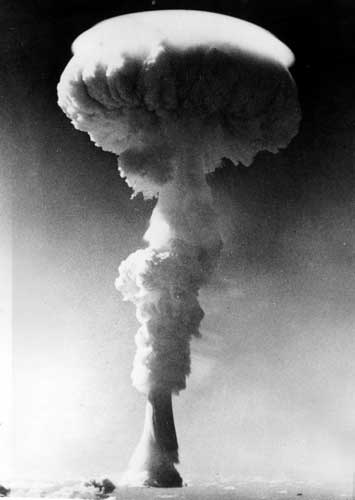
Ministers have been accused of blocking compensation claims brought by hundreds of nuclear test veterans who believe they developed cancers and other illnesses after being forced to witness atomic bomb experiments in the 1950s and '60s.
Despite pay-outs to former servicemen in the US, France and China, Britain has told its veterans there is no case for offering compensation, and that there is no scientific justification for a full investigation into birth defects suffered by the veterans' children and grandchildren.
Instead, the Government is relying on studies carried out on the Japanese survivors of Hiroshima and Nagasaki, which failed to establish a link to illnesses found among survivors and their families.
This refusal fully to investigate the human legacy of Britain's nuclear weapons test programme has come as a blow to the airmen, soldiers and sailors who stood on Pacific island beaches in the late 1950s watching nuclear explosions while wearing little more than shorts and sandals.
Ministers are also defending a legal claim brought by 1,000 British and overseas nuclear veterans and their families on the grounds that the case is time-barred. Ministry of Defence lawyers will go to the High Court next week to argue that the men, who could be entitled to hundreds of millions of pounds, should have brought the case as soon as they knew they had a claim, rather than waiting more than 40 years to start litigation. The Government will also say that the medical evidence does not support the veterans' claims of cancers linked to their time in the South Pacific.
It is estimated that the Government has already spent more than £100,000 defending the claim, which is being fought by the veterans' firm of solicitors, Rosenblatt.
In a letter written to Kevan Jones MP, the minister responsible for military veterans, the survivors and their MPs say they are "disappointed" by the Government's decision not to undertake a full medical investigation. They argue that the United Kingdom has a moral obligation to follow the lead of the US and France, which have agreed to pay compensation or accepted their responsibility to veterans. The Isle of Man government has also agreed to pay compensation to Manx veterans involved in the tests – there are thought to be only eight.
But The Independent on Sunday understands that meetings last month between the veterans and ministerial advisers have failed to persuade the Government to offer any compensation to either the men or their families. Advisers told the veterans that science was not able to provide conclusive proof concerning ill-health suffered by their offspring.
In a letter to Mr Jones, signed by John Baron MP, Ian Gibson MP and John Lowe, chairman of the British Nuclear Tests Veterans Association, they responded: "The overall message from our meeting with your adviser appears to be that science cannot answer the question of ill health in the offspring one way or the other. This disappointing conclusion must be understood in the context of the Government's position on the wider question of recognition and redress for test veterans. In your response to the Commons debate, you repeated the oft-made point that approaches should be 'evidence-based'. We are now being told it is not possible to establish a clear evidence base on this issue. It therefore makes sense to conclude that a solely scientific approach is not going to resolve this question; ultimately, it is a matter of political will and moral responsibility."
The letter adds: "The nuclear test veterans have not been calling for a new study out of general scientific curiosity; the case we have raised is a specific concern about a group of people who have never been examined. Work done on Japanese survivors (for example) is wholly unable to give comfort or bring peace of mind to the BNTV community. That is why we brought their case to you in the first place and were encouraged when you suggested action."
The veterans argue that the British servicemen who were used in the nuclear weapons testing were not given the protection that they deserved or the subsequent medical attention that they required.
"If your officials are now telling us that this matter cannot be determined one way or another through science, and given that the tribunal system has already demonstrated that some servicemen were placed in danger, we believe the only honourable option left open to the British Government is to follow the example of the French, avoid an ugly confrontation in the courts, and agree to pay damages to nuclear test veterans and their affected offspring," the survivors argue.
A spokesman for the Ministry of Defence said: "The UK Government recognises the vital contribution that service personnel played in the UK's nuclear tests during the 1950s and understands its obligation to veterans. When compensation claims are received, they are considered on the basis of whether or not the Ministry of Defence has a legal liability to pay compensation. Where there is a proven legal liability, compensation is paid."
'We saw the mushroom unfold at sea'
Barry Hands and his national service comrades were ordered to muster on the beaches of Christmas Island on 28 April 1958. "We heard a mighty boom and then turned around to see the mushroom unfold. It was an unbelievable, fantastic sight," said Mr Hands, 71, from Droitwich, West Midlands. He witnessed five nuclear explosions in 1958. "We were wearing just Navy-issue shorts and sandals. It was only on the final one that we were issued with white overalls. Later we went swimming in the lagoons. We weren't frightened, it was an adventure... We got on with our jobs and did as we were told."
Forty years later he suffered a malignant melanoma and a secondary cancer. Two of Mr Hands's grandchildren were born with abscesses on their bones. "Australian doctors have shown some connection between deformities in grandchildren and Christmas Island, but I would like to see more research by the British government," Mr Hands said.
Join our commenting forum
Join thought-provoking conversations, follow other Independent readers and see their replies
Comments
Bookmark popover
Removed from bookmarks