Outrage at ruling on helmets for cyclists
Judge says bare-headed cyclists may be to blame if they are injured in a collision
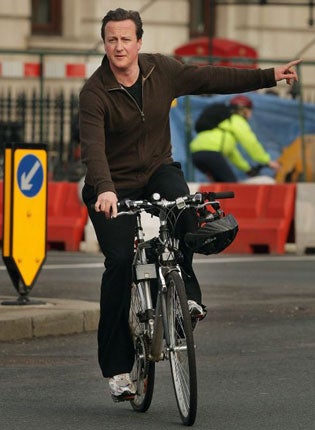
Britain's cyclists reacted in uproar yesterday to a High Court ruling that they can be blamed for their injuries if they don't wear a helmet – even if the accident itself was caused by someone else.
"There can be no doubt that the failure to wear a helmet may expose the cyclist to the risk of greater injury," Mr Justice Williams said, making the unprecedented ruling on an accident involving a motorbike and a cycle in Brightlingsea, Essex in June 2005.
"A cyclist is free to choose whether or not to wear one," he said in the legal ruling. But not doing so means "any injury sustained may be the cyclist's own fault and 'He has only himself to thank for the consequences'."
The national cyclists' organisation, CTC, said yesterday that it was considering taking legal action to overturn the "wrong and ill-informed" decision; other advocates of cycling described it as "absolute rubbish" and "sad".
The case involved cyclist Robert Smith, then a 51-year-old NHS manager, who was riding without a helmet to an opera group rehearsal when he was hit by Michael Finch's motorbike. He suffered serious brain injuries. The judge decided that the motorcyclist was "entirely" to blame for the crash because he had been going too fast and had ridden too close to Mr Smith's bicycle. He also dismissed Mr Finch's suggestion that Mr Smith's injuries were caused by his failure to wear a helmet. But the judge established the principle of "contributory negligence" for cyclists who ride without a helmet, citing a 1976 court ruling by Lord Denning in relation to seatbelts and advice in the Highway Code.
Roger Geffen, campaigns and policy manager for the CTC, said there was significant doubt about whether helmets increased cyclists' safety. After a law requiring helmets to be worn was introduced in Western Australia, the number of cyclists dropped by a third but head injuries fell by just 10 per cent.
Mr Geffen said CTC was investigating ways of overturning the ruling. "The judge didn't have any evidence before him about the effectiveness of cycle helmets," he said. "It just seems he has exceeded his remit.
"It's a kind of creeping compulsion by the back door and it leaves cyclists in a state of uncertainty. There's a feeling you might have to wear a helmet because you are legally at risk.
"What we know overall is that wherever helmet-wearing has increased, it hasn't improved cycle safety. We certainly feel the ruling is wrong and ill-informed. We need legal advice."
A spokesman for the Department for Transport said the Government had commissioned research on cycle safety, which would look at the effectiveness of helmets and report back in September 2010.
The former shadow transport secretary, Bernard Jenkin MP, whose North Essex constituency includes Brightlingsea, said he would raise the High Court ruling – which was made in January but only came to light yesterday – with the Government. Mr Jenkin, deputy chairman of the all-party cycling group, said: "The judge is clearly not a cyclist and he's exhibiting all the prejudices of someone who does not regularly use a bicycle." Dr Ian Walker, a Bath University psychologist, carried out a study which found passing motorists tended to give a cyclist without a helmet a wider berth than one wearing one. He said it was "quite strange" that the judge had set a precedent for a situation which did not apply to the accident he was considering.
View all comments that have been posted about this article.
Offensive or abusive comments will be removed and your IP logged and may be used to prevent further submission. In submitting a comment to the site, you agree to be bound by the Independent Minds Terms of Service.
- Print Article
- Email Article
-
Click here for copyright permissions
Copyright 2009 Independent News and Media Limited


Comments
Taking the tough guy approach when riding my motorcycle, I would opt to not wear my helmet when doing city riding. Thinking one does not get hurt at low speeds.
I have since changed my mind. After taking three spills from my bicycle, in recent years, two serious, one at 22 mph which left me laying prone on the ground, tangled in my bicycle, slowly assessing my body structure, being sure I did not break my hand, I now wear a helmet for both types of cycling.
The scars on my bicycle helmet made me realize that low speed impacts can be just as dangerous as having one at high speed with my motorcycle. I have come to realize that not wearing a helmet goes beyond ignorance and stops squarely on stupidity. Anyone who insists it's their right to not to wear a helmet places their bet clearly on the latter.
Helmets were developed and designed for a reason, your brains continued, uninterrupted functioning. Arguing against not wearing one shows your brain has possibly short circuited even before you start your ride.
If there were more cyclists, and fewer cars then the death rate of pedestrians would actually go down. Wouldn't that be a good thing? Or are you so full of hatred for cyclists that you would just think otherwise regardless of unimportant things like logic, common sense, human decency?
And why shouldn't cyclists safety be worth discussing? Are you saying that while I ride on the road, stop at red lights and for pedestrians at pedestrian crossings, that it is OK for me to be run down by some idiot boy racer in a borrowed car, because some idiot you saw yesterday decided the law didn't apply to him?
How do you really think such logic would apply to society generally, or in reverse?
I've certainly had my share of people more or less leaping out from the pavement in front me with total disregard for my totally legal presence or my safety, are you saying by your logic, having seen numerous dimwits do so, that I should feel free now to disregard their safety and simply collide with them at 20mph.
I mean, after all it would be their fault because I saw some other pedestrian jaywalk yesterday....
You rightly want sympathy for the plight of cyclists who are endangered by the actions of ignorant/moronic drivers. Sympathy is best gained by respecting the rights of others. It's called the moral highground, and in the view of many, many people cyclists are a long way away from it due to the actions of what feels like a large chunk of the two wheel brigade.
I used to live next to the Regents Canal in London. Cyclists used the towpath as a race track and used to get deeply upset if a pedestrian happened to be in the way. And then, by chance, I noticed the bye-laws for the Regents Canal, which state that anyone wishing to cycle on the towpath must a) have a permit, and b) give right of way to pedestrians. I raised these points with a couple of cyclists who seemed particularly irate at my existence (they had to slow down becasue I was there), but the only response I received was a metaphorical question mark above their heads (one helmeted), followed by verbal abuse. Hardly calculated to make me sympathetic.
We all have to use a limited amount of space to go about our daily business. This demands that we respect the rights of others. Sadly, in descending order, it seems that 1st) drivers have almost no respect for anyone on 2 wheels, 2nd) those on 2 wheels have very little respect for those on foot, and lastly) those on foot can sometimes be stupid, but let's face it - they are generally the losers.
You cannot compare the two.
I agree that poor drivers are much more dangerous than poor cyclists. But in terms of consideration and common courtesy, there are an awful lot of very, very rude cyclists. As someone who tries to be a polite cyclist, I should know. A little while back I tried counting cyclists who stopped with me at red lights vs ones who rode past. It was an even split, about 20 each during a half-hour ride into the City.
In return, having been sworn at and abused by motorists who I can only assume were doing so for fun, or because I had dared to slow them down for a few seconds; and having had the same treatment from pedestrians; and having been nearly taken out by pedestrians who don't know what that little red man is for; having feared for my safety from dangerous drivers, driving in a very aggressive and rude manner, is also by your own implication, trivial?
Sure enough there are very rude cyclists out there, probably about the same percentage as you would find rude motorists and rude pedestrians. Unlike them, these anti-social cyclists are unlikely to kill and maim you, a point which is born out by road death statistics.
Trivial?
Well, that would seem to be the case by the twisted logic applied wouldn't it.
A helmet would certainly have mitigated my head injury and I'd strongly recommend any cyclist to wear one. Don't listen to the self styled libertarians, it's your brain so protect it.
Oh, wait.
If the cyclist has fallen off with nobody else involved, tough luck, a helmet MIGHT have saved him but he chose not to wear one. However this case the accident was caused by a negligent motorcyclist, so the cyclist victim shouldn't have to shoulder any blame for not strapping a piece of foam to his head that may or may not have protected him.
Freedom of choice and make all car drivers pass a cycling proficiency before they get to do their test - as an active pedestrian, cyclist, motorcyclist, car driver and lorry driver - I can say that we all need to slow down and resopect the more vulnerable user first before taking unacceptable risks.
Well said.
And let's insist that pedestrians who do not wear helmets are also contributorily negligent
The organ donations necessary for modern medicine rely on the stupidity of cyclists.
Let them ride without helmets so I can get a spare body part.
Cheers!
WTFAY?
The fact remains that no helmet means an accident will result in body parts for the transplant industry.
Your waiting list is outrageous--no wonder your more affluent countrymen acquire needed parts on the Grey market.
Wearing a helmet may keep the cyclist alive and intact, but often in a vegetative condition which now requires long term care.
Any "additional" protection by way of wearing a helmet may save injury or reduce the extent of injury.
If I rode a head-forward sports machine though, or cycled every day in heavy urban traffic with lots of kerbstones and steel posts to crack my skull against, I'd probably take a rather different view of the matter. Living in Holland for a year I biked to and from work every day, and in that country you hardly ever see a helmet except on the heads of racing cyclists. But part of the reason for that is that the road system is set up for bikes, with cyclists most of the time separated off from motor traffic into special lanes. Likewise Dutch motorists are quite amazingly considerate of cyclists at junctions, cycling in that country being entirely democratic so that today's motorist can quite easily be tomorrow's cyclist riding to work if the weather's nice.
Helmets are of questionable effectiveness, uncomfortable to wear, ridiculous to look at and a bother to carry around. There is of course a body of helmet-wearing Health & Safety fundamentalists who'd like to get us all into them: partly (I've always suspected) because they won't feel quite such fools wearing the Dan-Dare-and-the-Mekon creations which so many of them have been persuaded into buying. And when they've got us all wearing helmets by law, would be on to compulsory knee- and elbow-pads, then all-round kevlar body armour. And I say, s*d them, and hope many more will do likewise. Life is an intriniscally dangerous business ending in death, and the only way to remove all risk is to stay in bed.
PS. For those who feel the need to wear a helmet but resent looking a complete idiot, there's a Danish firm which now makes a close-fitting, EU-approved cycle helmet with a variety of cloth covers in sober shades to fit over it. So far the safety freaks haven't yet found a way to close them down - but no doubt they're working on it.
I'm against making wearing helmets compulsory. If people choose to not to wear a helmet then that's up to them, but what I find astonishing is the argument that if a cyclist chooses not to wear a helmet, and then the court finds on the basis of the evidence in the specific case, that wearing a helmet a helmet would have avoided or reduced the injury, then the compensation should *not* reflect that fact.
Wear a helmet or not wear a helmet: it's our choice, but we should also be prepared to take responsibility for the consequences.
The important point is that there is little or no scientific evidence to show that wearing a helmet reduces the risk of serious injury. As the CTC spokesman pointed out, in countries where compulsory helmet wearing has been introduced the average number of head injuries per cyclist has actually increased.
Statements from single cyclists about how helmets saved their lives are scientifically meaningless. It is necessary to show that a statistically relevant number of cyclists have been prevented from injury by wearing helmets.
Depends what you mean by scientific evidence - scientific evidence would probably be pretty difficult to come by. But this paper reviews several studies on use of cycle helmets and comes to a number of conclusions including that, "Bicycle helmets have been found to be effective at reducing the incidence and severity of head, brain and upper facial injury."
If cyclists don't want to get run over they need to pull their heads out of their a***.
QED.
I think you need to pull your own head out of your own rear if you think 3200 deaths preferable.
1 - Helmets are a nuisance.
2 - The evidence that they protect the head is dubious - they may even exacerbate neck injury in a fall as their roundness can allow hyper-flexion of the neck.
3 - As some-one has mentioned, cyclists with a bare head are given a wider berth by motorised traffic.
4 - Most importantly of all, helmets give off the wrong message, that cycling is dangerous. Hillman in the BMJ several years ago showed that, mile for mile, CYCLING IS TWENTY TIMES SAFER THAN DRIVING. The small risk of injury to a cyclist is massively outweighed by the risks to health of being a couch potato in a car - obesity, hypertension, heart disease, stroke, diabetes, several cancers....We need to get as many people as possible out of their cars and onto bikes in the interests of their own health as well as that of the planet, and helmeted cyclists are a subtle but powerful disincentive to potential new cyclists.
There is substantial, credible research that demonstrates the effectiveness of bicycle helmets in reducing serious head injuries of cyclists involved in collisions. Clearly helmets won't save every life, but they do reduce the mortality rate and certainly also reduce the incidence of traumatic brain injury.
The question of whether or not helmet laws discourage cycling is certainly worthy of debate, but the evidence quoted is not necessaily reliable. The statistics used to bolster firmly held biases are open to question. A more accurate analysis might measure how much mileage logged by cyclists changed after helmet laws were introduced rather than just numbers of cyclists. More committed cyclists likely continued riding despite legislation while the marginal riders may have stopped, reducing numbers of cyclists more dramatically than distance ridden, a more useful metric when assessing cyclist exposure to risk.
While it is important to understand all of the impacts of helmet legislation and to raise questions about efficacy and those other issues, sound research should be used and misinformation should not be promoted to back up what is clearly an ideological position.
We have a mandatory helmet law in British Columbia (Canada) and cycling participation continues to increase dramatically. Helmet use, by the way, is the highest per capita in the world in our capital city of Victoria. While I was in no rush to endorse the legislation when it came in, I'm confident that it will not be rescinded so like a good soldier, I have moved on to fight other, more important battles.
John Luton, Executive Director, Capital Bike and Walk Society
Have we been reading the same research? The evidence presented by the medical profession has received considerable criticism for its statistical analysis, which, given the nature of the studies, amounts to criticism of its experimental design. I would invite anyone who has previously posted or is reading to visit http://www.cyclehelmets.org/ to reveiw the evidence presented on both sides of the argument.
What is apparent to me from this evidence is that helmets are a side show. Most cyclists in the developed world also walk and drive and and the dangerous fringe exhibit the results of the same behaviours while doing so. Any pedestrian complaining about cyclists should cycle down a segregated pavement type facility and see how many pedestrians walk across your path without looking. Any motorist complaining about cyclists should spend some time with a cyclist old enough to remember when cyclists were largely law-abiding and the thanks they got for it. (None)
Road saftey can only be consistantly improved by a culture that starts with thinking about the effects of your behavour on everyone else first. The judge in this case appears to have materially set back the saftey of not just cyclists, but all road users.
I'll read yours if you read mine. Try www.bhsi.org
I'm not suggesting that helmets improve safety, just that in the event of a collision, they better your odds. All the other issues you enumerate are valid comments on the behaviour of various road users, but they do not invalidate the value of helmets when your noggin happens to hit a hard object.
Abosultely I would agree that the judge is way out of line in his judgement. I'm hopeful that someone will disassemble his logic (or lack thereof) at an appeal.
Incidentely there are many people posting "I had an accident and a helmet saved my life" stories. They might want to read the section on anecdotal evidence.
Not only his remit, but his competence.
There can be no doubt that the failure to research or hear evidence on a subject before pontificating upon it may expose the court to the risk of greater ridicule.
Study the facts at http://www.cycle-helmets.com
Even without a mandatory helmet law in the UK (so far), the ignorance of Justice Williams has increased the injury risk to all cyclists in your country.
http://en.wikipedia.org/wiki/File:Adult
Paul Breen, Partner, Serious Law www.seriousinjurylaw.co.uk