Private prisons 'performing worse than state-run jails'
Report pours scorn on Government claim that private sector is raising standards
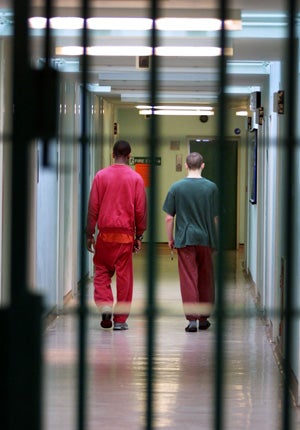
Britain's private prisons are performing worse than those run by the state, according to data obtained under the Freedom of Information Act.
The findings, based on the overall performances of 132 prisons in England and Wales, appear to undermine claims by ministers that the greater use of private jails is raising standards for the accommodation of more than 83,000 prisoners held across both sectors.
Separate figures, also released under the right-to-know law, show that nearly twice as many prisoner complaints are upheld in private prisons as they are in state-run institutions.
The Government is committed to building five more private prisons to accommodate the growing prison population, which is predicted to rise to 96,000 by 2014. But the poor performance ratings among 40 per cent of private prisons in England and Wales throw into question the cost savings and other benefits of using outside businesses to tackle the prison crisis.
The data obtained by More4 News shows that four of the 10 private prisons scored the second lowest rating of 2, "requiring development", and only one above an assessment of "serious concern."
The Ministry of Justice introduced the Prison Performance Assessment Tool (PPAT) last year, providing the first direct comparison between public and private prisons.
It ranks the prisons out of four gradings using a wide range of measurements, including escapes, assaults and rehabilitation. In the second quarter of last year, the average overall score for prisons in the private sector was 2.7. For the 123 public sector prisons the average was 2.83.
In the following quarter this gap had widened to 2.6 and 2.85. This is a difference of almost 10 per cent. No private prison attained the top mark of 4, defined as "exceptional performance."
There were also disparities in the number of complaints upheld in private and state-run prisons. Rye Hill Prison, a private prison run by G4S, which has been a focus of particular criticism since it opened in 2001, saw a total of 22 complaints, well above the average in both the public and private sectors.
Juliet Lyon, the director of the Prison Reform Trust, said: "There are some good private prisons but there are also some very poorly performing ones. The evidence doesn't suggest that it [use of private prisons] has driven up standards by providing good models. If you look across the prison estate at the public sector there is a high degree of resentment and rivalry between the two sectors and, until recently, little sharing of good practice and information, which is really disappointing."
She added: "It's been an interesting experiment. The end result is that 11 per cent of our prison population are now held in private hands. But one of the issues it has introduced is a kind of market drive to increase the prison population, to grow that business and that's something that really does concern us."
The Conservative Government took the first steps toward privatising prisons in the early 1990s by issuing short-term contracts to security companies to operate a limited number of publicly owned prisons.
Eleven prisons in England and Wales are run privately. Nine prisons have been financed, designed, built and are run by the private sector under PFI contracts. Two former privately managed prisons, Blakenhurst and Buckley Hall, are now publicly run.
Private prisons in England and Wales now account for 11 per cent of the prison population, holding around 9,100 prisoners. England and Wales have the most privatised prison system in Europe. Australia has 17 per cent of its prisoners held in private prisons and the US has 7.2 per cent. A Prison Service spokesperson said: "To claim that there is a difference in performance between public and private prisons based on these statistics is entirely misleading. It is also disingenuous to try to compare the average rating of the 122 publicly run prisons with the 11 privately run prisons. The sample sizes make these calculations a nonsense. The introduction of privately managed prisons has helped to generate significant overall improvements in value for money and performance, including in the public sector, which has been energised by the more competitive environment."
A report published today claims that the Government could save £1bn a year if petty criminals with drug problems were given comunity based sentences. Make Justice Work, the criminal Justice charity, says that diverting one offender from custody to residential drug treatment would save the tax-payer approximately £200,000 over the lifetime of the offender.
More4's report can be seen tonight on 'More4 News' at 8pm
Prisons for profit: The verdict
*HMP Altcourse, Fazakerley, Liverpool – G4S Justice Services
Opened in 1997, it was the first designed, constructed, managed and financed private prison in the UK.
Rating 3 (Good performance)
*HMP & YOI Ashfield, Gloucestershire – Serco
Opened in 1999, this prison and young offenders institution in Pucklechurch, Gloucestershire, holds up to 400 males aged between 15 and 18.
Rating 2 (requiring development)
*HMP Bronzefield, Ashford, Middlesex – Kalyx (previously UKDS)
Opened in 2004, Bronzefield is the only privately managed, purpose-built prison for women in the UK. It has a 12-bed, Mother and Baby Unit.
Rating 3
*HMP & YOI Doncaster – Serco
Opened in 1994, it houses 1,120 men aged 18 on remand and after sentence. The prison provides education, healthcare and counselling.
Rating 3
*HMP Dovegate, Staffordshire – Serco
Opened in 2001, it accommodates up to 860 adult male prisoners serving sentences of four years to life. A separate 200-bed therapeutic community houses repeat serious offenders.
Rating 3
*HMP & YOI Forest Bank, Pendlebury, Salford – Kalyx
Opened in 2000, it is one of the largest prisons in the UK, holding 1,064 male offenders. It also holds young offenders from Greater Manchester.
Rating 2
*HMP Lowdham Grange, Nottinghamshire – Serco
Opened in 1998, it accommodates up to 628 adult male prisoners serving sentences of more than four years.
Rating 3
*HMP & YOI Parc, Bridgend, South Wales – G4S Justice Services
Opened in 1997, The 1,200-bed Category B Local prison claims to be dedicated to reducing re-offending.
Rating 3
*HMP Rye Hill, Rugby, Warwickshire – G4S Justice Services
Opened in 2001, this training prison holds 660 adult male Category B prisoners sentenced to more than 4 years with 18 months left to serve, including 150 vulnerable prisoners.
Rating 2
*HMP Wolds, Everthorpe, East Yorkshire – G4S Justice Services
Opened in 1992 for remand inmates, the first privately run prison was given a new role in 1993 holding category B sentenced prisoners.
Rating 2
Join our commenting forum
Join thought-provoking conversations, follow other Independent readers and see their replies
Comments