Rail passengers face cut in services as recession bites
Train companies hit by fall in commuter numbers as Transport Secretary holds talks with 'big five' operators
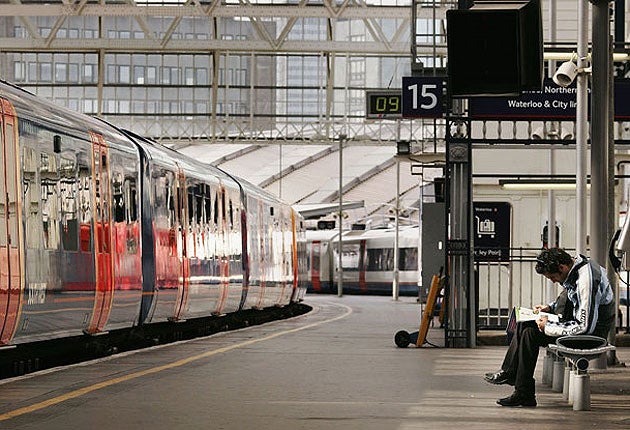
Rail passengers face cuts to services and higher prices after talks between the Government and rail chiefs over the prospect of the first fall in passenger numbers for 15 years.
Geoff Hoon, the Transport Secretary, met the "big five" operators, Stagecoach, National Express, Go-Ahead, Arriva and FirstGroup, amid fears they will have to reduce service commitments to cope during the recession.
Figures to be released soon by the rail industry will show that past year saw the first slowdown in passenger growth in six years.
Since the start of 2009, significant numbers of jobs have been lost, which will directly hit commuter numbers travelling to major cities.
Most rail companies are tied into tough franchise contracts with the Government which were agreed during the boom years and assumed continued growth in passenger numbers.
Several companies have already shed jobs and instituted wide-ranging internal restructuring to cut costs, but a slump in passenger numbers has led to a real fear of cuts to services.
One industry insider said: "There is historic evidence to suggest a retraction in demand in certain areas is on the cards this year. If that happens, companies will have to go back to the Government to discuss a change to their franchise agreements."
Last night, analysts raised concerns over the East Coast Main Line services run by National Express. The company paid £1.4bn for the franchise last year. "The franchise was one of the most recent sold and the company has said already it needs 10 per cent revenue growth to meet targets," said Gert Zonneveld, analyst at Panmure Gordon.
Both the rail operators and the Government last night refused to comment on their discussions. But the meeting came after senior figures in the rail industry admitted that they may have to renegotiate the terms of franchise deals agreed long before the downturn. Keith Ludeman, chief executive of Go-Ahead, said: "There is nothing to stop us, if demand falls, going to the department and asking to take services out."
A DfT spokesman said: "This was one of a regular series of pre-planned meetings the Secretary of State holds with train operating companies. A range of issues was discussed, including the fact that passengers and operating companies are facing uncertain economic times. The companies said passenger numbers were still growing but they would monitor the situation closely. The train operating companies did not propose any cuts in services."
Industry sources said that companies are looking to boost online ticket sales and increase use of automatic ticket machines to reduce costs. The moves could see ticket offices under renewed threat. "It is an area that companies are looking at as research suggests online and ticket machines are popular with customers," one said.
Unions also said they were concerned that cuts to services could be on the horizon and urged the Government to resist attempts from rail operators to change their franchise obligations.
Bob Crow, general secretary of the Rail Maritime and Transport union, said: "Revenues, profits and dividends have been rising steadily, but at the first hint of a slowdown they want to slash services and sack staff when that is the reverse of what the economy and environment need."
Gerry Doherty, leader of the Transport Salaried Staffs Association, said: "If the companies are allowed to cut services it can lead to more cattle truck conditions for passengers."
The Association of Train Operating Companies conceded that some operators may consider reducing train sizes, but said that the industry was fundamentally in good shape.
"If a major retailer announced growth of just under 5 per cent at a time like this, I think they would be pretty pleased," said a spokesman. "There is still growth in the industry."
View all comments that have been posted about this article.
Offensive or abusive comments will be removed and your IP logged and may be used to prevent further submission. In submitting a comment to the site, you agree to be bound by the Independent Minds Terms of Service.
- Print Article
- Email Article
-
Click here for copyright permissions
Copyright 2009 Independent News and Media Limited


Comments
Bob Crow hit the nail right on the head.
This has nothing to do with the recession, it is due to the unaturally high increases in rail fares. I also believe that if you buy a ticket this should entitle you to a seat in the train.
As someone who is cutting thier carbon footprint, by using public transport I find that both bus and train services are doing thier utmost to keep evey polluting car on the road. Traffic jams are due to the fact that we have far too many cars on the road, most of these cars do not need to be on the road at all, they are very short journeys that could be covered by walking, bus and train.
Make fares fair and cut them back to a usable price and you will find that more people will shun the traffic snarl ups and use the transport again.
We want more people using trains and buses and more rolling stock to take the passengers that will come, more frequent trains and buses and in the case of buses more routes.
When I moved to this area, buses were on every road, we now have to walk to the middle of the village to get a bus, quite a distance for some elderly people who had been used to getting a bus from the top of the road.
We need to reduce traffic now, just think how lovely it would be for the workforce to get on a train, not get stuck because of accidents on the Motorway get snarled up because of snow or ice, high winds etc the stress would be so much less.
I recently travelled to Manchester by train, it was bliss, no hunting for parking which was usually full, no stress of getting stuck in miles long tailbacks.
So lets stop all this rubbish talk, and get our public transport system back up and running properly.
My fellow sparrows and I are finding it increasingly difficult to find anywhere to live because of this type of human activity.
Sorry folks you will have to learn to be more patient and not worry about the concept of time and wanting to be everywhere else all at the same time, because we don't.
So it is possible to do with less and be of benefit, hmmm ?
What am I saying, everyone is going to use the car more, oh, please don't !
* cost - for one person use of (3rd class) rail and use of car are similar; parking can be expensive but not everyone lives near a station and may have to use expensive station car parks anyway. If more than one person is travelling rail does not stand a chance. How come EasyJet can fly me to Rome for less than it costs for me to take the train to London (with a seat too) - and they make money without government subsidies?
* convenience - no waiting, no taxis, no delays, no having to stand up in grubby smelly corridors, no rude patronising staff
* comfort - you are guaranteed a seat, you will be warm in winter and cool in summer (the trains from Reading to Paddington have their heaters on full blast in the middle of summer to encourage you to shell out the extra for the "second class" compartments (note I have downgraded the class of tickets because it would not be legal to claim the compartments were in any way first class)), trains crammed so full that if it was cattle it would not be legal, you don't get off after a 30 minute journey feeling burnt out and dishevelled.
* rude staff - like the guy who thought it was highly amusing that my ticket did not work and I had to queue to have it replaced for the fourth time that month, the driver who laughed out of the window at me instead of letting me on, sitting on the station for 2 minutes watching me, the ticket office guy who shouted at me to "f*ck off from my station" when the train was cancelled and I decided to walk to the next station (admittedly saying "stupid f*cking railways" under my breath)... And of course rail and underground strikes - if you want to be communists f*ck off to Russia, comrades.
Basically, if you show contempt for your customers they will go elsewhere regardless of how environmentally unfriendly it may be. It won't be long before the rail companies are being bailed out by the government like the banks are now...
Reliance World offers ready-to-use walk-in Video Conferencing services in 105 cities and towns across India and at 1100 locations in over 90 countries worldwide through its global affiliate network. For more information, visit http://www.relianceworld.in/vconf.h