Sheikh issues fatwa against all terrorists
Muslim leaders urged to denounce suicide bombers as hell-bound 'unbelievers'
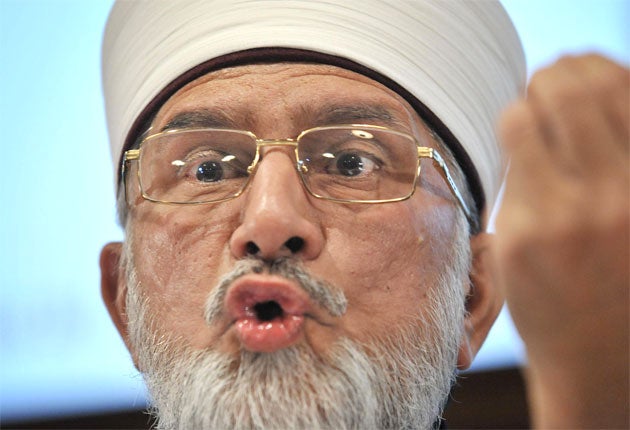
British imams must do more to condemn terrorism without any "ifs or buts" and should pronounce suicide bombers as "unbelievers" who are destined for hell, a leading Islamic scholar declared yesterday.
The comments were made during a remarkable assault on the ideology of violent Islamist extremists by Pakistani-born Sheikh Tahir ul-Qadri, a prominent theologian who launched a seminal fatwa in London yesterday condemning terrorism in all its forms.
The 59-year-old scholar, who has written more than 400 books on Islamic jurisprudence, told fellow Muslims: "Terrorism is terrorism, violence is violence and it has no place in Islamic teaching and no justification can be provided for it, or any kind of excuses of ifs and buts. The world needs an absolute, unconditional, unqualified and total condemnation of terrorism".
He also denounced those who try to justify suicide bombings by claiming Muslims who carry out such operations are martyrs destined for paradise. "They can't claim that their suicide bombings are martyrdom operations and that they become the heroes of the Muslim umma [Islamic community]," he said. "No, they become the heroes of hellfire and they are leading towards hellfire. There is no place for any martyrdom and their act is never, ever to be considered jihad [holy struggle]."
Although numerous fatwas condemning terrorism have been released by scholars around the world since 9/11, Dr Qadri's 600-page ruling is both significant and unusual because it is one of the few available in English and online. Those hoping to combat terrorism have long spoken of their frustration at the traditional Islamic hierarchy's inability to exert their influence on the internet, where violent jihadists and Saudi-influenced Wahabis have long reigned supreme.
Dr Qadri's ruling also goes further than most previous edicts by describing terror acts as so morally unjustifiable that they represent acts of "kufr" (disbelief). Most previous rulings only go as far as calling terrorism "haram" (forbidden). Kufr acts are so serious that those committing them essentially forfeit their right to call themselves Muslims.
A version of the fatwa in Urdu will also be launched later this month in Pakistan, where leading scholars have been killed by the Taliban for speaking out. Last year Sarfraz Ahmed Naeemi, a respected cleric and close friend of Dr Qadri, was assassinated days after issuing a verbal fatwa on national television condemning terrorism.
Dr Qadri's fatwa is unlikely to sway committed extremists. But counter-terrorism officials and mainstream scholars hope it will help to persuade those who may be moving towards a violent extremism but have yet to devote themselves fully to terrorist activities.
Rashad Ali, a former Islamist who now runs the counter-extremism think-tank Centri, said Dr Qadri's view that a terrorist is an unbeliever would cause many would-be extremists to think again about the religious justifications that they use to rationalise their path towards violence.
"[His] essential point is... someone that seeks to make licit what is explicitly illicit in religious terms, and agreed to be so by Muslim doctors of scripture, would then be considered to have permitted what God forbade, and to do so would take someone outside the pale of Islam," he said. "This is something that will have an impact amongst Muslim communities both in the East and in the West."
Finding fluent and approachable Pakistani scholars is important because most British-born extremists involved in domestic or overseas plots have family or cultural links within the Pakistani community.
Dr Qadri is a "sheikh ul-Islam", one of the highest positions in Islamic jurisprudence, and also the head of Minhaj ul-Quran, a global Islamic group with about 25,000 UK members, mostly from the British Pakistani community. Although his teachings have Sufi leanings – like much of Pakistan's Barelwi school of Islam – as an Islamic scholar he is considered part of the Sunni mainstream.
Join our commenting forum
Join thought-provoking conversations, follow other Independent readers and see their replies
Comments
Bookmark popover
Removed from bookmarks