UK

Mostly Cloudy with Showers 8° London Hi 9°C / Lo 5°C

Stark warning on Britain's shrinking coast

Abandon homes to the rising sea, warns Britain’s new environment chief
By Nigel Morris
Monday, 18 August 2008

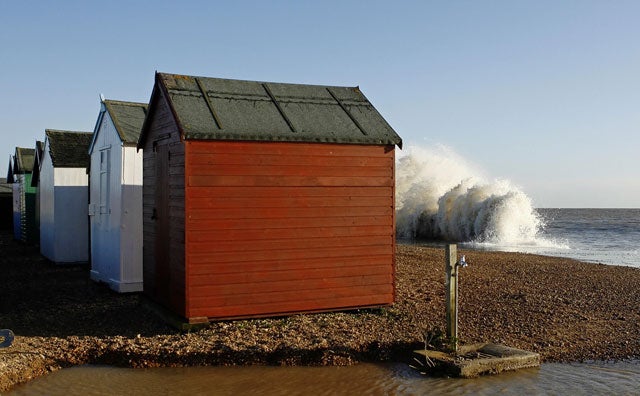
Waves crash against the seafront at Felixstowe in Suffolk. The coast along East Anglia is particularly in danger from coastal erosion

Leon Neal/AFP/Getty Images

Waves crash against the seafront at Felixstowe in Suffolk. The coast along East Anglia is particularly in danger from coastal erosion

Stretches of Britain's coastline are doomed and plans will soon have to be drawn up to evacuate people from the most threatened areas, the new head of the Environment Agency warns today.

In his first interview since taking office, Lord Smith of Finsbury says Britain faces hard choices over which areas of our coast to defend and which to allow the sea to reclaim. He said detailed work was already far advanced on identifying areas of the east and south coasts which were most vulnerable to erosion, and called on ministers to give emergency help to families whose homes will be lost.

In a wide-ranging interview, Lord Smith, a former cabinet minister, also warns that the Government is not taking the environment seriously in a series of key projects. He says:

*Building a third runaway at Heathrow Airport would be a "mistake" because of pollution and aircraft noise;

*Plans for a new generation of coal-fired electric power stations should be abandoned until the Government is certain they will not pump out harmful gases;

*The proposed Severn barrage will destroy fish stocks and wreck bird habitats.

Lord Smith disclosed that the agency was drawing up projections of where sea erosion will do most damage over the next five, 25, 50 and 100 years. It is also factoring in the additional problem of the threat to low-lying areas from rising sea levels. "This is the most difficult issue we are going to face as an agency," he said. "We know the sea is eating away at the coast in quite a number of places, primarily – but not totally exclusively – on the east and south coasts. It's a particularly huge issue in East Anglia, but in quite a number of other areas as well."

Lord Smith, a former culture secretary, promised to do his "level best to try to defend communities where there are significant numbers of properties under threat and where it's possible to find engineering solutions".

But he said the agency, working with ministers, would have to identify "priority areas" and warned: "We are almost certainly not going to be able to defend absolutely every bit of coast – it would simply be an impossible task both in financial terms and engineering terms." Suggesting that parts of north-east Norfolk and Suffolk faced the most immediate danger, Lord Smith promised to work closely with the communities involved to achieve as much "consensus" as possible over which coastal stretches to protect.

He said: "We will publish next year details of the work that's been done, where we think the particular threats are, where we think there is current defence in place. We will begin to talk with communities where we think defence is not a viable option."

He also said ministers could no longer rely on insurance companies to cover families who lost their homes, suggesting they would have to be rehoused at taxpayers' expense. He said: "We need to start having a serious discussion with government about what options can be put in place."

Lord Smith put himself on a collision course with his former colleagues over a number of important infrastructure projects championed in Whitehall. He dismissed the Department of Transport's insistence that building a new runway at Heathrow could be environmentally sustainable.

"The increases in volume of air traffic and the consequent increases in congestion on the ground are, from the analysis that we've done, pretty unavoidable," he said. "I think the Government is making a mistake and I will carry on telling them that I think they are making a mistake."

He opposed building a new coal-fired power station at Kingsnorth in north Kent – with others to follow – because he is not satisfied the promised technology to "capture and store" carbon would have been developed in time for its planned opening in the next decade. "My view would be that we should not go ahead with the development of a new coal-fired generation unless those [clean coal] technologies are in place and we can clean up the emissions."

Although he supported using the river Severn's huge tidal power to generate electricity, he said he was alarmed at the Government's support for a fixed barrier. "Effectively you would be destroying the fish populations of everything up the river system from the barrier. That is a major environmental downside."

Interesting? Click here to explore further

Comments

45 Comments

Rob Jones posts a question below about how many nuclear or coal fired power stations a Cardiff-Weston Barrage would displace. Some years ago when electricity supply was a nationalised industry I asked this question of a Central Electricity Generating Board engineer, and was rather surprised that the answer was as low as “one”.
That doesn’t mean that tidal power is not a potentially valuable resource; no one form of renewable energy is going to provide everything we need so we have to look at all of them. But we shouldn’t over-estimate the benefits of this one scheme.

Posted by mike birkin | 22.08.08, 09:50 GMT

Post a complaint

Please note all fields are required.

Contact details

Lord Smith has clearly not thought his new job through. When he has had time to take stock and treat the subject with the rigour it requires, his position will have to change.

Posted by Derrick | 20.08.08, 09:16 GMT

Post a complaint

Please note all fields are required.

Contact details

Can we be told to what extent the eroded land is being mined elsewhere as building materials?

Does the Environment Agency have any numbers for this important process?

Could they tell us thenre at what rate the country is expanding upwards at the expense of its sideways contraction?

Regarding the proposed Severn barrage:

Does the Environment Agency have any idea of the rate of increase in the days' length that would result from the additional tidal friction caused by the generation of electricity?

Of course in human lifetimes it would take a long time for the day to consist of 25 hours. However, I suspect that even that order of increase would be a worse disaster than man made global warming.

Posted by Robin Turner | 19.08.08, 16:27 GMT

Post a complaint

Please note all fields are required.

Contact details

interesting how flood defences have been repaired to protect the house of Tony Benn as we know father of Hilary Benn (Environment Sec). While ordinary tax payers are losing their own houses on the east coast.

Posted by SuseC | 19.08.08, 15:41 GMT

Post a complaint

Please note all fields are required.

Contact details

As well as land being eroded, new land is also being deposited at points on our coast.

I suggest that persons who are made homeless by undefended coastal erosion are allocated portions of the new land which is being created. They could build a house there or sell it, as they felt inclined, to defray the losses which they have already sustained...

Posted by Dodgy Geezer | 19.08.08, 14:44 GMT

Post a complaint

Please note all fields are required.

Contact details

Rob Jones : 18.08 : 21.25

"A fixed barrage, between Weston-SuperMare and Cardiff areas, could provide enough electricity to power the South West of England and South Wales - all renewable, and as reliable as night following day."

I can remember reading, many years ago, that tidal power schemes would have a measurable effect on the slowing of the earth's rate of rotation. At the time we were more inquisitorial than adversarial in our discussions, and this was presented as something to discuss, rather than as a definitive thought-stopper, as would happen nowadays.

Is anyone able to tell me whether the non-appearance of this factor in current considerations of tidal power is due to it having been scientifically resolved as being insignificant? Or is it more that we are so prevailed upon to accept the apocalyptic prognostications about man-made global warming that any carbon-free form of power generation is allowed to pass through on the nod?

Posted by Simon S | 19.08.08, 08:03 GMT

Post a complaint

Please note all fields are required.

Contact details

More alarmist nonsense. Turn the problem over to the private sector. Get out of the way and it will be solved.

Posted by Jeff Perren | 18.08.08, 23:21 GMT

Post a complaint

Please note all fields are required.

Contact details

Wildlife has a legal right to protection from flooding- the Environment Agency spends up to £5,000 each re-housing water voles. People just aren't important. Consultation is a joke and the EA staff use hire cars to avoid missing their departmental carbon footprint target.

Posted by Sam | 18.08.08, 21:50 GMT

Post a complaint

Please note all fields are required.

Contact details

A fixed barrage, between Weston-SuperMare and Cardiff areas, could provide enough electricity to power the South West of England and South Wales - all renewable, and as reliable as night following day. Use Flatholm & Steepholme as staging points.
I'd like to see a structure capable of carrying both road and rail traffic between the two ends, to increase South Wales business links and accessibility to the South Coast ferry ports and mainland Europe, and the resultant waters upstream would provide this country with an absolutely massive world-class leisure and tourism resource. How many neclear or CO2 generating powerstations would a project such as this save?

Posted by Rob Jones | 18.08.08, 21:25 GMT

Post a complaint

Please note all fields are required.

Contact details

Dear Sirs,

Only 5 years ago The Arctic Council assured us that an ice-free Arctic Ocean would occur by 2070 to 2100 at the earliest. We at FIPC strongly challenged this and said in 2005 that the Arctic sea ice disappears by the end of this decade.

How right we have been! The current state of the North Pole ice cap is such that if the current rate continues unabated until the end of this month we will have just 2 million km2 of ice left.

I must remind more informed readers who attended Professor James Lovelock's presentation at the Royal Society, where I pointed that we at FIPC expect ice-free Arctic Ocean by 2009. Go to Cryosphere Today using Google to see that ice is thin, dark almost melted.

Once Greenland is surrounded by warmed oceans, its ice surface melts. This meltwater then falls under the ice sheet and which begins to float on its own meltwaters. Just in a few years afterwards there will be an ice sheet land containment failure.

Info FIPC: 07794 - 981238

Posted by Veli Albert Kallio | 18.08.08, 20:11 GMT

Post a complaint

Please note all fields are required.

Contact details

45 Comments

Article Archive

Day In a Page

Sun | Mon | Tue | Wed | Thu | Fri | Sat

Select date