The Big Question: Why do we have honours, and how does the system operate?
Dictionaries date the title 'Sir' and its female equivalent 'Dame' precisely to the year 1297
Why are we asking this now?
As is now the custom just ahead of New Year's Eve, the Government has published a long list of prominent British citizens whose achievements are being given formal recognition in the New Year's Honours List. Hundreds of men and women now have initials after their names, such as CBE, OBE, and MBE.
How old are all these honours?
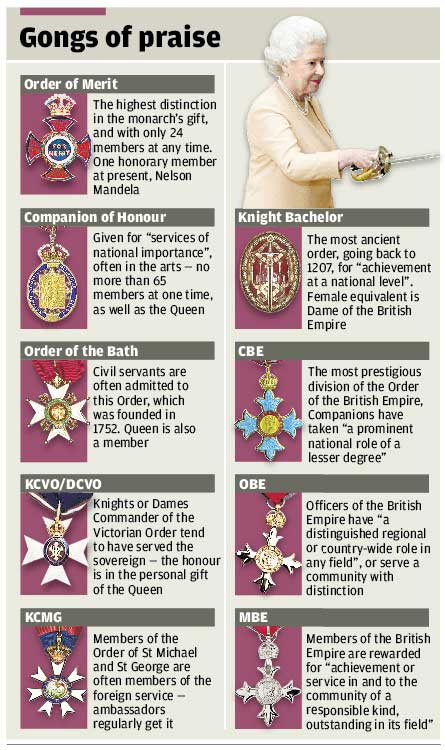
Dictionaries date the title 'Sir' and its female equivalent 'Dame' precisely to the year 1297. This was a year when King Edward I was almost overthrown by his rebellious subjects, and was compelled to reaffirm the Magna Carta, which recognised the rights of the nobility. Sir replaced "sire" as the correct way to address the 6,000 knights who made up the lowest level of the nobility, whose support the King desperately needed to fight a war in France and to help suppress the Scottish rebel William Wallace.
Most of the other honours featured in today's list were founded in June 1917, to honour people who had contributed to the war effort but did not qualify for bravery awards. They include, in order of seniority, the CBE, which according to some anonymous contemporary wag stood for "Covers Bloody Everything", the OBE – "Other Bugger's Efforts", and MBE – "Measly Bleeding Effort".
Do you have to be British to be a 'Sir'?
Being knighted involves an oath of allegiance to The Queen, which means that you have to be a citizen of the United Kingdom, Canada, Australia or one of the other Commonwealth countries that recognises the Queen as head of state to be Sir Anybody or Dame Anyone. So Bill Gates is entitled to call himself William Gates KBE, as an honorary Knight Commander of the British Empire, but he is not Sir Bill. For the same reason, Bob Geldof is a knight, but he is not Sir Bob.
What did Sir Mark Thatcher do to deserve a peerage?
Even now there are men who are entitled to be called "Sir" just because of who their father was. Mark Thatcher became The Honourable Sir Mark in 2003 when his father died. Sir Dennis was created baronet very soon after his wife had been ousted from Downing Street, becoming the first new baronet for 26 years. John Major said he made the award as "a response to powerful representations". But nobody can inherit initials like CBE or OBE.
All very elitist, isn't it?
Parts of the honours list are certainly exclusive. If you reach a certain level of seniority in the armed forces or the civil service, you automatically get an award, and there are awards reserved for senior public servants only. To be awarded the Most Honourable Order of the Bath, which dates back to 1725, you have to be a senior military officer or civil servant.
The Most Distinguished Order of St Michael and St George, founded by George, the Prince Regent, in 1818, is for diplomats only. To be given the Royal Victorian Order, created by Queen Victoria in 1896, you have to have served the Royal Family in some capacity.
What about honours for ordinary folk?
The idea of introducing the MBE and the other civilian awards was to open the system up to people who were outside the Establishment, and in 1993, John Major tried to open it up still further with his "people's honours" system, which allowed members of the public to nominate ordinary people in ordinary jobs whose exceptional services deserved recognition. But four years later, a correspondent wrote to The Times pointing out that 55 per cent of the people on the honours list were there because their awards went automatically with the jobs they held.
When Gordon Brown became Prime Minister, he launched a new attempt to take the elitism out of the honours system. His first New Year's Honours List included a record number of MBEs and OBEs for people from ordinary walks of life. Last January, he launched a region by region campaign to get more nominations from the public. Yet despite his efforts, the best way to an honour is still to hold an important job.
What if you don't want an honour?
Long before any names are published in the honours list, all the nominees receive letters asking if they would accept an honour. Anyone who does not want an honour can refuse at this stage, without anyone fuss or publicity. Last year, around two dozen people refused, which is about the usual number. The Cabinet Office never discloses the names of refuseniks, though some choose to go public, and a list of more than 300 was leaked from the Cabinet Office five years ago.
Harold Pinter, who died on Christmas Eve, chose not to become Sir Harold. Stephen Hawking, Ralph Vaughan Williams, E M Forster, Humphrey Lyttelton, David Hockney, Ringo Starr and others have also turned down knighthoods. The record holder was the painter, L S Lowry, who turned down an MBE, an OBE, a Companion of Honour, twice, and a knighthood. In a different category, there are the show-offs, such as John Lennon, who accept the honour then return it later in a blaze of publicity.
Can you buy an honour?
In the 1920s, the Liberal party, led by David Lloyd George, had no compunction about handing out honours in exchange for donations for party funds. The resulting scandal led to the 1925 Honours (Prevention of Abuses) Act, which makes it a criminal offence to offer peerages or other honours for sale. The only person ever convicted under the Act was Lloyd George's broker, Maundy Gregory, though it was under the same Act that the Metropolitan Police conducted the "cash for honours" inquiry during which Tony Blair was questioned and his fundraiser, Lord Levy, was arrested but never charged.
Who draws up the Honours List?
In theory, all honours come from The Queen. Actually, since 1937, the lists have been drawn up by the Ceremonial Secretariat, or Ceremonial Branch, as it was known until 2001, which reports to a Cabinet Committee chaired by the Cabinet Secretary, Sir Gus O'Donnell. That committee has eight sub-committees that sift through nominations from different branches of public life. Ultimately, the list is controlled by the Prime Minister.
How can you get nominated?
Strictly speaking you cannot nominate yourself, though there are plenty of examples of self-important people who have pushed themselves forward one way or another. If you want to nominate someone you know who has made a difference to their community or brought distinction to their work, you should download a nomination form from the Cabinet Office website, or write to ask for one from the Cabinet Office, Honours and Appointment Secretariat, Ground Floor Admiralty Arch, London SW1A.
Is there any point to the honours system?
Yes...
* There has to be some way of honouring a contribution to public life, other than money.
* An award is a great source of pride for many people whose efforts might otherwise have gone unrecognised.
* It is a tradition going back centuries, and there is nothing Britons love like a tradition.
No...
* Honours belong to an archaic class system that should have died out a century ago.
* People who deserve respect can earn it without having initials after their names.
* Despite the few ordinary people included, honours remain how those in top jobs congratulate each other.
Join our commenting forum
Join thought-provoking conversations, follow other Independent readers and see their replies
Comments