The Big Question: Why has Britain become more unequal, and can it be changed?
Why are we asking this now?
Because a damning picture of an increasing dominance of top jobs by children from the wealthiest families emerged yesterday in a strongly worded report.
It is difficult for ministers to dismiss its findings, as the detailed analysis of the "closed shop" operating in the most prestigious professions was commissioned by Gordon Brown and was written by a panel of experts led by the former Health Secretary Alan Milburn.
Tony Blair committed the party to boosting social mobility a decade ago when he told the Labour conference that the "old elites [and] establishments" had "run our professions and our country too long".
Critics protested yesterday that the former prime minister's voter-friendly rhetoric had not been matched by action and that landing a top job depends as much as ever on who – rather than what – you know.
What did the study discover?
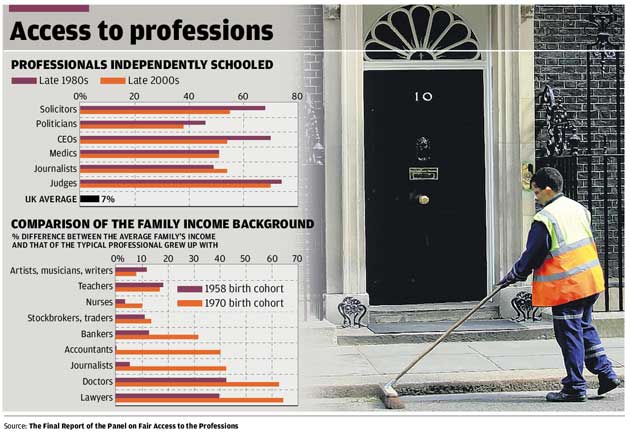
Only seven per cent of youngsters are privately educated. But 75 per cent of judges, 70 per cent of finance directors, 55 per cent of solicitors, more than 50 per cent of top journalists and 45 per cent of senior civil servants are public-school products.
Well-paid professional jobs continue to be passed down between the generations: doctors, lawyers, accountants and bankers typically grow up in families with incomes two-thirds higher than average.
Hasn't that always been the case?
Of course. But the Milburn study, Fair Access to the Professions, presents research that the trend has accelerated in recent decades. It says: "Access to the professions is becoming the preserve of those from a smaller and smaller part of the social spectrum."
More stockbrokers, scientists, engineers, bankers, accountants, journalists, doctors and lawyers in their thirties came from well-off backgrounds than their 50-year-old counterparts. The study forecasts that if action is not taken to reverse the historical trend then the typical professional of the future will come from the wealthiest 30 per cent of homes. In other words, the professional elite will become even more elitist.
There are signs that some professions – including business executives, solicitors and politicians – are becoming less public school dominated, but the trend is only slight. Journalism, however, is more exclusive while medicine is unchanged.
What is the reason?
Researchers believe selection procedures in some professions have been tightened to recruit more people similar to those already in the job.
Some professions have also become virtually graduate-only. In recent decades senior accountants could have started as bookkeepers or national journalists as local newspaper messengers. Such career ladders, offering a chance of social mobility, have diminished. Vocational apprenticeships rarely translate into professional jobs.
The Milburn panel also noted a trend of upper middle-class families helping their children get a foot in the door of their chosen career by getting them an internship or work experience.
Wasn't opening up universities meant to change that?
The Government has moved steadily towards its long-term target of getting 50 per cent of children in higher education. The proportion is currently 42 per cent and British universities this year received record numbers of applicants. But suspicions remain over how substantially this has benefited lower-income families – particularly with the financial burden of tuition fees.
The Milburn report says: "Access to university is extremely inequitable and the correlation between the chances of going to university and parental income has strengthened in recent years. Far too many young people who have the ability to go university are unable to do so because of their background."
Why does this matter to the economy?
Seven million white-collar posts need to be filled over the next decade – the vast majority of new jobs in the economy. Struggling to achieve that could put Britain at a competitive disadvantage with nations such as China and India heavily investing in skills.
Mr Milburn and his team argued that it was in the interests of all the professions to cast their net as widely as possible. The former minister, who grew up on a council estate, called for "a second great wave of social mobility" similar to that experienced by Britain half a century ago to help fill the vacancies.
How does the Government respond?
Downing Street conceded that opening up the professions is an area "where we need to do more". But it insisted that it had made widespread progress in tackling social inequality over the last decade. It said record numbers of students were in higher education, the highest-ever proportion of 16- to 18-year-olds were in education and training and 600,000 youngsters had been lifted out of poverty.
How can the exclusivity be changed?
Mr Milburn believes it has to be challenged from the bottom up by encouraging youngsters aspire to a wider range of professions. Among 88 recommendations, his team calls for careers advice to begin in primary school and for state schools to teach "soft skills", such as public speaking. Teamwork could be encouraged by establishing armed services cadet forces, currently largely the preserve of independent schools.
It backs a mentoring scheme for children from disadvantaged backgrounds and an Obama-style "yes you can" campaign to help them raise their sights. Universities could be opened to a wider range of people by offering "degrees without fees" to students living at home and for universities to compile information about undergraduates' social backgrounds. The professions should be obliged, it says, to give more details of recruitment and internship policies.
Is there other evidence of widening inequality?
While more families have been lifted out of poverty under Labour, the gap between the worst-off and most affluent has not closed. It has, if anything, widened slightly. The best-off 1 per cent of the population owned 21 per cent of the national wealth in 2003; the proportion in 1996 was 20 per cent. If housing is excluded, the proportion of Britain's wealth concentrated in the hands if the richest one-hundredth of citizens has jumped from 26 per cent to 34 per cent over the period.
Will anything actually change?
Government sources say Mr Brown is sensitive to the issues raised in the report, pointing out that he would not have commissioned it if he did not think there was not a problem. Ministers could even begin setting out ways of tackling the inequality as early as next week – possibly with a view to putting their ideas to voters in the election expected next spring.
Their problem is the natural scepticism of electors who might reasonably ask: what is the point of Labour if it has failed to boost social mobility after 12 years in power?
Has inequality widened over the last decade?
Yes...
* Top jobs increasingly go to children already in the best-off families.
* Degrees are more important than ever for landing well-paid posts.
* The gap between the wealthiest and worst-off has grown.
No...
* More youngsters from working-class homes are going to university than ever before.
* Numbers of youngsters growing up in poverty have fallen.
* The proportion of public school-educated recruits is falling in some professions.
Join our commenting forum
Join thought-provoking conversations, follow other Independent readers and see their replies
Comments
Bookmark popover
Removed from bookmarks