The hijab debate: 'I don't want to be judged on my looks'
The President of France caused a furore last week when he described the head covering worn by Muslim women as 'a sign of subservience'. But is the issue as simple as Nicolas Sarkozy thinks? Here 10 British women explain to Andrew Johnson why – to varying degrees – they choose to cover up
Saleha Islam
45, from London. Head of the NSPCC's Asian Child Protection Helpline. Wears the hijab – usually a headscarf to cover the hair and shoulders – and Western clothes
"I started wearing hijab properly about 15 years ago. I've worked in social work for over 20 years and have worked with all types of people and I've learnt what's oppression and what isn't. I'm not an oppressed woman. I head a large service in the NSPCC; I'm one of the few women trustees of a mosque. Wearing the hijab is just saying 'I'm a Muslim'. It's part of my identity. I like looking smart, I like looking good. But it's modest. I'm not going to say there aren't any problems in Muslim families. I lead the Asian Child Protection Helpline in the UK and we suffer the same sorts of issues as anybody else. It took a lot of guts for me to wear the hijab. There were few Muslims who were wearing it at the time, so I had a lot of questions from my own community."
Sarah Joseph
38, from London. Editor of Emel, the Muslim lifestyle magazine. Wears the hijab
"I wear straightforward Western clothes with it. It was very much a feminist standpoint for me. It's saying I reject beauty fascism and aspiring to bodily perfection. I was brought up in the fashion industry, where looks were predominant and I didn't want that. I became a Muslim 21 years ago. The hijab is also religious obligation and part of a spiritual journey. You try and wear clothes which are part and parcel of your spiritual life."
Sanja Bilic
33, from York. PhD student. Wears the hijab with Western clothing
"I'm European: I'm from Bosnia, but I'm British. I came to England for a two-week holiday when I was 16 in 1992. The war broke out and we couldn't go home. It was a very traumatic time. When I first put on the scarf, it was commented on for about five minutes as if I'd changed my hair. I wouldn't wear the niqab as I don't believe it is justifiable for me, but I'm not going to condone it or condemn it."
Abeer Pharaon
40, from Nottingham. University researcher. Wears the hijab and jilbab, a long, loose-fitting gown
"Islam thinks that we need to regulate the relationship between men and women, for society to prosper. A man shouldn't look at any woman in the street. He should lower his gaze. Covering the body helps men, and protects society from relationships outside marriage. If you expose the body of a beautiful woman in the street, a man may go home and see his wife is not as beautiful, so go and have a relationship. And, in the same way, women should not look at men."
Ruhana Ali
23, from Luton. Wears the burqa, which covers the entire body
"I chose to wear it to because I want to practise my faith. It was a choice in terms of identity, for me to be a Muslim, and I'm proud to wear it. I thought about it for a couple of years before I put it on. I was worried about how I'd be treated. Your hair is what makes you feel beautiful, but when you do it you are proud to cover up your beauty and be modest in accordance with the Islamic faith."
Marriam Ghaffar
21, from Nottingham. Student. Wears the hijab and jilbab
"I've worn the hijab since I was 18, and then, through my university experience, I felt more comfortable with my image as a Muslim and I felt the need to wear the jilbab as well. It was a slow transition: it wasn't imposed on me from a young age. Society does to an extent play a role, but it was my own decision, without pressure, for my own personal development. I wasn't rebelling against anything either. I was happier as a person, and it was a mark of devotion to give to my religion."
Aicha Manakoua
31, from London. Wears the hijab and jilbab
"I was brought up a Catholic and was very active. My mother cried. She said: 'Why do you have to show people you're Muslim?' It was difficult for them because they didn't see the step-by-step change. I've never felt I can't communicate with people because they have a piece of cloth over their face. If you look back at the Catholic Church, my grandma would wear a scarf over her hair, so I don't see a difference."
Haneefa Sarwar
27, from London. Wears the hijab and jilbab
"Before 7/7 everything was fine. After that I was walking down Baker Street [in London]. A few people started walking behind me and I could hear people saying there might be a bomb. On the Tube, especially in white areas, I do get stared at. In the evening I try not to go out, because that's when people will be abusive."
Ayesha Ayub
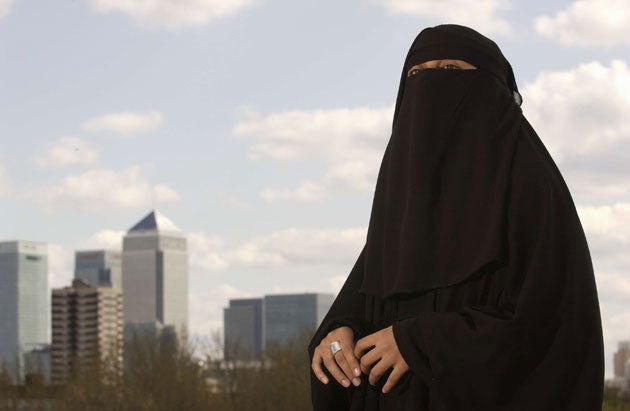
20, from Manchester. Part-time teacher. Wears the niqab, which leaves only the eyes exposed
"I started wearing it when I was 18. It brought me much closer to my God. There are different levels of covering up in Islam; the more you can do the closer you are to God. I feel much more empowered wearing the veil. When I'm speaking to people, especially of the opposite sex, they're not looking at me, or judging me by the clothes I'm wearing, but speaking to me."
Na'imi B Robert
32. Editor of Sisters magazine. Wears the niqab
"I wasn't always Muslim. But seeing the hijab on a visit to Egypt 10 years ago opened my eyes. I asked one woman why she wore it and she said: 'I want to be judged for what I do, not what I look like', so that got me thinking. I never wanted [the niqab] to cut me off from society. So if I wore it, I would speak to my neighbours and make sure they could see me smiling at them."
Join our commenting forum
Join thought-provoking conversations, follow other Independent readers and see their replies
Comments