Threat of cyber attack is the new priority as cuts hit major projects
Trident decision will be delayed and aircraft carriers compromised in defence shake-up
The Government unveiled its long-awaited National Security Strategy yesterday introducing, for the first time, a league table of "threats" to the UK ranging from terrorism and cyber warfare to illegal immigrants and pandemic flu.
The document presented three "tiers" of dangers facing Britain, based on an assessment of their scale of impact and the likelihood of their taking place.
Cyber attacks, international terrorism and "major accidents" such as floods were all included in the top tier, considered to be the "highest priorities for the UK national security over five years". Relegated to Tier Two was the "risk of major instability, insurgency... overseas which creates an environment that terrorists can exploit to threaten the UK".
Senior British officials stated that the tier system was "looking at the future", yet, by the Government's own estimate, UK forces will remain in Afghanistan at least until 2015.
Although cyber warfare is ranked as one of the top threats, many Whitehall computers still run on Internet Explorer 6 and the Coalition Government has decided against an expensive upgrade – despite the nine-year-old software system being dropped by governments and corporations because of the risk posed by hackers. The strategy, "A Strong Britain in an Age of Uncertainty", comes ahead of the Strategic Defence and Security Review (SDSR) today, which will set out the future shape of the armed forces and detail just how much the budget for the defence of the realm has been reduced as part of the Government's spending cuts.
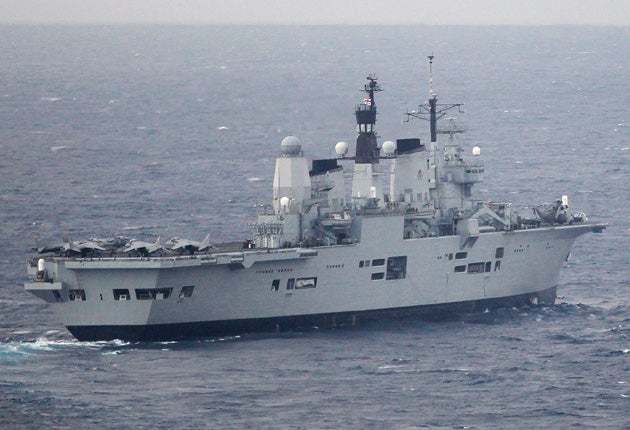
Further details emerged last night about the scale of the cuts and the major adjustment to defence policy this has entailed. The highly controversial decision to proceed with building two aircraft carriers, at a cost of £15bn with aircraft and support ships, comes with the caveat that one of them, HMS Queen Elizabeth, will be ready in 2016 – but without any planes. It will be a helicopter carrier rather than an aircraft carrier. The second carrier, HMS Prince of Wales, will not sail until 2019, having to wait a further year to get any strike aircraft.
This would leave the UK without cover from an aircraft carrier for a number of years as the current carrier, HMS Ark Royal, will be decommissioned early.
In a foreword to the document, David Cameron and Nick Clegg accused their New Labour predecessors of leaving a "litany of scandalous defence procurement decisions, which have racked up vast and unfunded liabilities, without delivering the type of equipment our forces need to fight modern wars".
Mr Cameron will also announce today that the decision on replacing Britain's Trident nuclear deterrent is to be put off for up to five years – a move that will save £750m over the next four years.
The delay will be welcomed by Liberal Democrat members of the coalition who strongly oppose Trident's replacement. It could ultimately mean a new generation of submarines not coming into service until 2029.
Cyber warfare, very much a conflict of the modern age, will receive an additional £500m in funding, said the Foreign Secretary William Hague, because the "country needs an increased capability to protect ourselves, not only against cyber attacks on the government but on businesses and individuals. Such attacks can, in the future, become a major threat to our economic operations in the country and to our economic welfare but also to national infrastructure, such as electricity grids."
Iain Lobban, the director of GCHQ (Government Communication Heaquarters) argued last week in his first public speech that a purely defensive posture in cyber warfare by Britain is not enough. According to Whitehall sources, the initial sum under discussion for cyber warfare was more than £1bn, but has been scaled back after discussions with the Treasury.
New technology specialists also pointed out that two months ago the Coalition Government rejected, on cost grounds, the replacement of Internet Explorer 6 on Government computers, despite a petition by IT professionals working in Whitehall warning of the risks posed by a nine-year-old system.
IE6 has been dropped by a number of governments, including the French and the German, and a host of major multinational corporations, because it had been repeatedly breached by hackers.
The new dangers...
Cyber attack
Government computers now receive 20,000 "malicious" emails a month, 1,000 of which deliberately target them, GCHQ director Iain Lobban warned last week. The National Security Strategy highlighted the "stuxnet" computer worm, which has appeared on the computer system of the Iranian nuclear programme, as an example of the damage such attacks can cause.
Terrorism
Al-Qa'ida and its affiliates still represent the "principal" terrorist threat, including the possibility of an attack with chemical, biological or nuclear weapons. However, the report also highlighted the threat from dissident Irish republicans. The threat level for international terrorism is currently at "severe", meaning an attack is highly likely. On the mainland, the threat from Irish-related terrorism is "substantial", indicating an attack is a strong possibility.
Major accidents and hazards
Also in Tier One are major accidents or natural hazards, such as pandemic flu or flood, and international military crises.
...and the old
Traditional warfare
With cuts to the defence budget looming, the HMS Ark Royal is likely to be decommissioned early, and its replacements will be delayed and compromised. A large-scale conventional military attack on the UK is rated only as a Tier Three priority, as is the possibility of such an attack on an overseas territory.
Join our commenting forum
Join thought-provoking conversations, follow other Independent readers and see their replies
Comments