Alastair Campbell 'misled' Chilcot over dossier
We were explicitly told to make case for war, says top intelligence official
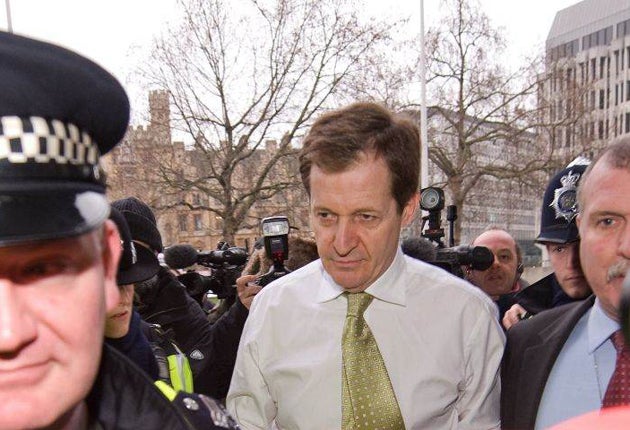
Alastair Campbell misled the Iraq Inquiry, according to a senior intelligence officer who has claimed that intense political pressure was applied to turn a dossier reporting on Saddam Hussein's absent weapons of mass destruction arsenal into a justification for invading Iraq. Tony Blair's communications director had repeatedly dismissed claims that the dossier of September 2002 was embellished to pave the way for military action. He told the inquiry: "It was not the case for war, it was the case why the Prime Minister has become more concerned."
But Mr Campbell's version is directly contradicted by the man who was Director General of Defence Intelligence Staff at the time the dossier was being drafted. In hitherto secret testimony, Major-General Michael Laurie has detailed how Downing Street suppressed versions of the document which did not fit with what it wanted.
General Laurie was so concerned by what he regarded as Mr Campbell's inaccurate testimony that he felt it imperative that what actually took place should be put on the record. He contacted the inquiry: "I am writing to comment on the position taken by Alastair Campbell during his evidence to you.
"Alastair Campbell said to the inquiry that the purpose of the dossier was not 'to make a case for war'. I had no doubt at that time this was exactly its purpose and these very words were used. I and those involved in its production saw it exactly as that, and that was the direction we were given. The previous paper... was rejected because it did not make a strong enough case. From then until September we were under pressure to find intelligence that could reinforce the case."
In his evidence to the hearing last year, Mr Campbell said: "I defend every single word of the dossier, every single part of the process." The document did not "in any sense misrepresent the situation" with regard to Iraq at the time. Claims such as Iraq's ability to use chemical and biological weapons within 45 minutes, which was later proved to be false, were actually a cautious assessment, claimed the spin chief.
Like others appearing before Sir John Chilcot, Mr Campbell was not under oath when giving his testimony. But all witnesses were expected to give a written undertaking that what they said was accurate and honest.
General Laurie's account also calls into question statements made by Mr Blair and members of his cabinet – they had also denied that the dossier was designed to facilitate Britain joining George Bush's attack on Iraq.
General Laurie, in charge of collating and analysing intelligence, presented a picture of Britain's security apparatus being constantly harried to produce what Downing Street wanted. His boss, Air Marshal Sir Joe French, the then Chief of Defence Intelligence, was "under pressure" and a similar situation was being experienced by members of the Joint Intelligence Committee (JIC) which was putting together the document.
Sir John Scarlett, the chairman of the JIC, the author of the dossier, whose conduct in assembling the document was criticised by witnesses in the earlier Hutton inquiry, was later made the head of MI6 by Mr Blair.
In his letter to Sir John, General Laurie added: "We could find no evidence of planes, missiles or equipment that related to WMD, generally concluding that they must have been dismantled, buried or taken abroad. There has probably never been a greater detailed scrutiny of every piece of ground in any country. During the drafting of the final dossier, every fact was managed to make it as strong as possible, the final statements reaching beyond the conclusions intelligence assessments would normally draw from such facts. We knew at the time that the purpose of the dossier was precisely to make a case for war, rather than setting out the available intelligence, and that to make the best out of sparse and inconclusive intelligence the wording was developed with care."
The published dossier included a foreword by Mr Blair, drafted by Mr Campbell, in which he stressed his belief that "intelligence" had established "beyond doubt" that Iraq had continued to produce WMD in breach of United Nations resolutions.
Investigations carried out after the invasion of Iraq by Western scientists in the Iraq Survey Group, proved the claims to be false. Dr David Kelly, a British scientist who was involved in that work, was named as the source of a story by the BBC journalist Andrew Gilligan that Mr Campbell had played a part in "sexing up" the dossier.
In a posting on Twitter last night, Mr Campbell responded: "Nothing to add to evidence to inquiry. Dossier not case for war. Set out why govt more concerned re IraqWMD. Never met Gen Laurie."
Join our commenting forum
Join thought-provoking conversations, follow other Independent readers and see their replies
Comments
Bookmark popover
Removed from bookmarks