Blair warned in 2000 Iraq war was illegal
Secret papers withheld by Chilcot inquiry reveal Foreign Office fears over invasion
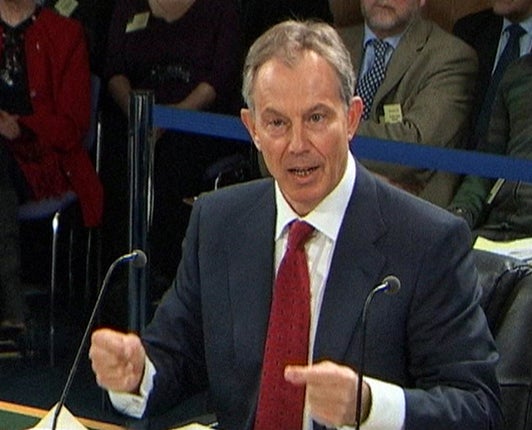
An invasion of Iraq was discussed within the Government more than two years before military action was taken – with Foreign Office mandarins warning that an invasion would be illegal, that it would claim "considerable casualties" and could lead to the breakdown of Iraq, The Independent can reveal.
The extent of Whitehall opposition to the policy eventually backed by Tony Blair emerges just three days before Gordon Brown will appear at the Iraq Inquiry, where he will be asked to explain his role in the Government's decision to invade.
Secret Foreign Office strategy papers drawn up by senior civil servants at the end of 2000 have been obtained by this newspaper and are published for the first time today. The Iraq: future strategy document considers options for dealing with the belligerent Iraqi leader Saddam Hussein. It is one of the key documents that Sir John Chilcot's Iraq Inquiry has declined to release.
A policy of "regime overthrow" is proposed, but roundly condemned. In an eerily portentous assessment of the consequences of taking military action, it states: "Such a policy would command no useful international support. An overt attempt to be successful would require a massive military effort, probably including a land invasion: this would risk considerable casualties and, possibly, extreme last-ditch acts of deterrence or defiance by Saddam."
The mandarins add: "It would also be illegal. Covert attempts, on the other hand, seem very unlikely to succeed and run the risk of fragmenting Iraq, which runs clearly contrary to our wider interests in the region." Iraq descended into violence in the wake of the March 2003 invasion. Hundreds of thousands of Iraqis were killed in the aftermath, as well as more than 100 British troops.
The document also calls into question Mr Blair's claim that using troops to bring down Saddam Hussein was only discussed after the 9/11 terror attacks on New York – and will increase pressure on the inquiry to call Mr Blair back to give further public evidence this summer.
Nick Clegg, the Liberal Democrats' leader, said it was "yet more damning evidence" against Mr Blair's decision to take Britain to war in Iraq. He also warned that the fact that the document had not been published by the Chilcot inquiry raised "serious questions" about its powers to reveal sensitive material. The Government has retained the power to veto publication of classified documents. Protocols agreed between the Chilcot team and Whitehall hand the final say on publication of disputed documents to the head of the Civil Service, Sir Gus O'Donnell.
Requests to secure the document using the Freedom of Information Act were initially refused. However, the Foreign Office eventually agreed to release a redacted version – with the views of the United States and other countries blacked out – after The Independent demanded an internal review. "Releasing the paper would make Government more accountable and increase trust," the Foreign Office conceded. "There is public interest in being able to assess the quality of advice being given to ministers and subsequent decision-making."
Critics of the decision to go to war pounced on the document. "Days before Gordon Brown will try to defend his role at the heart of the Government that took us to war, this is yet more damning evidence against the attempt to justify the invasion of Iraq," Mr Clegg said. "The Foreign Office was clearly advising against regime change as illegal and counter to our national interest."
The strategy paper was commissioned by Sir William Patey, then head of Middle East policy at the Foreign Office, ahead of the November 2000 presidential election which brought George Bush to the White House.
It states that a 1999 United Nations resolution, demanding that weapons inspectors be given access to Iraq, was "beginning to fray at the edges", and would soon "lose credibility" should Saddam fail to co-operate with inspectors. However, it recommends that the policy of "containing" Saddam, and perhaps loosening the sanctions imposed on the Baghdad regime, remained "the best option for achieving our policy objectives towards Iraq". It concludes: "Other alternatives remain unattractive at this stage."
The document in question
Join our commenting forum
Join thought-provoking conversations, follow other Independent readers and see their replies
Comments
Bookmark popover
Removed from bookmarks