Cameron pledges to restore 'real people power'
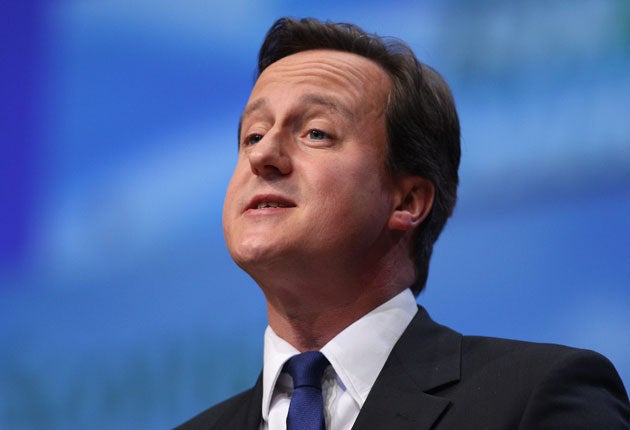
A Tory government would restore "real people power" to address public rage fuelled by the MPs' expenses scandal, Opposition leader David Cameron pledged today.
Mr Cameron said a "massive sweeping, radical redistribution of power", including a curb on the power of the Prime Minister, was required to halt social breakdown.
He set out a raft of proposed reforms for town halls, parliament and Britain's relations with Europe as Justice Secretary Jack Straw urged him to join cross-party talks on the issues.
Mr Straw defended Labour's record on constitutional reform and said the Tory leader was "catching up".
Setting out his reform plans, Mr Cameron said the "leeching" of power from individuals and communities to the state had led directly to social problems such as family breakdown, teenage pregnancy and drug abuse.
He dismissed suggestions the UK needed a revolution, but argued that the public would accept only fundamental changes, not just a clean-up of the discredited expenses system.
"We must keep a cool head and a sense of proportion. But equally, we must not let ourselves believe that a bit of technocratic tinkering here, a bit of constitutional consultation there, will do the trick," he said in a speech to the Open University in Milton Keynes.
"I believe there is only one way out of this national crisis we face: we need a massive, sweeping, radical redistribution of power.
"From the state to citizens; from the Government to parliament; from Whitehall to communities; from Brussels to Britain; from judges to the people; from bureaucracy to democracy.
"Through decentralisation, transparency and accountability we must take power away from the political elite and hand it to the man and woman in the street."
Renewing his calls for an immediate General Election, he said the party would "seriously consider" whether the UK should move to fixed-term parliaments - removing the power of the prime minister to decide the date.
But he remained on collision course with Labour modernisers such as Health Secretary Alan Johnson by ruling out changes to the voting system - arguing that proportional representation would reduce people power.
Mr Cameron detailed plans to slash the number of MPs by at least 10 per cent, to give voters the chance to have proposals backed by large petitions debated by the Commons, to give wide freedoms to local councils, to allow MPs more free votes and to reduce the number of political advisers to ministers.
He called for more "open primaries" where election candidates were chosen by all local people not just party supporters and pledged to reverse a ban on Parliamentary proceedings being shown on YouTube.
He concluded: "The lack of power and control people experience in their daily lives was barely tolerable when times were good.
"But now times are hard, and people are on the receiving end of wage cuts, job losses, negative equity, home repossession and rising crime and revelations about their rulers' behaviour which has disgusted them.
"They are furious and finally demanding big change. I'm making clear that big change and a new politics is exactly what people can expect from a new Conservative government."
Urging the Tories to join cross-party talks on reforming the political system, Mr Straw said: "Many of those mentioned by David Cameron today have been around for some time. What's important is that there is now a growing consensus in favour of many sensible changes."
There had been a great deal of progress since Labour came to power in 1997, including the introduction of the Human Rights and Freedom of Information Acts, he said.
"For constitutional reformers this is a glass three-quarters full, not a quarter empty," Mr Straw added.
"It is good to see the Conservatives catching up at last."
He went on: "I have listened carefully to David Cameron's contribution and today invite him to nominate a representative to join cross party talks on these reforms."
Politicians on all sides have highlighted reforms as Westminster struggles to contain the tide of public anger over the revelations of MPs' expenses claims.
Health Secretary Alan Johnson last week called for a referendum on voting reform for Westminster elections, while Energy Secretary Ed Miliband proposed ending old-fashioned parliamentary procedures like MPs addressing each other as the right honourable or honourable member.
"In the past few days and weeks there has been much excited talk about revolution. I think that is overblown: we must keep a cool head and a sense of proportion," Mr Cameron said.
Calling for a cut in the number of MPs, he said: "I think we can do a better job with fewer MPs: we can, to coin a phrase, deliver more for less.
"So at the election we will include proposals in our manifesto to ask the Boundary Commission to reduce the House of Commons, initially by ten per cent."
"I believe the arguments for fixed-term parliaments are strengthening too," he went on.
"Because if we want Parliament to be a real engine of accountability, we need to show that it is not just the creature of the executive.
"That's why a Conservative Government will seriously consider the option of fixed-term Parliaments when there is a majority government."
But rejecting demands for a shift to elections using PR, he said: "A Conservative Government will not consider introducing proportional representation.
"The principle underlying all the political reforms a new Conservative Government would make is the progressive principle of redistributing power and control - from the powerful to the powerless.
"PR would actually move us in the opposite direction, which is why I'm so surprised it's still on the wish-list of progressive reformers."
Mr Cameron said a new "right of initiative" would allow voters who collected enough signatures backing a policy proposal to have it "debated in the House of Commons and become law".
Legislation would also be published online in a more user-friendly way, he said.
"This will help people easily access Bills and other legislation in order to create useful applications - like text alerts when something you're interested in is debated.
"And it will mean many more expert eyes helping to explain laws as they're formed, flagging up flaws and suggestions for improvement.
"Anything that acts as a barrier between politics and the public has got to be torn down - including the ridiculous ban on parliamentary proceedings being uploaded to YouTube."
He said: "Now I know you've heard politicians promise this kind of thing before. But the times are right to do it properly now.
"We're living in an age where technology can put information that was previously held by a few into the hands of almost everyone.
"So the argument that has applied for well over a century - that in every area of life we need people at the centre to make sense of the world for us and to make decisions on our behalf - simply falls down.
"And in its place rises up a vision of real people power."
To help rebalance the power of the Commons to hold the government to account, he said, it would take more control over its timetable, nominating select committee members independently of party whips, and being allowed to properly debate legislation in detail through free votes in committees.
Mr Cameron insisted that expenses had been just the spark that lit a tinderbox of wider dissent against an over-powerful state, including NHS bosses, the police and town halls.
"We rage that as we go about our business we are picked on and poked and bossed around, annoyed and irritated and endlessly harassed by public and private sector officialdom that treats us like children with rules and regulations and directives and laws that no-one voted for, no-one supports, but no-one ever seems to be able to do the slightest thing about," he said.
That also contributed to social breakdown, he suggested.
"It is the direct result of the collapse in personal responsibility that inevitably follows the leeching of power and control away from the individual and the community into the hands of the elite."
Join our commenting forum
Join thought-provoking conversations, follow other Independent readers and see their replies
Comments
Bookmark popover
Removed from bookmarks