Cameron reveals how he will fix broken Britain (well, you will...)
Tories would call up 5,000-strong 'neighbourhood army' to take control of public services. Andrew Grice reports
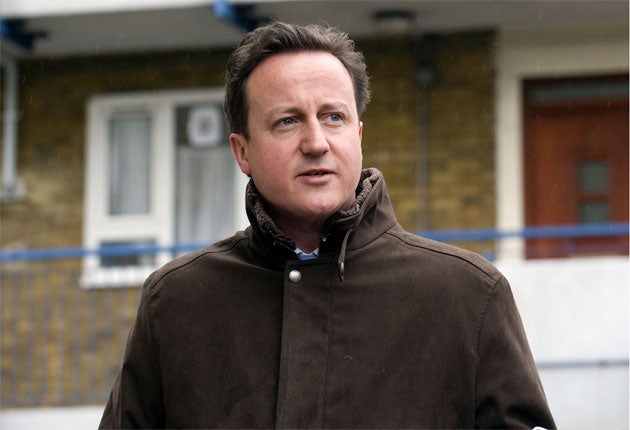
David Cameron yesterday promised to call up a 5,000-strong army of full-time professional community organisers modelled on the American scheme which saw Barack Obama come to prominence in Chicago.
The Conservative leader outlined his "big idea" for the general election as he put flesh on the bones of his plans to create a "big society" in which control of some public services would be devolved to charities, voluntary and community groups.
Mr Cameron's "neighbourhood army" would identify local community leaders, bring people together, help them to raise funds and start local organisations. He said: "Barack Obama trained as a community organiser in Chicago. And I hope that in the years to come, a similar inspirational figure will emerge from community work in our inner cities – and go from the back streets of Bradford or Bolton or Birmingham all the way to Downing Street."
The "big society not big government" programme is the Tories' prescription for curing what they call Britain's "broken society".
Mr Cameron announced that a Tory government would set up a "Big Society Bank", funded from unclaimed assets in dormant bank and building society accounts. It would provide start-up money for social enterprises so they could bid for government contracts run on a payment-by-results basis and would aim to attract hundreds of millions of pounds of private investment in charities and neighbourhood groups.
The Tory leader said: "This election will not just be about the economy. Britain's broken society will be on the ballot too. People doubt whether change can really happen. They see drug and alcohol abuse, but feel there's not much we can do about it. They see the deep poverty in some of our communities, but feel it's here to stay. They experience the crime, the abuse, the incivility on our streets, but feel it's just the way we are going. They see families falling apart, but expect that it's an irreversible fact of modern life."
Mr Cameron said his goal was to build a fairer, richer, safer Britain, where opportunity is more equal and poverty is abolished. "Some people say that there are no big ideas in politics anymore. But I think this is about as big as it gets," he said.
He denied that his plans would help relatively prosperous areas, insisting that funds would be directed to the most deprived, or that they would be scuppered by the squeeze on public spending. "This is not about cut-price welfare or a return to Victorian government," he said. "In the medium-term, reforming the way we provide public services will be crucial if we are going to deliver more for less."
The Government hit back in a report, Our Nation's Civic Health, showing that community spirit in Britain is strong. John Denham, the Communities Secretary, said: "David Cameron likes to claim that Britain is broken but his attempt to scare people into voting Tory will not work. The vast majority of people know that when they step out of their front door, the neighbourhood they live in is not riddled with crime or antisocial behaviour, but is a community where they feel they belong and where people get on with each other."
Academics and experts also question some of the Tories' claims. Crime has fallen by 45 per cent since 1995, according to the British Crime Survey, largely due to a drop in burglary and vehicle theft. However, the Tories point to a rise in serious crimes such as those involving the use of guns and knives.
The Tories cite 10,000 incidents a day of antisocial behaviour, while Labour insists that the problem affects a small minority of places and that police and local authorities have been ordered to use every tool at their disposal to tackle it.
Although the number of teenage pregnancies has been falling, it is still among the highest in Europe. Similarly, the Tories say Britain has one of the highest rates of family breakdown in the EU, but Labour argues that Mr Cameron's plan to reward marriage in the tax system would be better targeted at the poor.
The Tories cite research suggesting that Britain has the highest level of problem drug use and second highest level of drug-related deaths in Europe. They point to the million victims of alcohol-fuelled violence in 2008-09.
Some experts say there has been a fall in overall drug abuse, but that use of cocaine is on the rise. They suggest that fewer people are drinking to excess but that those who do so are drinking more.
However, public perceptions are often very different to the picture that emerges from the official statistics. The Tories hope that these perceptions mean that Mr Cameron's "broken society" message will strike a chord and reinforce his "vote for change" pitch.
Changing lives: Community organisers
*"What's a community organiser?" sneered Governor Sarah Palin during the 2008 US presidential campaign in reference to Barack Obama's past on the streets of Chicago. Within days, T-shirts were rolling off the presses, declaring: "Jesus was a community organiser, Pilate was a governor".
Now, after David Cameron announced that community organising is key to his creation of the "Big Society", the same question is being asked in the UK. Community organising is a means by which ordinary people influence the decisions that affect them by building relationships with people in power. People are organised via the institutions to which they belong – faith congregations, trade unions, schools – and trained in the art of negotiation. They agree on the agendas they wish to pursue in assemblies, and then carry out campaigns and "actions" to achieve them.
A community organiser is a professional relationship-builder who spends at least 15-20 hours a week in one-to-one meetings with the leaders in every community who have drive, vision, and followers. In Citizens UK – which includes the country's largest citizens alliance, London Citizens, with 150 member institutions – we have 18 full-time organisers whose job it is to enable ordinary people to move "the world as it is" towards "the world as it should be". The problems ordinary people across our city face – jobs, immigration, wages, street safety – are broken down into issues, and the targets identified.
It might be the head of a bank or a local authority whom we want to persuade to pay a living wage to its cleaners; or it might be the Mayor of London whose support we are seeking for a conditional amnesty for long-term undocumented migrants; or shops we want to work together to create a safer street. But it's how we go about it that makes community organising different – it all begins, and ends, in relationships – just as all power does.
Neil Jameson is executive director of Citizens UK
Join our commenting forum
Join thought-provoking conversations, follow other Independent readers and see their replies
Comments
Bookmark popover
Removed from bookmarks