Cameron to cut seats in Commons by 10 per cent
Constituency boundary review designed to give Tories second victory, claims Labour
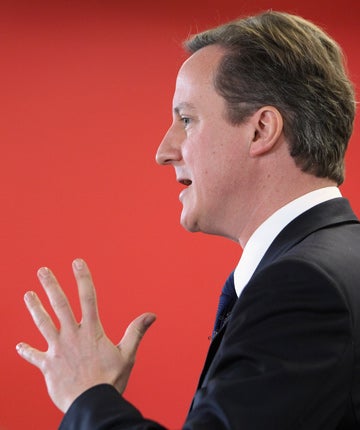
David Cameron will rush through a 10 per cent cut in the number of MPs if he wins power this year in an attempt to boost the Conservative Party's prospects of a second victory at the following general election.
A Bill ordering a review of the constituency boundaries in England and Wales would be introduced within days of Mr Cameron's first Queen's Speech, shadow ministers have told The Independent. In contrast to previous reviews, which have taken up to seven years, the Boundary Commissions for England and Wales would be given a tight timetable of between a year and 18 months to produce a new electoral map so the changes could be introduced at the election after next.
Ministers are describing the Cameron plan as "blatant gerrymandering" and fear that it would prolong Labour's spell in the electoral wilderness if it loses this year. They say there is no urgent need for another shake-up in England because new boundaries take effect this year and reviews are supposed to take place only every eight to 12 years.
Labour officials fear the party will "take a hit" in Wales. Its 40 constituencies, which currently have an electoral quota of 55,640, are likely to be reduced in number to bring the country closer to England and Scotland, where the target for the number of registered voters is 69,934 people per constituency. The number of seats in Scotland, another traditional Labour stronghold, was cut from 72 to 59 before the last election.
Mr Cameron has presented his plan as a way of cleaning up politics and saving £15.5m after the MPs' expenses controversy. It would cut the number of MPs from 650 to 585 by the election after next. Labour fears that it could be permanently deprived of between 20 and 30 seats and that up to 80 seats could be abolished.
David Blunkett, the former Home Secretary, said yesterday: "David Cameron's policy of shrinking the Commons by 10 per cent is not about cutting the cost of politics; it's about advantaging the Tory party. Boundaries drawn on the basis of registered electors, rather than the population as a whole, already distort the electoral map because registration rates are lowest in the poorest areas. Cutting 65-80 seats by crudely equalising registered voters will simply reduce the number of seats in inner cities and areas that have devolved government (apart from London). In short, areas that never elect Tory MPs. This will be Florida-style gerrymandering of the electoral system, disenfranchising many of the most vulnerable people in society."
However, the Tories insist there are big disparities in the size of seats, which make it harder for some MPs to represent their constituents. For example, the Isle of Wight has 107,000 voters, well above the planned new target of about 77,000.
The Tories deny that the move is designed to counteract the bias against them in the electoral system. Labour won 55 per cent of the seats at the 2005 election with just 35 per cent of the votes cast. The Tories won 32 per cent of the votes and only 30 per cent of the seats, and the Liberal Democrats 22 per cent of the votes and only 10 per cent of the seats.
Some election experts believe that the review will not tilt the balance back to the Tories because the Labour vote is more "effective" while Mr Cameron's party piles up "wasted votes" in many safe seats.
New research at the University of Plymouth concludes: "The geography of each party's support base is much more important, so changes in the redistribution procedure are unlikely to have a substantial impact and remove the significant disadvantage currently suffered by the Conservative Party."
A Tory spokesman said: "We believe that each constituency should have the same number of electors. This is what the Commitee on Standards in Public Life has recommended. Unlike Labour ministers, we are committed to implementing these recommendations."
* David Cameron will promise today that mending Britain's "broken society" would be a defining mission for his government, with "social recovery" needed as well as economic recovery. Unveiling his party's draft manifesto on the issue, he will accuse Labour of a "moral failure".
Join our commenting forum
Join thought-provoking conversations, follow other Independent readers and see their replies
Comments
Bookmark popover
Removed from bookmarks